GOBARdhan, India’s National Unified Scheme for Compressed Biogas
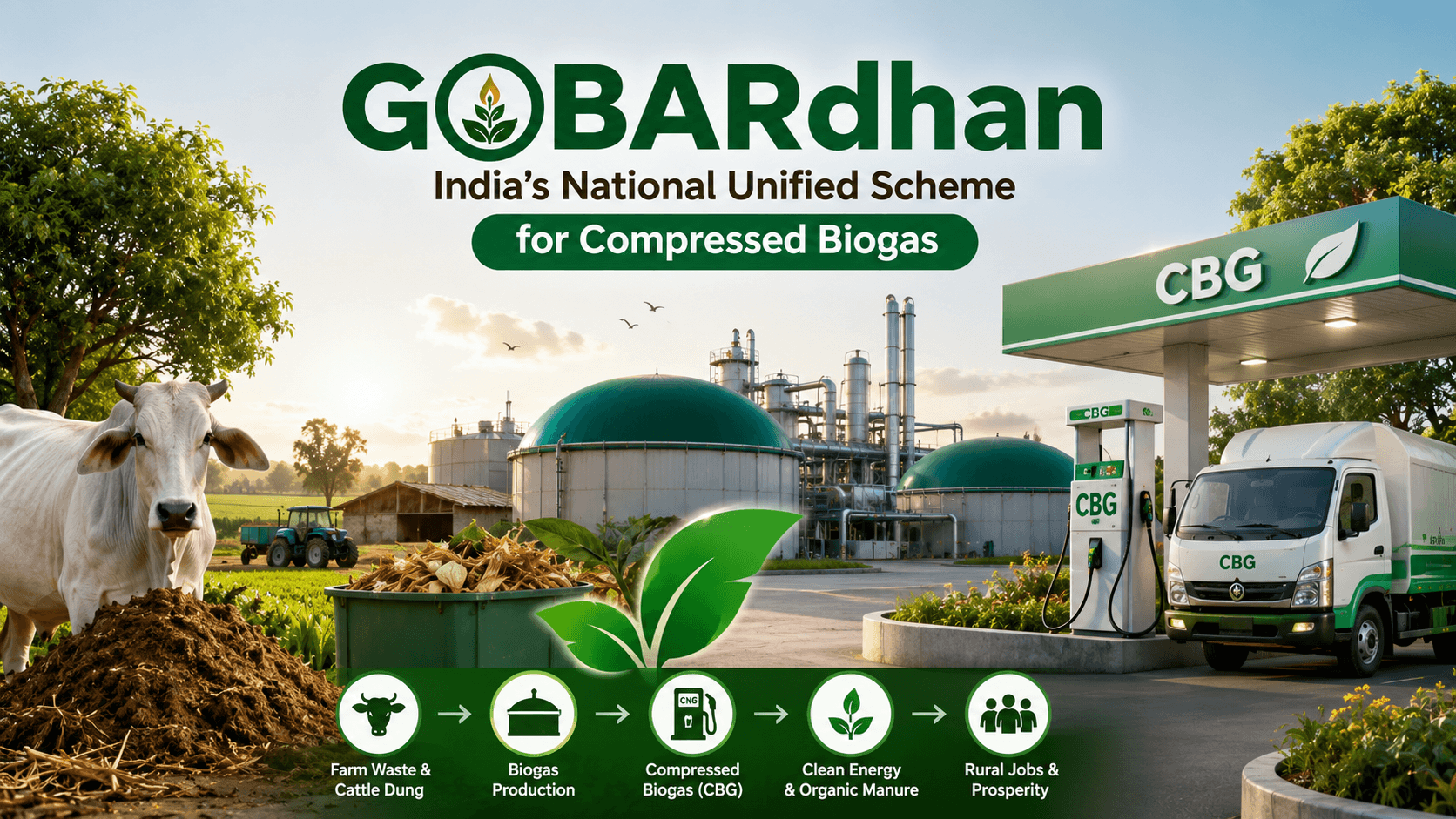
Recently, the Union Cabinet chaired by Prime Minister Narendra Modi approved GOBARdhan, the National Circular Bioenergy Scheme. The scheme aims to increase domestic CBG production almost ten-fold. By turning farm waste, cattle dung, and other organic material into clean fuel, it will strengthen India’s energy security and reduce dependence on imported gas.
At the same time, GOBARdhan is expected to create new income opportunities for farmers, rural entrepreneurs, and cooperatives while attracting more private investment into the sector. It also promotes the idea of waste-to-wealth and supports the larger vision of an Atmanirbhar Bharat by building a circular, self-reliant energy economy.
About GOBARdhan
GOBARdhan (Galvanizing Organic Bio-Agro Resources Dhan) is a national push to make compressed biogas a core part of India’s energy future.
Running from FY 2026-27 to FY 2035-36, the scheme brings everything CBG producers need under one roof - guaranteed buyers, stable prices for 10 years, capital support, pipeline connections, easier loans, and help with technology.
The goal is simple: turn the waste we already have—farm residue, cattle dung, press mud, and city organic waste—into clean fuel, organic manure, rural jobs, and real economic value.
With assured demand and a predictable policy framework, GOBARdhan aims to scale India’s CBG sector nationwide and mark a big step forward in our clean energy journey.
From Strong Roots to Nationwide Impact
Over the last few years, the Government of India has laid a solid base for the CBG sector through programs like SATAT, MDA for organic manure, BAM, DPI, and financial support under the National Bioenergy Programme.
Thanks to these efforts, more than 200 CBG plants are now running. We have set up production and offtake systems, boosted the organic manure market, and shown that CBG works across different feedstocks and regions.Now, GOBARdhan takes this forward.
Run by the Ministry of Petroleum and Natural Gas, it brings the entire CBG value chain under one roof. This means faster project rollout, better economics, and more confidence for investors, banks, and developers.
Why it matters for India
India’s need for natural gas is growing in transport, homes, and industry. CBG, made from farm waste and cattle dung right here in India, can meet more of that demand. It cuts our reliance on imported gas and makes our energy system stronger.
Since CBG is just like natural gas, it fits easily into the existing gas network. Beyond energy, every CBG plant builds a local circular economy.
It creates jobs in collecting waste, running plants, and selling organic manure. It also helps manage waste better and lowers greenhouse gas emissions.
Six Growth Engines of GOBARdhan
| Assured CBG Offtake: | City Gas Distribution companies will have to buy a set share of CBG—3% in FY 2026-27, 4% in FY 2027-28, and 5% from FY 2028-29 onwards for CNG and PNG. This gives producers a guaranteed, long-term market and makes projects easier to finance. |
| Stable CBG Pricing: | CBG will have a fixed price of Rs 2,110 per MMBTU for at least 10 years. With government backing and cost-sharing, producers get revenue certainty while consumers don’t face big price shocks. |
| Capital Assistance:- | New CBG plants can get up to Rs 2 crore per TPD of capacity. The support covers not just plant machinery, but also feedstock collection and organic manure units. Even existing plants expanding capacity are eligible. This reduces upfront cost for MSMEs, cooperatives, and rural entrepreneurs. |
| Pipeline Infrastructure: | Funding for pipelines to connect CBG plants to main gas networks and city gas grids. Better connectivity means lower transport costs, wider market access, and higher plant utilization. |
| Credit Guarantee Support: | A dedicated guarantee will help banks lend more confidently to MSME-led CBG projects. Less collateral, cheaper loans, and faster approvals will especially help women and first-time entrepreneurs. |
| CBG Ecosystem Challenge Fund: | This fund will push district-level action. It will pay for feedstock mapping, collection systems, local planning, tech upgrades, manure value addition, training, and awareness. The goal is to build strong local CBG value chains from the ground up. |
Government Initiatives to Promote Biogas in India
- The government is pushing biogas and CBG through a mix of demand, funding, and infrastructure support. Under SATAT, launched in 2018, the aim was to set up 5,000 CBG plants and get entrepreneurs to supply CBG to oil marketing companies.
- GOBARdhan focuses on turning cattle dung, crop residue and other waste into biogas and bio-slurry, with up to ₹50 lakh assistance per district for community or cluster plants.
- To create a guaranteed market, a CBG Blending Obligation has been introduced—starting at 1% in FY26 and going up to 5% from FY29 for CNG and domestic PNG. Financially, the National Bioenergy Programme offers Central Financial Assistance for CBG, Bio-CNG, and waste-to-energy plants.
- For feedstock, the Biomass Aggregation Machinery Scheme with ₹564.75 crore helps producers buy equipment to collect and transport farm residue.
- On infrastructure, ₹994.5 crore has been allocated for pipelines to connect CBG plants to gas networks, and SBM-Urban 2.0 also backs bio methanation and CBG plants for municipal waste. Together, these schemes aim to scale up biogas, cut waste, and create new rural livelihoods.
Conclusion
GOBARdhan is basically about turning the waste we already have—farm residue, cattle dung, and municipal garbage—into clean fuel, jobs in villages, and real economic value. The scheme brings everything together in one place: assured buyers, stable prices, funding, pipelines, easy credit, and overall ecosystem support. That’s what CBG needs to actually scale up across India. It also ties directly into bigger national goals—stronger energy security, waste-to-wealth, Atmanirbhar Bharat, and the vision of Viksit Bharat.
GOBARdhan, this topic spans across multiple sections. It is directly connected to General Studies Paper-I (Section-II - Current Affairs): National and international events of importance and General Studies Paper-II (Section-II - Indian Economy and Geography & Environment): Government policies for rural development, renewable energy, and sustainable waste management.
Reference:-
- https://www.pib.gov.in/PressReleasePage.aspx?PRID=2295480®=48&lang=1
- https://www.pib.gov.in/PressReleasePage.aspx?PRID=2295738®=6&lang=1and General
What is the GOBARdhan scheme approved by the Union Cabinet?
GOBARdhan is the National Circular Bioenergy Scheme, approved by the Union Cabinet chaired by PM Modi, aimed at increasing India's domestic compressed biogas (CBG) production almost ten-fold by turning farm waste, cattle dung, and organic material into clean fuel.
What does the acronym GOBARdhan stand for?
GOBARdhan stands for Galvanizing Organic Bio-Agro Resources Dhan.
What is the duration of the GOBARdhan scheme and which ministry runs it?
The scheme runs from FY 2026-27 to FY 2035-36 and is run by the Ministry of Petroleum and Natural Gas.
What is the CBG offtake obligation under GOBARdhan?
City Gas Distribution companies must buy a set share of CBG for CNG and PNG: 3% in FY 2026-27, 4% in FY 2027-28, and 5% from FY 2028-29 onwards.
What fixed price has been set for CBG under the scheme?
CBG will have a fixed price of Rs 2,110 per MMBTU guaranteed for at least 10 years, giving producers revenue certainty.
How much capital assistance can new CBG plants receive?
New CBG plants can get up to Rs 2 crore per TPD of capacity, covering plant machinery, feedstock collection, and organic manure units. Expanding existing plants are also eligible.
What are the "Six Growth Engines" of GOBARdhan?
Assured CBG offtake, stable CBG pricing, capital assistance, pipeline infrastructure funding, credit guarantee support for MSME-led projects, and a CBG Ecosystem Challenge Fund for district-level action.
How many CBG plants are currently running in India, and which earlier schemes supported this growth?
More than 200 CBG plants are currently running, built on the foundation of programmes like SATAT, MDA for organic manure, BAM, DPI, and the National Bioenergy Programme.
What was the goal of the SATAT scheme launched in 2018?
SATAT aimed to set up 5,000 CBG plants and encourage entrepreneurs to supply CBG to oil marketing companies.
How is GOBARdhan relevant to the BPSC/UPSC syllabus?
It connects to General Studies Paper-I (Current Affairs) and General Studies Paper-II (Indian Economy and Geography and Environment), covering government policies for rural development, renewable energy, and sustainable waste management.