India’s Poverty Decline: A Remarkable Shift
Why in News?
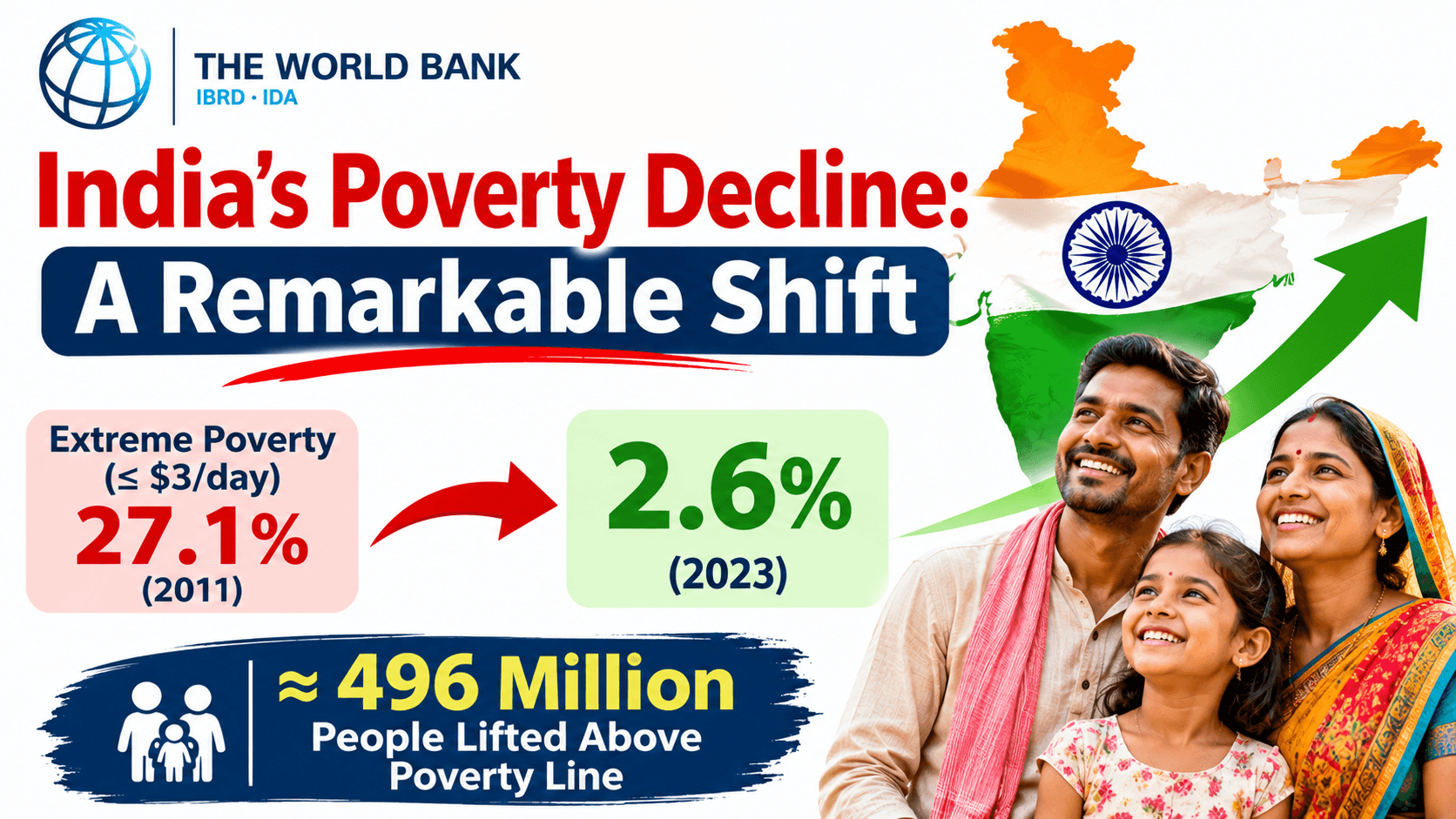
Recently, according to the World Bank’s October 2026 Poverty and Equity Brief, India has made remarkable progress in reducing poverty over the past decade. Between 2011 and 2023, extreme poverty declined from 27.1% to 2.6%, while nearly 496 million people moved above the Lower Middle-Income Country poverty line.
The report highlights rising employment, strong consumption growth, and government welfare transfers as major factors behind this progress. However, income inequality, youth unemployment, and regional disparities remain important challenges.
Key Findings of the Report
Significant Decline in Poverty
The World Bank reported a substantial reduction in both monetary and multidimensional poverty.
| Poverty indicator | 2011 / Earlier period | 2023 / Latest period |
| Poverty below $4.20 per day | 57.7% (2011) | 16.1% (2023) |
| Extreme poverty below $3 per day | 27.1% (2011) | 2.6% (2023) |
- Around 496 million people moved above the $4.20-a-day poverty line between 2011 and 2023.
- The World Bank expects poverty measured using the $4.20-a-day line to decline further, from 14.2% in 2026 to 12.1% by 2028, although at a slower pace.
Improvement in Multidimensional Poverty
Poverty is not limited to low income; it also includes deprivation in areas such as education, health, and living standards.
According to the report, India's Multidimensional Poverty Index (MPI), measured by the Oxford Poverty and Human Development Initiative (OPHI), declined from 53.8% in 2005–06 to 16.4% in 2019–21. The World Bank's MPI measure stood at 15.5% in 2022–23.
Major Drivers of Poverty Reduction
The World Bank identified several factors behind India's progress:
- Employment growth: Employment increased by around 134 million people between 2017 and 2023.
- Women's participation: Rural women entering paid employment contributed significantly to the rise in household earners.
- Government support: Food subsidies and other social transfers helped improve household consumption.
- Consumption growth: Rising household consumption contributed to better living standards.
Key Challenges Highlighted by the Report
Despite the decline in poverty, the report points to several concerns.
1. Wage Inequality
Income gains remain unevenly distributed among workers.
- In 2023, median earnings of the top 10% of workers were around 13 times higher than those of the bottom 10%.
- Poverty is increasingly concentrated among households with low education, fewer assets, limited access to stable employment, and more dependents.
2. Regional Disparities
Poverty remains concentrated in certain parts of the country.
- A geographical belt extending from Uttar Pradesh to West Bengal accounts for around 57% of India's poor population.
- This indicates that improvements in living standards have not been uniform across all states.
3. Rising Youth Unemployment
Although employment expanded between 2017 and 2023, the report highlighted concerns about the quality of jobs.
- Youth unemployment increased from 14.6% to 15.9% between Q1 FY2026 and Q1 FY2027.
- The increase was particularly noticeable among rural young women.
- Real earnings remained broadly unchanged, while much of the employment growth was concentrated in relatively low-productivity activities.
Government's Response
Finance Minister Nirmala Sitharaman welcomed the World Bank's findings. She highlighted consumption growth, rising employment, particularly among women, and expanded social transfers, including food subsidies, as important contributors to poverty reduction.
Way Forward
The findings suggest that reducing poverty requires more than increasing household income. India needs to focus on:
- Creating productive jobs with better wages, particularly for young people.
- Expanding women's access to stable and paid employment.
- Reducing regional inequalities through targeted development.
- Improving access to quality education, healthcare, and essential services.
- Strengthening social protection for vulnerable households.
Conclusion
The World Bank's report highlights India's substantial progress in reducing poverty over the last decade. However, persistent wage inequality, regional concentration of poverty, and rising youth unemployment show that the next challenge is to make economic growth more inclusive. The focus must now shift from poverty reduction alone to better-quality employment, higher earnings, and equal opportunities across regions and social groups.
Reference: