Gender Equality: India’s Long Road
Why in News?
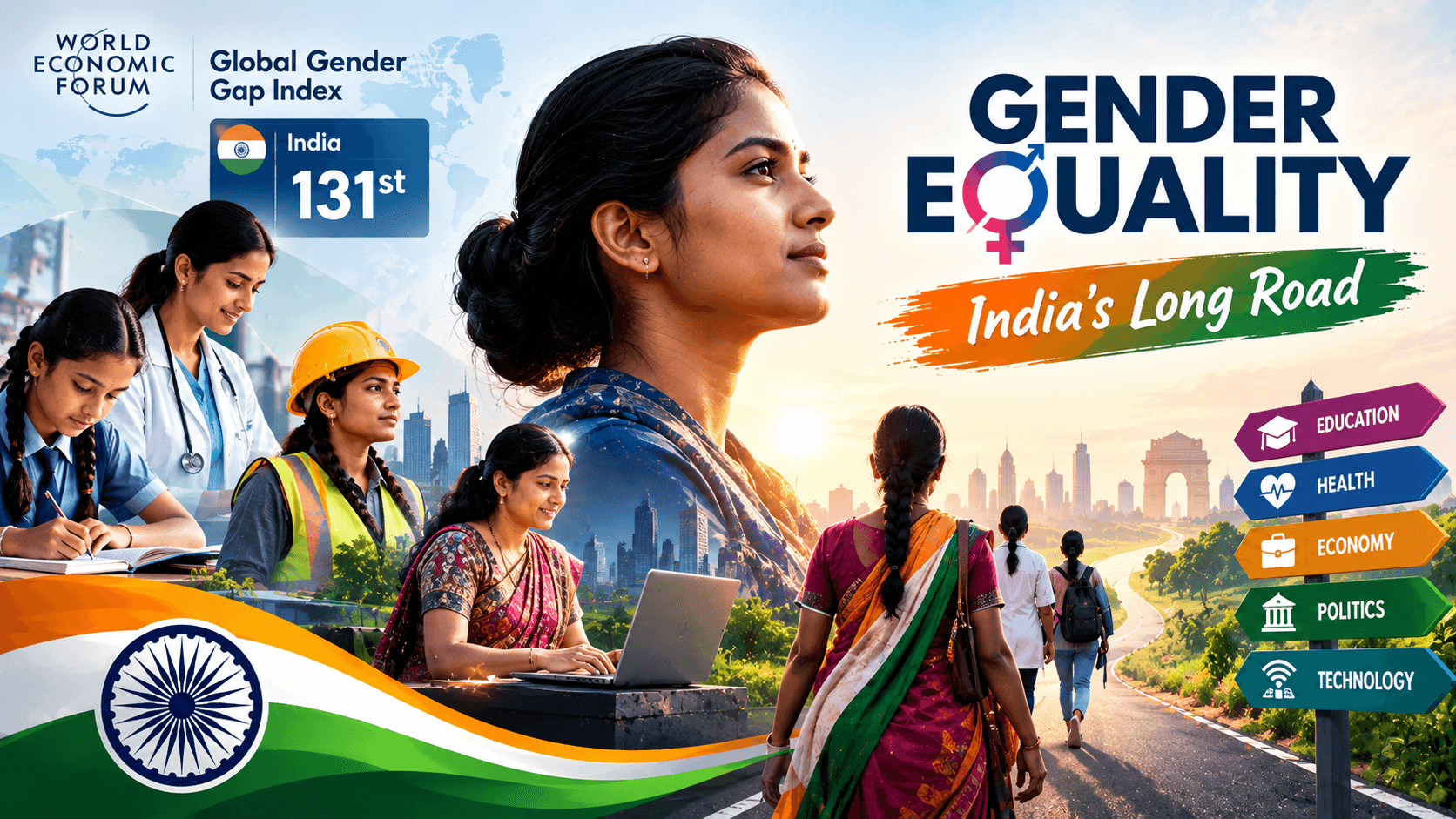
India has once again been ranked 131st out of 145 countries in the Global Gender Gap Index 2026, released by the World Economic Forum. Despite some progress, the ranking shows that the country still has a long way to go in bridging the gap between men and women in areas like health, education, economy, and politics.
Actually. India has retained the previous rank of 131st in the Global Gender Gap Index 2026, having achieved 64.5% gender parity so far. While the country performs well in education and health, significant gaps remain when it comes to economic participation, political representation, leadership roles, and access to technology.
To bridge this gap, India needs to focus on improving women's participation in the workforce, reducing the burden of unpaid care work, ensuring safety, and bridging the digital divide. At the same time, strengthening political representation, gender-responsive budgeting, care infrastructure, skill development, and financial inclusion will be crucial.
Key Highlights of India's Report Card:
| 1. | Overall Score: | India scored 64.5% in gender parity and is ranked 131st out of 145 countries. This is 4.3% better than in 2006 but still below the global average of 69.2%. |
| 2. | Political Empowerment (24.5%): | This remains a weak area. While overall political parity is low, the share of women in ministerial positions has dropped drastically to just 5.9% from 30% in 2019. |
| 3. | Economic Participation (41.2%): | This is India's biggest challenge. On a positive note, women in professional and technical jobs have doubled to 49.9% since 2006. But only 13.1% of senior leadership roles are held by women. |
| 4. | Educational Attainment (96.6%): | One of India's strongest areas. There is almost equal enrollment of boys and girls in secondary and higher education. |
| 5. | Health and Survival (95.6%): | Health indicators have improved, but the sex ratio at birth is still lower than what it was in 2006. |
What the World Looks Like:
Top Performers: Iceland is No. 1 for the 17th year in a row, closing 93% of its gap. It is followed by Finland and Norway. Australia entered the top 10 for the first time.
Bottom 3: Chad is at the bottom (145th), along with Pakistan and Iran.
Long Road Ahead: The world has closed 69.2% of the gender gap. At this pace, it will still take about 120 years to achieve full parity.
Other Key Trends:
Women hold only 19.1% of CEO roles globally.
Women are twice as likely as men to take career breaks for parenting and face slower growth after returning.
Since 1995, over 80% of countries have adopted quotas to improve women's political representation.
In technology, women account for less than 1 in 5 AI engineers globally.
Major Challenges in Bridging the Gender Gap in India
| Low Female Workforce Participation: | As per PLFS 2026, overall female labor force participation is 34.8%. But this rise is mainly due to rural women taking up distress-driven farm work (39.4%). In cities, it is still stuck at just 25.4%. |
| The Education Penalty: | Strangely, as women become more educated, their unemployment rate rises. This shows a clear mismatch between their skills and the jobs available and corporate workplaces that are not flexible enough to retain them. |
| Burden of Unpaid Care Work: | Women still do most of the household and caregiving work. This "motherhood penalty" breaks their career path and stops them from moving from informal to formal jobs. |
| Safety and Mobility: | Concerns about safety, poor street lighting, and unsafe public transport limit how far women can travel for work or education. |
| Digital Divide: | With the rise of Industry 4.0, many women are getting left behind due to low digital literacy and less access to smartphones, which keeps them out of tech and gig economy jobs. |
| Proxy Leadership: | Even though 33% of seats are reserved for women in Panchayats, the "Sarpanch Pati" culture is still common, where the husband takes decisions and women remain just namesake leaders. |
| Poor Implementation of Laws: | Laws like the Maternity Benefit Act and POSH Act are strong on paper but poorly enforced, especially in the unorganized sector where 85% of working women are employed. |
| Double Discrimination: | For SC, ST, and minority women, the challenge is double: they face both caste and gender discrimination, especially in land rights and wages. |
| Health and Nutrition: | As per NFHS-5, more than 50% of women in reproductive age are anemic. This affects their health and productivity and increases maternal risks. |
| Lack of Reproductive Autonomy: | Limited access to family planning and menstrual hygiene in schools affects girls' education and women's career continuity. |
| Climate Change Impact: | Rural women are the worst hit by climate change. Falling water levels and deforestation mean they must walk longer for water and firewood, leaving them with less time for education or paid work. |
Measures Needed to Overcome the Gender Gap in India
| Fix the Care Work Problem with the 3R Framework: | Recognize unpaid care work in national data, reduce it by building public infrastructure like affordable crèches and piped water, and redistribute it by giving mandatory paternity leave so that women alone are not seen as a liability. |
| Shift from Maternity Leave to Parental Leave: | The Maternity Benefit Act, 2017, made companies bear the full cost, which created a bias against hiring women. The solution is shared parental leave, funded partly by the government like in Nordic countries, to end the "motherhood penalty." |
| Make Budgets Work for Women: | Gender budgeting should not be just about allocation. The government needs to track whether the money actually leads to better safety, health, and skilling for women. |
| Bring More Women into Politics: | Fast implementation of the Nari Shakti Vandan Adhiniyam, 2023 (33% Women’s Reservation), is needed. More women in Parliament and Assemblies will automatically push policies towards health, education, and care infrastructure. |
| Bridge the Digital and Skills Gap: | Offer STEM scholarships for girls, incentives for hiring women in tech, and run digital literacy programs specially designed for rural women to bring them into the formal economy. |
| Change Mindsets: | Strengthen campaigns like Beti Bachao Beti Padhao to challenge son-preference and patriarchal thinking around property and education for girls. |
| Build a Care Economy: | As per ILO, investing 2% of GDP in the care economy can create 11 million jobs, mostly for women. A dedicated 'Care Economy Fund' can be used to build quality crèches in industrial areas and cities so women can return to work. |
| Focus on Health and Nutrition: | Strengthen POSHAN Abhiyaan to tackle anemia among adolescent girls and women, which is critical for their overall productivity and well-being. |
| Improve Financial Access: | Expand collateral-free loans and micro-credit for women entrepreneurs through schemes like Stand-Up India to help women start their own businesses. |
About Global Gender Gap Report 2026
The Global Gender Gap Report is an annual flagship report published by the World Economic Forum (WEF). It was first launched in 2006 and is considered a global benchmark to track how close countries are to achieving complete gender equality. The report measures gender parity on a scale of 0 to 100, where 100% means full equality. It does this across four key dimensions:
- Economic Participation and Opportunity: It checks the share of women in the workforce, equal pay for equal work, and how many women are in leadership and managerial roles.
- Educational Attainment: It looks at literacy rates and the ratio of girls to boys enrolled in primary, secondary, and higher education.
- Health and Survival: It evaluates the sex ratio at birth and the healthy life expectancy of men and women.
- Political Empowerment: It measures women's representation in parliament, at the ministerial level, and as heads of state in the last 50 years.
Conclusion
The Global Gender Gap Report 2026 is a reminder that while India has made real progress in education and health, true equality is still far away. With only 64.5% parity and a rank of 131, the gaps in economy, leadership, and politics continue to hold women back. Bridging this gap is not just about fairness; it is an economic necessity. When women participate equally, the entire nation grows. The way forward lies in moving from laws on paper to implementation on the ground through shared parental leave, a strong care economy, safe public spaces, digital inclusion, and actual political power for women. If India invests in its women today, it can turn its demographic dividend into a gender dividend.