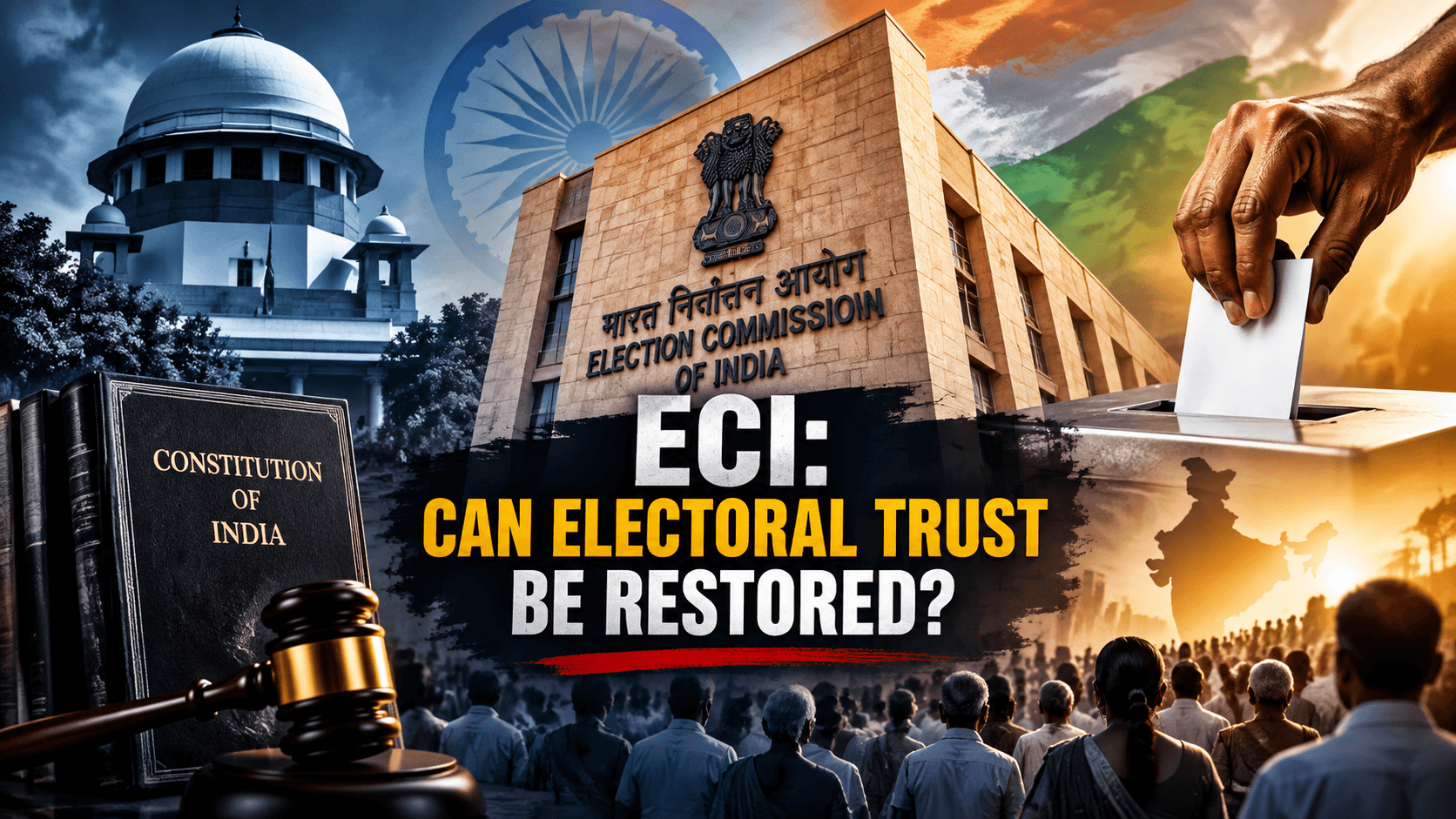
ECI: Can Electoral Trust Be Restored?
Why in News?
The Election Commission of India (ECI) is under fresh scrutiny over its independence and functioning. Opposition parties have demanded action against the Chief Election Commissioner (CEC) after reports that two Election Commissioners (ECs) had objected to several decisions, though the ECI claimed its final decisions were unanimous.
At the same time, the Supreme Court has referred petitions challenging the Chief Election Commissioner and Other Election Commissioners (Appointment, Conditions of Service, and Term of Office) Act, 2023, to the Chief Justice of India for a Constitution Bench after a 1:1 split verdict.
What are the core concerns? Regarding the ECI?
- Article 324: It gives the power of superintendence, direction, and control of elections to the ECI. It says the appointment of the CEC and ECs shall be made by the President, subject to any law made by Parliament. For over 70 years, Parliament did not make a specific law for these appointments, so the process remained fully under the Central Government.
- Removal: The CEC can only be removed like a Supreme Court judge. Other ECs can be removed only on the recommendation of the CEC.
- The 2023 Act: In March 2023, a 5-judge Constitution Bench in Anoop Baranwal v. Union of India ruled that until Parliament makes a law, the CEC and ECs should be appointed by a committee consisting of the Prime Minister, Leader of Opposition (LoP) in Lok Sabha, and the Chief Justice of India (CJI). To replace this interim setup, Parliament passed the 2023 Act, which created a new Selection Committee:
- Prime Minister (Chairperson) Leader of Opposition in Lok Sabha (Member)A Union Cabinet Minister nominated by the Prime Minister (Member)
Key Concerns with the 2023 Act:
Exclusion of CJI: The biggest controversy is the removal of the CJI from the selection panel and replacing him with a Cabinet Minister nominated by the PM.
Executive Dominance: With the PM and Cabinet Minister, the Executive has a 2:1 majority in the Selection Committee. This gives the government the final say and makes the LoP's presence largely symbolic.
Perception of Bias: Critics say this affects the perception of ECI's independence and raises doubts about free and fair elections.
Reference to Larger Bench: The core judicial concern, as noted in the split verdict, is that "it is not enough for ECI to be independent; it must also appear to be independent." Critics argue the 2023 Act fails this perception test, which can weaken public trust in its neutrality.
Concerns Regarding Internal Governance of ECI
Collegial Decision-Making: ECI is a multi-member body—CEC + 2 ECs. Under Article 324, decisions should be by unanimity or majority. Reports of dissent and decisions taken without informing all commissioners raise concerns about transparency and collegiality.
Procedural Irregularities in Form 6: During Special Intensive Revision (SIR), Form 6 (for new voter registration) was allegedly changed through administrative orders, not proper legal procedure. Form 6 is a statutory form under the Registration of Electors Rules, 1960. Under Section 28 of the RP Act, 1950, only the Central Government can amend it through Gazette notification in consultation with ECI. Changing it via portal updates is legally questionable.
Centralization of Electoral-Roll Management: Dissenting ECs flagged centralization of IT systems like ERO Net in Delhi. Limited access for state officials could weaken decentralized roll management.
Risk of Mass Disenfranchisement: Despite ECI's principle of "no voter to be left behind," reports say about 13 crore voters were deleted during SIR. This raises serious questions about transparency and accuracy and risks disenfranchising genuine voters.
Institutional Credibility: Repeated internal dissent and procedural concerns affect transparency, accountability, institutional coherence, and public confidence in the ECI.
What Measures Are Needed to Ensure Institutional Integrity of ECI?
1. Broad-Based Selection Committee: The appointment process should be reformed to reduce executive dominance and improve perception of independence. The Dinesh Goswami Committee (1990), the Law Commission's 255th Report (2015), and the Anoop Baranwal judgment (2023) all suggested a more balanced and consensus-based selection panel.
2. Equal Protection for ECs: Election Commissioners should get the same removal protection as the CEC, so they can take independent decisions and dissent without fear.
3. Post-Retirement Safeguards: A cooling-off period should be introduced to bar ECs from taking executive posts soon after retirement to avoid the perception of quid pro quo.
4. Clear Transaction of Business Rules: Internal rules should be codified so that all major decisions are circulated and approved by all commissioners. This will strengthen collegiality, transparency, and accountability.
5. Follow Statutory Procedure: Any change to electoral forms and rules under the RP Act, 1950, and Registration of Electors Rules, 1960, must follow proper legal procedure and Gazette notification, not just administrative orders.
6. Protect Decentralized Administration: Systems like ERONet should support, not centralize, electoral management. State and district officials must retain adequate access and operational autonomy.
7. Expenditure Charged on Consolidated Fund of India: Unlike SC, CAG, and UPSC, ECI's expenses are "voted" by Parliament, not "charged" on the Consolidated Fund. Making it "charged" will protect ECI from financial pressure by the executive.
8. Independent and Permanent Secretariat: Like Parliament (Article 98) and the Supreme Court (Article 146), which have their own secretariats, ECI should also have an independent cadre with its own service conditions. This will reduce dependence on deputation from central services and build institutional memory.
Conclusion
The ECI's credibility rests not just on being independent but also on being seen as independent. The 2023 Act reports of internal dissent and procedural lapses during SIR have raised concerns about both perception and practice. Restoring trust requires reforms, a balanced selection process, equal security of tenure for all commissioners, codified internal procedures, adherence to statutory processes, and financial and administrative autonomy. Strengthening these safeguards will ensure that the ECI remains a truly independent guardian of free and fair elections, which is the foundation of India's democracy.