BRICS 2.0: A New Global Order?
Why in News?
Recently, at the 18th BRICS Summit in New Delhi in September 2026, PM Modi told all BRICS leaders, Let's make 10 solid ideas to fix how the world is governed. The plan is to turn these 10 ideas into a full BRICS Reform Roadmap by the 2027 Summit.
At the same time, the UN Secretary-General himself said that the UN Security Council has become almost useless because power is concentrated in a few hands. So, both news are connected; it shows that the current global system is not democratic and needs urgent fixing, and India is trying to lead that change through BRICS.
What is India's BRICS Reform Roadmap?
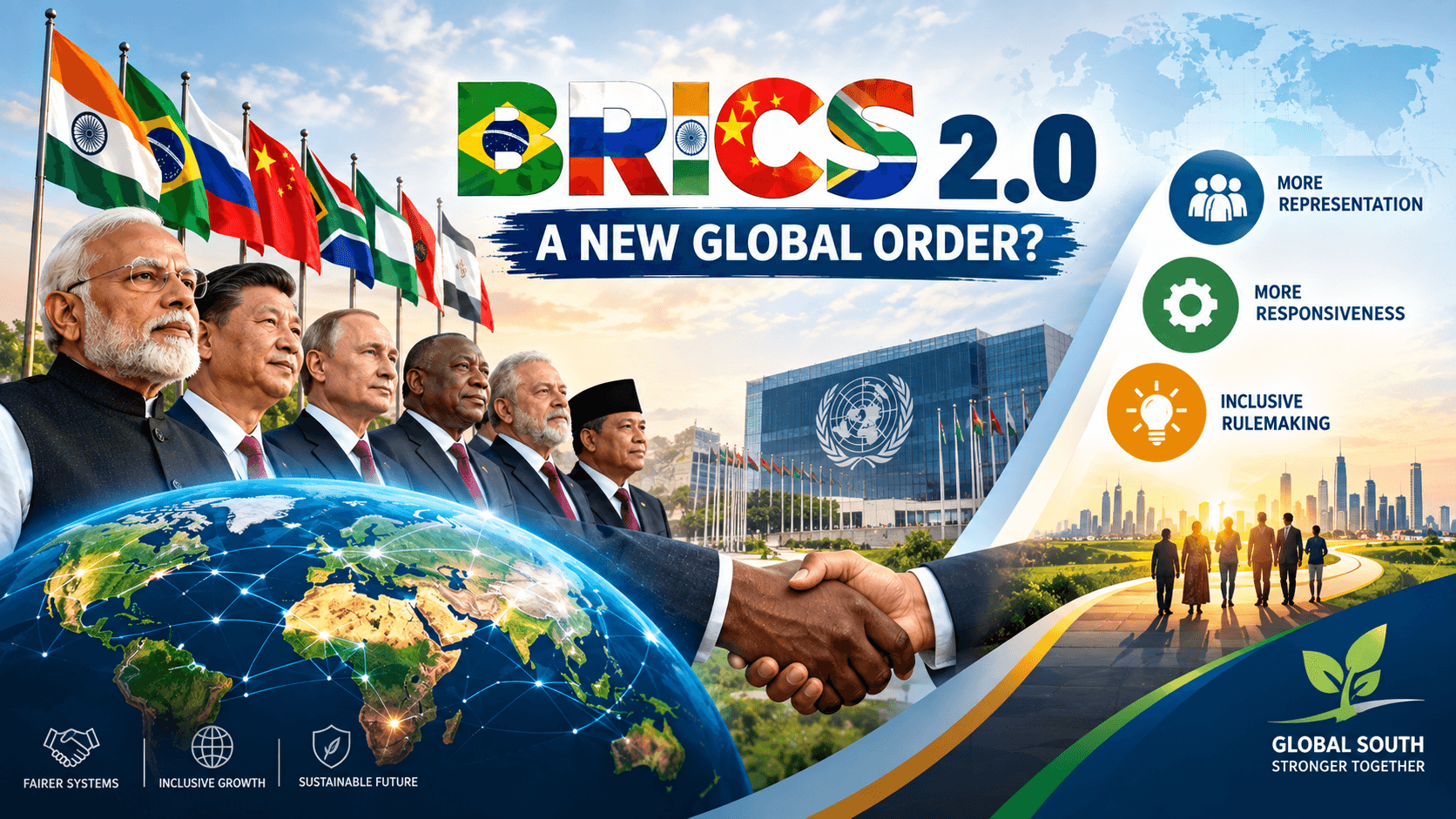
India's proposed BRICS Reform Roadmap is basically about fixing the unfairness in how the world is run. Right now, global institutions are controlled by a few developed countries, while the Global South is mostly left out. So, India has proposed reforms based on three ideas, such as more representation, more responsiveness, and inclusive rulemaking.
What problems does it want to fix?
It wants to solve real problems like no permanent seat for India and Africa in the UNSC, unequal voting power in the IMF and World Bank, the failure of the WTO's dispute system, and being excluded from making new rules for AI and critical technology. The aim is to give the Global South a proper seat at the table and make global governance more inclusive and equal for all.
| UNSC: | 1.4 billion Indians have no permanent voice. |
| IMF / World Bank: | The US and Europe still have maximum votes, while the Global South gets loans with conditions. |
| WTO: | Its dispute system is almost dead, so trade is unfair. |
| Technology: | Rules for AI and semiconductors are being made without India and Africa. |
To make global governance fairer, where the Global South is not just a follower but a co-decision maker.
Key Highlights of India's BRICS Reform Roadmap
1. From Rule-Takers to Rule-Shapers: India said the current global system is a "pyramid of privilege" where few countries are on top. It should become a "platform of partnership" where the Global South, who faces most crises, also gets to make rules.
2. Consensus-Based Approach: India clarified that BRICS is not against any country or trying to make an anti-West bloc. It wants reforms through dialogue and cooperation, not confrontation.
3. The Three Pillars (3Rs) - Base for 10 proposals:
Representation: UNSC reform can't wait anymore. Need time-bound text-based talks. Also, IMF and World Bank voting rights must reflect today's economy, not 1944's Responsiveness: Global bodies are too slow in crisis. India gave a practical idea: the Seafarers’ Emergency Support Network for quick rescue and medical help to maritime workers. Rulemaking in New Tech: Rules for AI, cyberspace, space, biotech, and critical minerals are being made without the Global South. India proposed training young diplomats from the Global South in legal and negotiation skills so they can shape these rules.
4. Continuity Mechanism: To stop ideas from dying after every summit, India proposed a BRICS Troika system (past, present, and future chairs) and a secure digital repository to track all initiatives and deadlines.
Significance of the Roadmap
Empowering the Global South: With 11 members now, BRICS represents ∼40% of world GDP and half the world's population. India is using this huge weight as a counter to the G7 so that the Global South's numbers finally convert into real decision-making power.
Future-Proofing Governance: This roadmap is not just about old bodies like the UN. It also talks about new-age rules for AI, space, and cyberspace. This ensures developing countries are not left out of the rules that will run the 21st-century economy.
From Critique to Constructive Action: BRICS is now 20 years old. Till now it was mostly criticizing Western institutions. With this 10-point roadmap, it is finally growing up, moving from just complaining to giving a practical, alternative plan for fair global governance.
Impediments to Global Governance
Outdated UNSC: The UNSC still shows the 1945 world map. Entire Africa and Latin America have zero permanent seats. That's why G4 (India, Brazil, Germany, and Japan) and Africa (Ezulwini Consensus) are demanding permanent seats.
Unwritten Rule in IMF/World Bank: The World Bank President is always American, and the IMF chief is always European. Voting quota also doesn't reflect India's or the Global South's real economic size.
Veto Misuse: P5 uses veto to save friends, not for peace. Like Russia vetoing Ukraine and the US vetoing Gaza. This has paralyzed UNSC.
Double Standards: International rules are applied selectively. For example, NPT is enforced based on who is friend or foe, not by the same rules for all. This creates a trust deficit.
Donor-Driven UN: UN bodies depend on voluntary money from rich countries. Like 80% of the WHO budget is earmarked funding, so it has to work as per donor interest, not universal need.
WTO is Crippled: The US has blocked the WTO's Appellate Body since 2019. So no one can punish trade rule breakers.
Unilateral Actions: Rich countries bypass global consensus. The EU's CBAM (carbon tax) and the US's IRA (huge subsidies) hurt developing countries directly.
Weaponization of Finance: Throwing countries out of SWIFT and freezing central bank reserves has destroyed trust in neutral finance. This is why BRICS wants its own payment system and de-dollarization.
Minilateralism in Tech: New rules for AI, chips, and space are made in small Western clubs like the G7 Hiroshima AI Process. The Global South is locked out.
Internal Fights in the Global South: Reform is also blocked by developing countries themselves. Like Coffee Club (Pakistan, Italy, etc.), it opposes new permanent seats in the UNSC to stop rivals like India.
US Disengagement: The US leaving the Paris Climate Deal, cutting funds for the Green Climate Fund and Loss & Damage Fund, and leaving UNESCO all this weakens global institutions financially and morally.
Way Forward
Start Text-Based Talks for UNSC: Stop endless open debates in IGN. The UN General Assembly should start proper time-bound negotiations with a draft text to expand the UNSC in both permanent and non-permanent seats.
Fix IMF/World Bank: Fast-track quota reform so voting power matches today's GDP of emerging economies like India. Also, stop the unwritten rule of choosing World Bank and IMF heads on merit, not on nationality (American/European).
Revive WTO: Break the deadlock and appoint judges to the WTO's Appellate Body again to restore the trade court. Also, protect Special & Differential Treatment for developing nations so trade remains fair.
One Voice of the Global South: BRICS, the African Union, and the G20 must come together and speak in one voice on UNSC reform, climate justice, and trade. Internal fights like Coffee Club vs. G4 will only help the status quo.
Make Rules for Future Tech Now: Don't wait for G7 to make AI and space rules. The Global South should use BRICS tech-diplomacy training to co-create UN-backed rules for AI, outer space, and critical minerals so we become rule-makers, not just rule-followers.
Conclusion
The current global order was built for 1945, not for 2025. When institutions like the UNSC become non-operational and global finance remains biased, trust in multilateralism collapses. India's BRICS Reform Roadmap is important because it doesn't just complain; it offers a practical plan from time-bound UNSC talks to fair rules for AI. It marks a shift from a pyramid of privilege to a platform of partnership. If implemented by the 2027 Summit, it can finally make global governance more democratic, responsive, and ready for the future where the Global South is not just at the table but also shaping the menu.