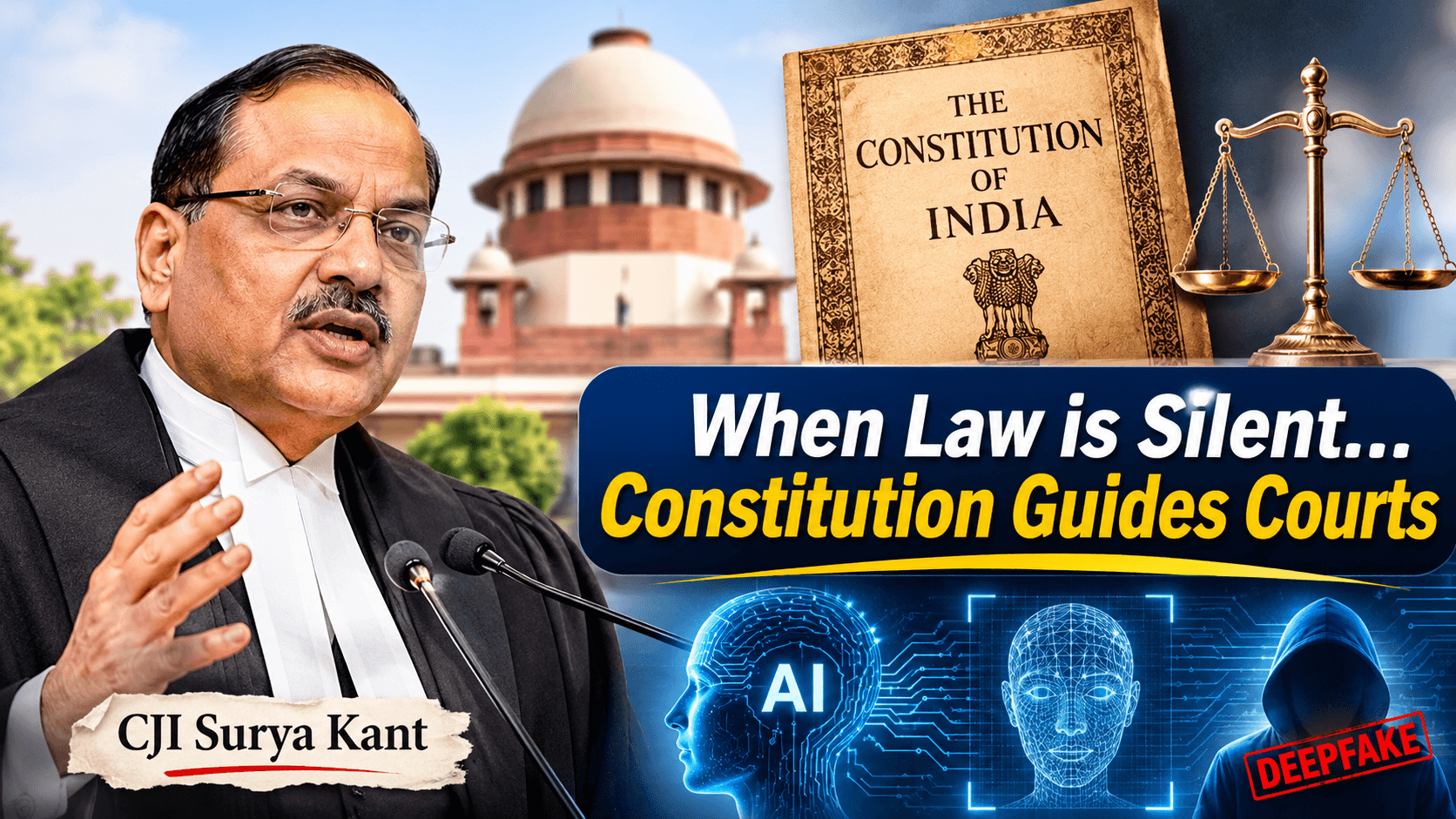
Arrest vs Detention: SC Clarifies the 24-Hour Rule
UPSC IAS/BPSC | GS Paper 2 | Polity & Governance |
Why in the news?
Recently, in a landmark judgment, the Supreme Court has made one thing very clear: liberty cannot be taken away on technicalities. Whether the police call it “arrest” or "detention," if a person is not free to leave, it is the same in the eyes of the Constitution.
There is no constitutional distinction between “arrest” and "detention." The mandatory 24-hour period for producing a person before a magistrate under Article 22(2) starts from the exact moment a person’s liberty is curtailed. It does not start when the police formally record the arrest on paper.
An arrest is the act of taking a person into legal custody by an authority, such as the police, to deprive them of their freedom of movement, usually because they are suspected of or observed committing a crime. whereas, Detention is the act of keeping a person in official custody or restricting their freedom of movement by a legal authority, often for questioning, investigation, or public safety reasons. While it limits a person's liberty, a detention is legally distinct from an arrest and is usually a temporary measure while authorities verify facts or determine next steps.
A detention only requires reasonable suspicion, a lower standard where an officer has a factual reason to suspect you might be involved in criminal activity. An arrest requires probable cause, a much higher standard where facts and evidence point to a reasonable belief that you actually committed a specific crime.
A detention is investigative. Its purpose is to temporarily hold you to freeze a scene, ask questions, or verify your identity to determine if a crime occurred. An arrest is prosecutorial. Its purpose is to take you into official custody, book you into the legal system, and formally charge you with a crime.
A detention is strictly temporary and must end as soon as the immediate suspicion is cleared or confirmed. An arrest is a definitive conclusion to the interaction, moving you from the street into the jail and court system.
What the Court Actually Said: The Court did not just give a ruling; it closed all the loopholes that were being used to keep people in custody without showing it on record. Conjunctive Reading of Article 22(2) The phrase “arrested and detained in custody” is conjunctive and synonymous. Authorities cannot create an artificial distinction between the two terms to delay presenting the accused before a magistrate.
Elimination of “Informal Custody": Holding a person for “prolonged interrogation” or “search and seizure” without recording a formal arrest is unconstitutional. There is absolutely no legal “buffer period” before an arrest.
Resetting the 24-Hour Clock: The constitutional 24-hour countdown starts immediately upon actual detention. The only permissible exclusion is the journey time to the magistrate's court.
What Does Article 22(2) Actually Say? Every arrested person must be produced before the nearest magistrate within 24 hours of arrest, excluding travel time. Any further detention requires the magistrate’s authorization. Exception Under Article 22(3) This safeguard does not apply to enemy aliens and persons detained under preventive detention laws.
About Preventive Detention
Preventive detention means detaining a person without trial or conviction, not to punish for a past offense, but to prevent a future offense. It cannot exceed three months unless an advisory board finds sufficient cause for extension. Grounds are based on State security, public order, foreign affairs, etc.
Two Types:
Preventive Detention: A person is held on mere suspicion of committing a criminal act or harming society. Police can hold/arrest without a warrant or magistrate’s authorization in certain cases.
Punitive Detention: Detention as punishment after an offense is actually committed or attempted.
What Happens If the Rule Is Broken?
The court made it clear that Article 22(2) is not just a formality. If it is violated, the consequences are immediate and serious.
| Immediate Release upon Violation | If a suspect is held beyond 24 hours without being produced before a magistrate, it is a direct violation of fundamental rights. Such a person is entitled to be released forthwith. |
| Reasonableness of Detention — Section 58, BNSS | Relying on Section 58 of the BNSS, 2023 (formerly Sec 57 CrPC), the Court said that merely staying within 24 hours does not make detention automatically lawful. The magistrate must actively verify if the detention within those 24 hours was "reasonable." Magistrates can decline police remand if there is an unexplained, unreasonable gap, for example, 18 hours in informal custody, between physical detention and formal arrest. |
| Primacy of Fundamental Rights | Statutory restrictions on bail under special laws like the NDPS Act, 1985, cannot override fundamental rights under Article 21 (Right to Life and Liberty) and Article 22. The Constitution dictates the interpretation of the statute, not vice versa. |
| CCTV Surveillance | Reiterating Paramvir Singh Saini v. Baljit Singh (2020), the Court emphasized audio-video CCTV surveillance with night vision in police stations and offices of agencies like CBI, ED, and NIA, where interrogation and detention take place. |
Significance & Impact
This ruling is a major safeguard against custodial violence and torture. It strictly limits arbitrary state action. It ends the mechanical granting of remands by shifting the burden of active oversight onto magistrates.
Reference: