World Development Report 2026
Why in News?
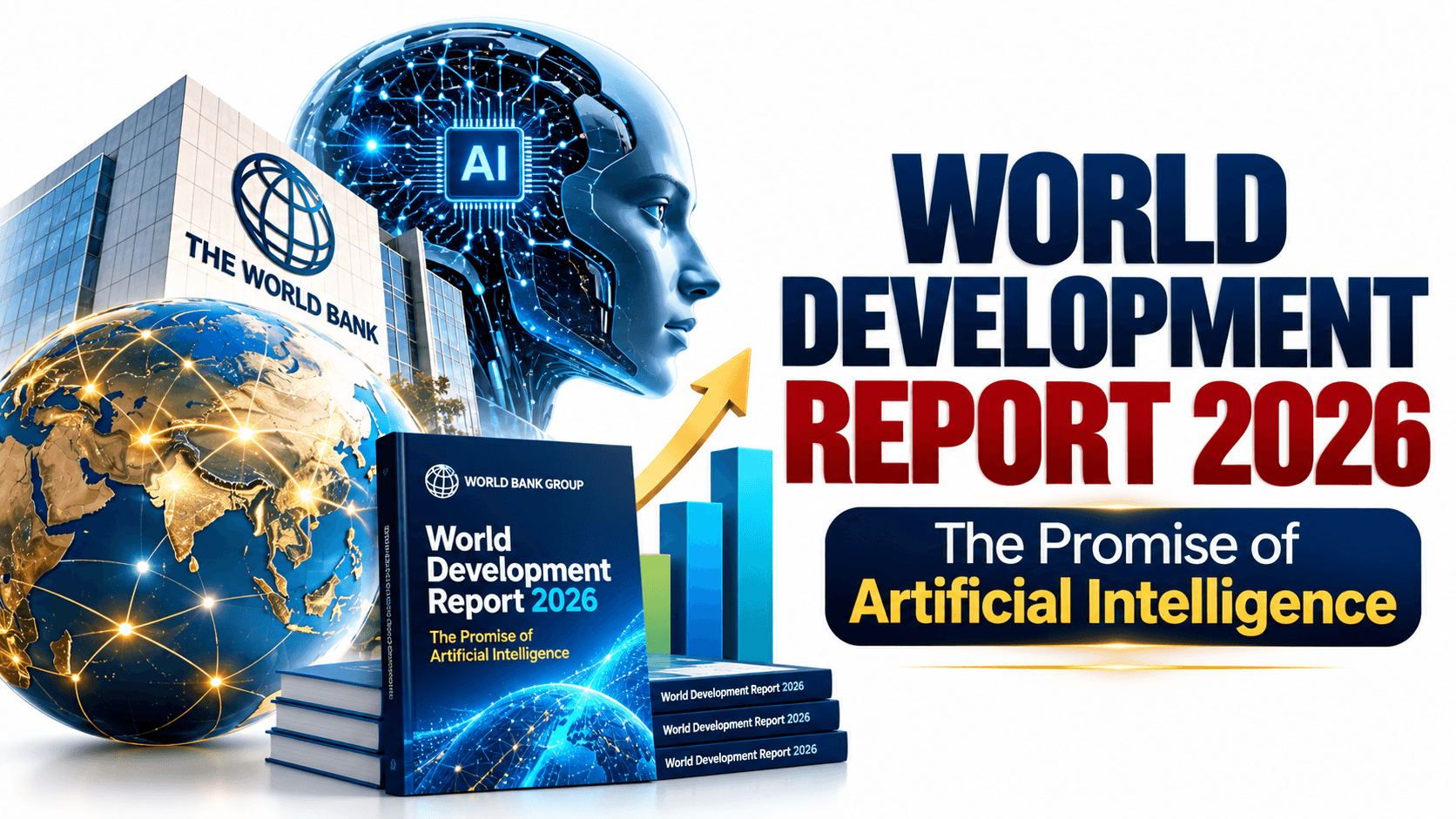
Recently, the Union Minister for Electronics and Information Technology, Railways, and Information and Broadcasting, Ashwini Vaishnaw, launched the World Bank Group’s World Development Report 2026: The Promise of Artificial Intelligence.
This report is published by the World Bank Group. The India AI Mission under the Ministry of Electronics and Information Technology (MeitY), Government of India, is a launching partner.
The report examines the opportunities and challenges that Artificial Intelligence (AI) presents for developing economies and sets out a framework for countries to harness AI for development through adoption, adaptation, and advancement.
What it is?
It is the World Bank Group's flagship annual report considered a leading global guide on major development issues. The 2026 edition is titled The Promise of Artificial Intelligence. It looks at how AI can create big opportunities for growth but also how it could disrupt jobs and what low- and middle-income countries need to have in place to benefit from it.
Key Findings of the Report:
Adopt and Adapt: Developing countries should use existing open-source AI models and customize them for local languages and needs, instead of spending huge amounts to build expensive frontier models from scratch.
Jobs and Automation: Just over 4% of Indian jobs face immediate automation risk, compared to over one-third in advanced economies. However, entry-level BPO job postings in South Asia have already fallen by about 20%.
Risk of Big Subsidies: Generous incentives like India's 20-year tax holiday for foreign data centers could put pressure on public finances, raise electricity costs, and mainly benefit large multinational companies.
Limits of AI Sovereignty: Just having local data centres does not mean true tech independence. Countries still depend on imported advanced chips, specialized cloud services, and global supply chains.
AI Talent Drain: Despite having the world's second-largest AI talent pool of around 50,460 professionals in 2025, India lost a net 200 top AI researchers and inventors between 2011 and 2024.
Preparedness Gap in Global South: Only 1 out of 25 low-income countries has an active national AI strategy, showing a big gap in readiness and governance.
Public Perception: Only 18.8% of Indians are worried about AI, compared to 50.5% in the US—showing more optimism in India and greater support for flexible regulations.
About the World Bank:
The World Bank is an international financial institution set up to support reconstruction and development. It initially focused on rebuilding after the war, but over time its work shifted towards poverty reduction, infrastructure, human development, environmental sustainability, private sector growth, and institutional reforms.
Historical Background:
The World Bank was created in 1944 at the Bretton Woods Conference in New Hampshire, USA, along with the IMF. It was first known as the International Bank for Reconstruction and Development (IBRD), and its main aim was to rebuild war-torn Europe after World War II. Later, its role expanded to funding infrastructure and supporting developing countries in agriculture, education, health, poverty reduction, and more. Over the years, its priorities have kept evolving to meet new global challenges like climate change, pandemics, debt issues, digital transformation, fragile states, and private sector-led growth.
President: Ajay Banga is the current and 14th president of the World Bank Group. He took charge on June 2, 2023, for a five-year term.
Headquarters: Washington, D.C., United States. This is where its global operations are coordinated.
Reports Published by the World Bank:
World Bank reports are a key source of economic and development information for governments, researchers, businesses, and international organizations. Some of its important flagship reports are
Global Economic Prospects: Looks at major economic trends, commodity markets, and slowdowns in global growth.
World Development Report: Focuses on long-term social and economic issues such as jobs, infrastructure, and standards.
Human Capital Index (HCI): A benchmark that measures how much human capital a child born today is expected to have by age 18.
Business Ready (B-READY): Assesses the business and investment climate in different economies. It has replaced the earlier Ease of Doing Business Report.
Country Climate and Development Reports (CCDRs): Combines climate and development goals for individual countries.
Significance:
The report encourages governments to move beyond small pilot projects and scale up AI for use by the entire population, using digital public infrastructure like AgriStack and AI-based weather forecasting.
It also highlights how multilingual, voice-enabled AI tools can help fill the gap where there are not enough skilled professionals in areas like healthcare, agriculture, and education, especially for communities that are still not fully digitally connected.