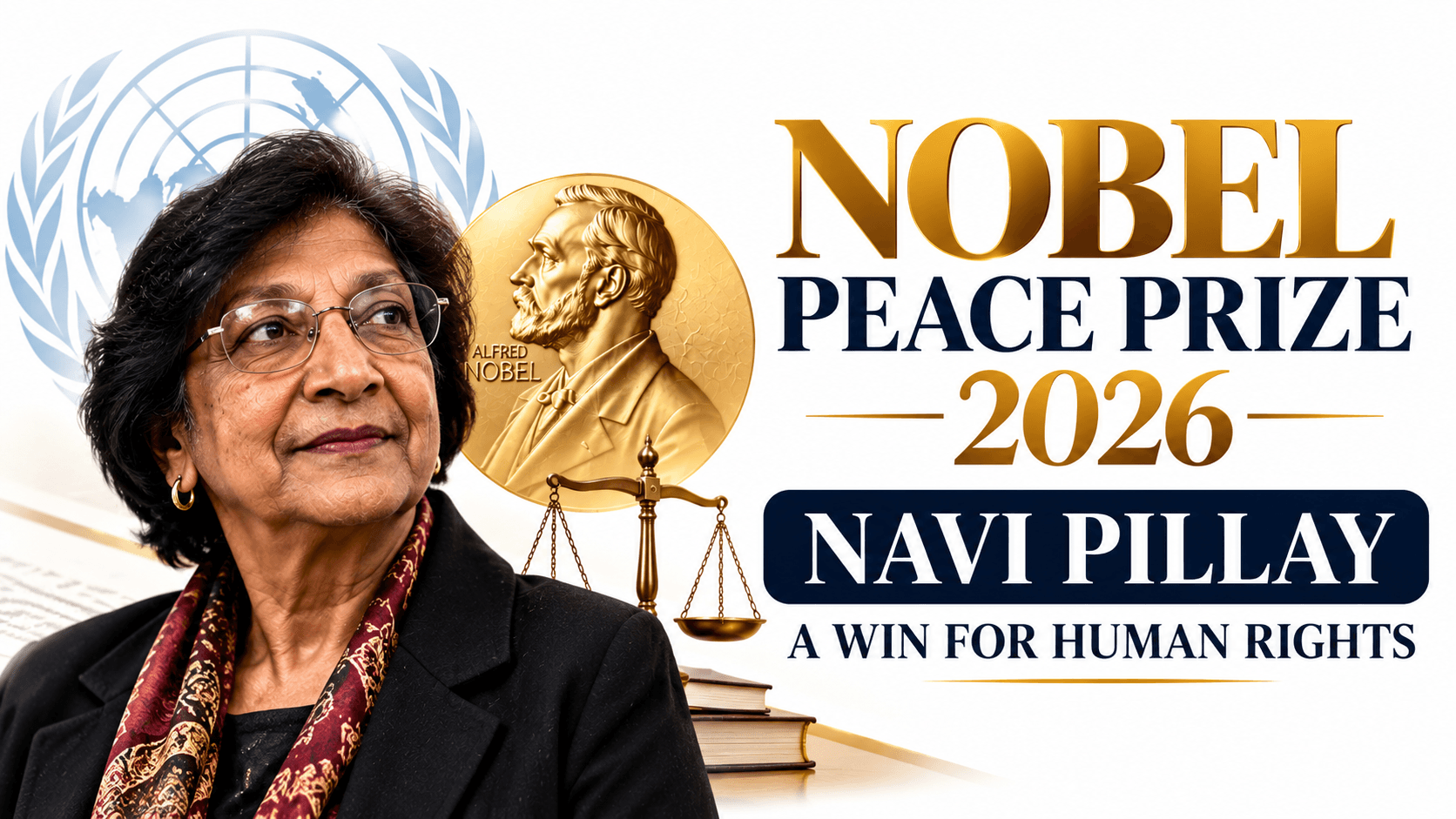
Nobel Peace 2026: A Win for Human Rights
Why in News?
South African jurist of Indian Tamil origin, Navanethem “Navi” Pillay, has been awarded the 2026 Nobel Peace Prize for her efforts to strengthen international law and ensure accountability for serious international crimes, including war crimes, crimes against humanity, and genocide.
Her recognition highlights the importance of justice, human rights, and the rule of law in building lasting peace across the world.
There are two of a total of 9 individuals with Indian citizenship or Indian ancestry who have been awarded the Nobel Peace Prize. One is Mother Teresa, who won the Nobel Peace Prize in 1979, and second, Kailash Satyarthi, who got the Nobel Peace Prize in 2014.
Who Is Navi Pillay? A Jurist of Indian Origin
Navi Pillay was born into an Indian Tamil family in Durban, South Africa, during the apartheid era, when racial discrimination was deeply rooted in the country's political and social system.
Despite facing challenges, she went on to build a distinguished career in law and international justice. Through her work, she has helped strengthen the legal systems designed to protect victims and hold perpetrators of serious crimes accountable.
Key Facts About Navi Pillay
| Full name: | Navanethem “Navi” Pillay |
| Country: | South Africa |
| Heritage: | Indian-Tamil origin |
| Profession: | Lawyer and international jurist |
| Major areas of work: | Human rights, international criminal law, genocide prevention, and accountability for serious crimes |
| Major international roles: | UN High Commissioner for Human Rights and judge in international judicial institutions |
Navi Pillay’s Major International Positions
| Institution | Role or contribution |
| South African judiciary | Served as a judge of South Africa’s High Court |
| International Criminal Tribunal for Rwanda (ICTR) | Served as a judge in cases involving genocide and other international crimes |
| International Criminal Court (ICC) | Served as a judge |
| United Nations | Served as UN High Commissioner for Human Rights from 2008 to 2014 |
| International Court of Justice (ICJ) | Her judicial career and involvement in international proceedings have connected her work with the wider international legal system. |
About the International Court of Justice (ICJ)
The International Court of Justice (ICJ), popularly called the World Court, was created in June 1945 under the UN Charter and began working in April 1946. It is the main judicial body of the United Nations, though it functions independently of the UN Secretariat. It is headquartered at the Peace Palace in The Hague, Netherlands, making it the only one among the six principal UN organs that is not located in New York. Its official languages are English and French. All UN member states are automatically parties to the ICJ, and even non-UN states can join by ratifying its Statute. The Court does not have permanent representatives from countries; instead, states communicate with its Registrar through their Foreign Minister or their ambassador to the Netherlands.
Navi Pillay’s Contribution to International Law and Human Rights
Pillay has played an important role in advancing international justice, particularly in cases involving genocide, sexual violence, and crimes against civilians.
Her work has helped establish that serious human rights violations cannot be ignored simply because they occur during conflicts or are committed by powerful individuals or governments.
1. Recognizing Sexual Violence as an International Crime
One of Pillay’s significant contributions came through her work at the International Criminal Tribunal for Rwanda.
Her involvement in landmark proceedings helped advance the recognition that rape and sexual violence can constitute crimes against humanity and, under specific circumstances, acts of genocide.
This was an important step towards ensuring that sexual violence committed during armed conflicts is treated as a serious international crime rather than an unavoidable consequence of war.
2. Combating Genocide and Its Incitement
Pillay has contributed to efforts to hold individuals accountable for encouraging or participating in mass atrocities.
International criminal law recognizes that directly and publicly inciting genocide can itself constitute a crime. Propaganda that promotes hatred and encourages the destruction of a protected group can therefore have serious legal consequences. Her work underscores the need to address not only the violence itself but also the actions and rhetoric that may encourage such crimes.
3. Promoting Accountability for War Crimes and Crimes Against Humanity
Pillay has served in several prominent international legal institutions, contributing to the development and enforcement of international criminal law. Her career has included service at the International Criminal Tribunal for Rwanda, the International Criminal Court, and the United Nations.
These institutions play an important role in investigating serious violations, prosecuting alleged perpetrators within their respective jurisdictions, and strengthening the international system of justice.
Why Is the Nobel Peace Prize Significant?
The recognition highlights the connection between international law and lasting peace. Peace is not simply the absence of war; it also requires justice, accountability, and protection for people whose rights have been violated.
Pillay’s work draws attention to three important principles:
- Accountability: Individuals responsible for serious international crimes should be held accountable under applicable law.
- Protection of victims: International justice can help recognize victims’ suffering and strengthen safeguards against future abuses.
- Rule of law: Powerful individuals and states should not be beyond the reach of applicable international legal obligations.
The award also highlights concerns about the weakening of international institutions and the growing influence of power politics in global affairs.
Indian Judges at the ICJ:
So far, four Indians have served as judges at the ICJ: Justice Dalveer Bhandari, a former Supreme Court judge, has been serving since 2012. Justice R.S. Pathak, former Chief Justice of India, served from 1989 to 1988, and Nagendra Singh, former Chief Election Commissioner, served from 1973 to 1988. He also served as vice president of the court from 1976 to 1979 and as president from 1985 to 1988. Sir Benegal Rau, advisor to the Constituent Assembly, was a member from 1952 to 1953.
India and the ICJ
India has appeared before the ICJ in six cases so far, four of which involved Pakistan:
- Right of Passage over Indian Territory (Portugal v. India, 1960)
- Appeal Relating to the Jurisdiction of the ICAO Council (India v. Pakistan, 1972)
- Trial of Pakistani Prisoners of War (Pakistan v. India, 1973)
- Aerial Incident of 10 August 1999 (Pakistan v. India, 2000)
- Obligations concerning Negotiations relating to Cessation of the Nuclear Arms Race and to Nuclear Disarmament (Marshall Islands v. India, 2016)
- Kulbhushan Jadhav Case (India v. Pakistan, 2019)
Conclusion
Navi Pillay’s recognition places the spotlight on the role of international justice in protecting human dignity and preventing impunity for serious crimes. Her career demonstrates how legal institutions can help challenge discrimination, recognize victims’ rights, and strengthen accountability for atrocities. For the international community, the broader message is that lasting peace requires more than diplomatic agreements; it also requires respect for human rights, the rule of law, and justice for victims.