Physics Nobel 2026: Francis Halzen’s Discovery
Why in News?
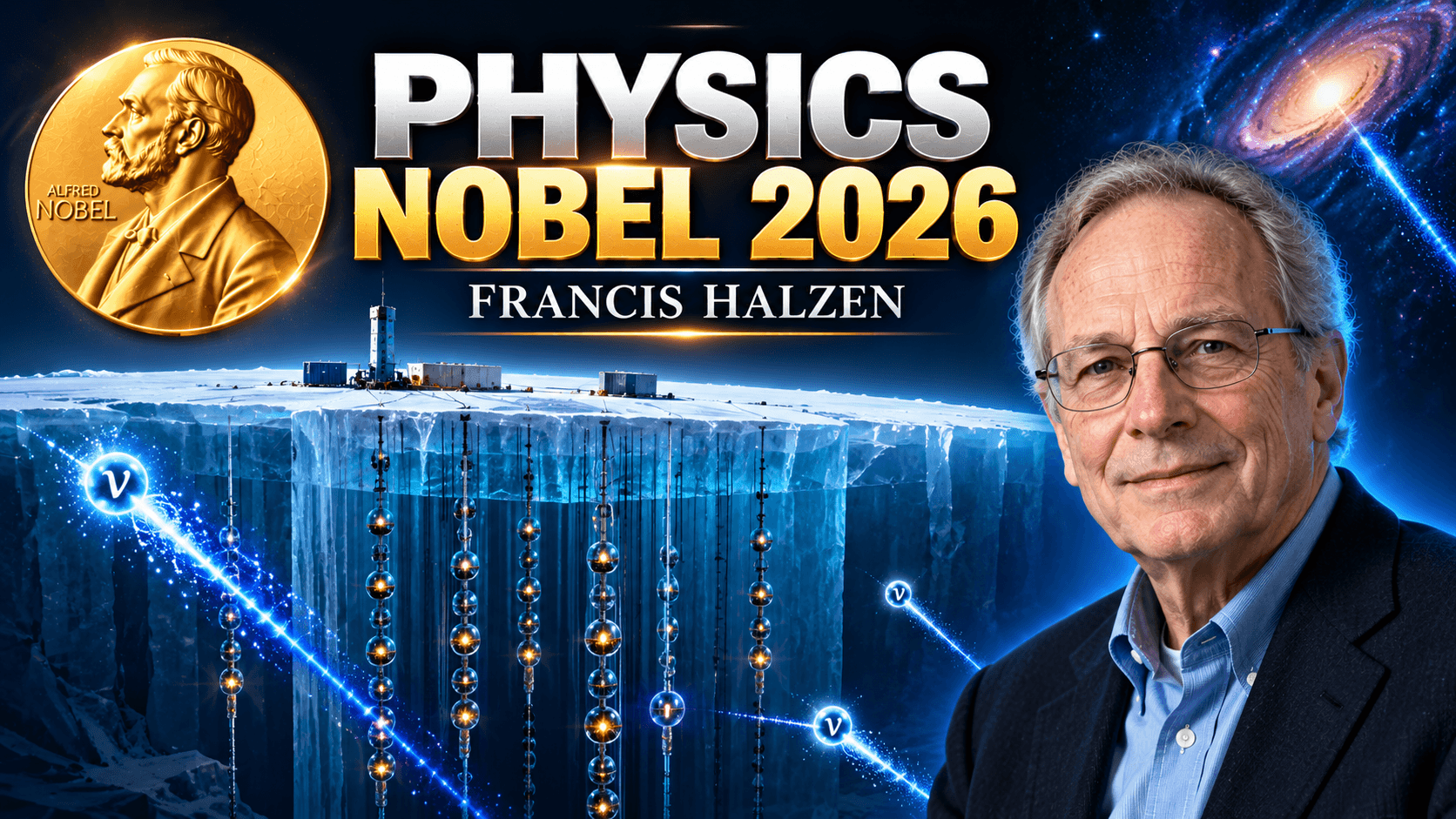
The 2026 Nobel Prize in Physics has been awarded to Francis Halzen for his decisive contributions to the IceCube Neutrino Observatory and the discovery of high-energy neutrinos of astrophysical origin.
"Astrophysical" means relating to astrophysics, the science that uses the rules of physics and chemistry to explain how stars, black holes, and galaxies work.
The award highlights a major breakthrough in our understanding of the universe and the powerful cosmic events that produce high-energy particles. Gamma-ray bursts, supernova, collisions of cosmic rays, etc. are some powerful cosmic events.
Who is Francis Halzen?
Francis Halzen, a physicist known for his work in particle physics and astrophysics, played a key role in developing the IceCube Neutrino Observatory. The observatory is designed to detect neutrinos—tiny, electrically neutral particles that can travel through matter with very little interaction.
His work helped scientists use these elusive particles as a new way to study the universe.
What Are High-Energy Neutrinos?
Neutrinos are extremely light and electrically neutral particles that interact only very weakly with matter. This makes them difficult to detect, but it also gives them a special advantage.
Unlike light, neutrinos can travel across vast distances without being significantly affected by matter or magnetic fields. This means they can carry information about some of the most energetic events in the universe directly to Earth.
The discovery of high-energy neutrinos of astrophysical origin therefore opened a new window for studying the cosmos.
What Is the IceCube Neutrino Observatory?
The IceCube Neutrino Observatory is a giant neutrino detector located deep beneath the ice at the South Pole in Antarctica.
It uses thousands of light sensors embedded in Antarctic ice to detect the tiny flashes of light produced when neutrinos interact with matter.
IceCube has allowed scientists to identify high-energy neutrinos coming from sources beyond our solar system, providing valuable clues about the most powerful cosmic phenomena.
Note: Only a tiny fraction of neutrinos ever interact with matter. So the detector must be enormous, kilometers in size. A thick layer of ice naturally provides that volume. Building and filling such a large tank with water or liquid would be far too expensive. When a neutrino hits an atom in the ice, it creates a charged particle that emits a faint blue Cherenkov light. In clear ice, this light can travel hundreds of meters, where sensors buried in the ice can detect it.
Why Is the 2026 Physics Nobel Important?
The work recognized by the Nobel Prize has strengthened our understanding of the universe in several ways:
- It established high-energy neutrinos as valuable astronomical messengers.
- It helped scientists investigate the sources of extreme cosmic energy.
- It demonstrated how particle physics and astronomy can work together to study the universe.
- It opened a new field of neutrino astronomy, allowing scientists to explore cosmic events through particles rather than only through light.
Nobel Prize in Physics: Key Facts
The Nobel Prize in Physics has been awarded 120 times to 231 Nobel Prize laureates between 1901 and 2026.
One of the most notable facts about the Physics Nobel is that John Bardeen remains the only person to have received the Nobel Prize in Physics twice—first in 1956 and again in 1972.
This means that 230 individuals have received the Physics Nobel during this period, as Bardeen is counted twice among the total number of laureates.
Conclusion
The 2026 Nobel Prize in Physics recognizes the importance of neutrinos in understanding the universe. Francis Halzen's contributions to the IceCube experiment helped transform these elusive particles into powerful tools for exploring distant and energetic cosmic phenomena. For students and competitive-exam aspirants, the award is particularly important for understanding the connection between particle physics, astrophysics, and neutrino astronomy.