India’s Fight Against TB
The particular topic on India's fight against TB directly maps to the General Studies (GS) papers of both the UPSC Civil Services Examination and the BPSC Combined Competitive Examination. It is directly connected to the Issues relating to development and management of Social Sector/Services relating to Health.
Why in News?
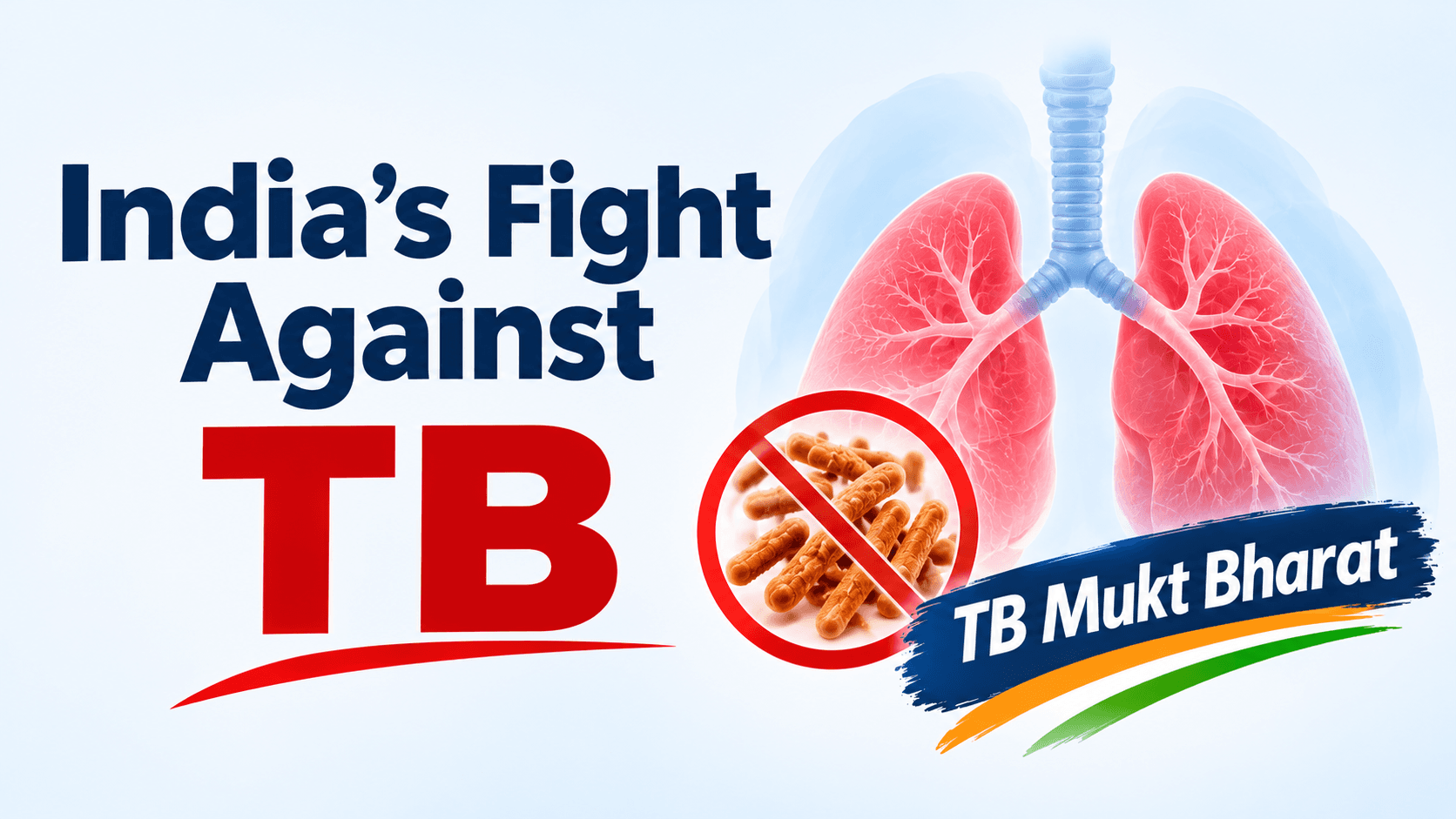
India is moving fast towards TB elimination. TB cases in India have dropped by 21% between 2015 and 2024, which is almost double the global decline of 12%, as per WHO's Global TB Report 2025.
To speed this up, the government has intensified its push with TB Mukt Bharat Abhiyaan, expanded screening and preventive treatment, and launched JOSH (Joint Squad for Health) to boost community participation.
According to WHO's Global TB Report 2025, India's TB incidence has dropped by 21% between 2015 and 2024, and treatment coverage has improved to 92%, but the country still accounts for 25% of global TB cases.
To address this, India under NTEP is focusing on early detection, AI-enabled diagnostics, nutritional support through Ni-kshay Poshan Yojana, shorter treatment for drug-resistant TB, and stronger community participation towards a TB-free India.
Key facts about Tuberculosis (TB):
TB is an infectious disease caused by the bacterium Mycobacterium tuberculosis. It mainly affects the lungs (pulmonary TB) but can also affect other organs like the brain, kidneys, and spine (extrapulmonary TB).
Latent TB: Many people carry the bacteria without symptoms and cannot spread it, but it can turn active later.
Who is at higher risk: Children, people living with HIV, and those with weak immunity, malnutrition, and diabetes are more likely to develop active TB.
Symptoms: Persistent cough sometimes with blood, chest pain, fever, night sweats, fatigue, and unexplained weight loss. Symptoms vary with organ affected.
How it spreads: Through air when a person with infectious lung or laryngeal TB coughs, sneezes, speaks, or sings, especially in poorly ventilated spaces. It does NOT spread by handshake, sharing food/utensils, or public toilets.
Infectious period: Infectiousness drops substantially within the first few weeks of effective treatment, but time to become non-infectious varies with treatment response and drug resistance. Extrapulmonary TB is generally non-infectious, except laryngeal TB.
Treatment and prevention: TB is preventable and curable with proper antibiotics; untreated active TB can be fatal. The BCG vaccine protects children against severe forms of the disease.
Government support: Under NTEP, free diagnosis and treatment are available at public health facilities and participating private providers. The Ni-kshay Sampark helpline provides guidance on TB services.
Multidrug-resistant tuberculosis (MDR-TB) is a type of tuberculosis that is caused by bacteria that are resistant to at least two of the most powerful anti-tuberculosis drugs, isoniazid and rifampicin.
Government Initiatives to End TB in India
1. National Tuberculosis Elimination Programme (NTEP)
In 2020, the government renamed the Revised National TB Control Programme (RNTCP) as the National TB Elimination Programme (NTEP). This shows India's ambitious goal to eliminate TB by 2025, which is 5 years before the global target of 2030 under SDG-3. The NTEP works on the National Strategic Plan's four pillars, such as Detect, Treat, Prevent, and Build, which means early diagnosis, proper treatment, stopping transmission, and making health systems stronger.
Early Diagnosis: Promotes high-quality testing and active community outreach to find hidden TB cases, especially among vulnerable people.
Prompt Treatment: Ensures timely treatment with quality medicines, including special regimens for drug-resistant TB.
Private Sector Engagement: Works with private doctors and hospitals to improve diagnosis, case notification, and continuity of care.
Patient-Centric Support: Gives nutritional and financial help through DBT and community support under the Ni-kshay Mitra initiative.
Prevention and Contact Tracing: Contact tracing gives preventive treatment to high-risk groups like household contacts, children, and people living with HIV and promotes airborne infection control.
Multisectoral Approach: Involves different sectors to address root causes of TB, like malnutrition, poverty, and poor living conditions.
1. Pradhan Mantri TB Mukt Bharat Abhiyaan (PMTBMBA)
Launched on 9th Sept 2022 as a key part of NTEP, it aims to make TB elimination a Jan Andolan, a people's movement, by involving individuals, NGOs, civil society, and corporates through CSR. Provides community-based nutritional, psychosocial, and other support to improve treatment adherence and outcomes.
2. Ni-kshay Poshan Yojana & Ni-kshay Mitra Programme
Ni-kshay Poshan Yojana (2018): Gives Rs 1,000/month via DBT to every notified TB patient for nutrition. Since April 2018, about Rs 4,454.68 cr has been given to 1.38 cr beneficiaries.
Ni-kshay Mitra: Means TB friend—a volunteer who gives extra help during treatment.
Support includes food baskets, psychosocial help, and vocational support from individuals, NGOs, corporates, and community groups.
Youth participation: 2 lakh+ MY Bharat volunteers (age 15-29) have become Ni-kshay Mitras. MY Bharat connects youth with the government, the private sector, and civil society.
3. 100-Day TB Mukt Bharat Abhiyaan
Launched on 7 Dec 2024 by the Health Ministry in 347 high-priority districts across 33 states/UTs. Focus on vulnerability mapping, systematic screening, and early diagnosis in high-risk groups. Whole-of-government and whole-of-society approach with 30,000+ elected representatives and 24 ministries. The model later expanded nationwide.
Progress till June 2026: 28.1 cr+ people screened, 20 lakh+ got TB Preventive Treatment (TPT), and 5.7 lakh new Ni-kshay Mitras joined.
Second phase from March 2026: 1.7 lakh Ayushman Arogya Shivirs in 1.2 lakh high-risk villages/wards, with 32 lakh students and 1.9 lakh MY Bharat volunteers. Result: 90% treatment success rate, above the global average of 88%.
4. Recent Technological & Treatment Initiatives
A. Treatment and Prevention:
BPaLM Regimen: A shorter 6-month treatment with bedaquiline, pretomanid, linezolid, and moxifloxacin for MDR/RR-TB patients. 15,000+ patients started.
TB Preventive Treatment (TPT): Preventive medicines for household contacts, PLHIV, and other vulnerable groups to stop latent TB from turning active.
B. Ayushman Arogya Mandirs:
Primary health facilities under Ayushman Bharat are offering TB screening and referral. As of 13 Oct 2026, there are 187,250 mandirs across India.
C. Tech Infrastructure: 9,800+ rapid molecular testing facilities and 107 culture & drug susceptibility labs for early diagnosis and drug-resistance detection. 500+ AI-enabled handheld chest X-ray units deployed, 1,500 more on the way—led to a 34-fold increase in X-ray screening.
Ni-kshay platform: Digital case management, patient monitoring, and DBT delivery. TB Mukt Bharat App & Khushi Chatbot: Citizen engagement, program monitoring, AI-based info on symptoms, and nearest diagnostic center. More radiographers under NHM and more Truenat & CBNAAT machines.
D. AI-Led Initiatives: Cough Against TB (CATB): Uses acoustic AI to analyze 3-sec cough recording via smartphone app. 1.62 lakh+ screened, 12-16% extra case detection vs conventional methods. Adverse Outcome Prediction: Predictive analytics to find patients at high risk of treatment failure for timely action. 27% drop in adverse outcomes after nationwide rollout.
DeepCXR: AI tool to read digital chest X-rays for TB signs like nodules and cavities. Deployed free in 8 states/UTs to overcome specialist shortage.
5. JOSH (Joint Squad for Health) Initiative Pilot in 11 States, 55 districts, with a nationwide social media campaign by the Health Ministry.
Each JOSH team = MY Bharat volunteers + NCC cadets + Class-I officers to promote awareness, early screening, timely treatment, and adherence. Its objective is to mobilize youth, reduce stigma, and strengthen grassroots participation through Jan Andolan.
Conclusion
India's 21% decline in TB incidence, 92% treatment coverage, and 90% treatment success rate show that the country is moving steadily towards TB elimination despite accounting for 25% of global cases. The shift from a purely medical approach to Jan Andolan through PM TB Mukt Bharat Abhiyaan, Ni-kshay Mitra, the 100-Day campaign, and JOSH teams, combined with nutritional support, the BPaLM regimen, and AI-led tools like handheld X-rays, CATB, DeepCXR, and the Ni-kshay platform, reflects a comprehensive strategy based on Detect-Treat-Prevent-Build. If community participation, technology integration, and multisectoral coordination continue at this pace, India can set a global example in achieving TB-free status and meeting SDG-3 goals.
Reference: