US Sanctions on Russia: India’s Tariff Risk
Why in News?
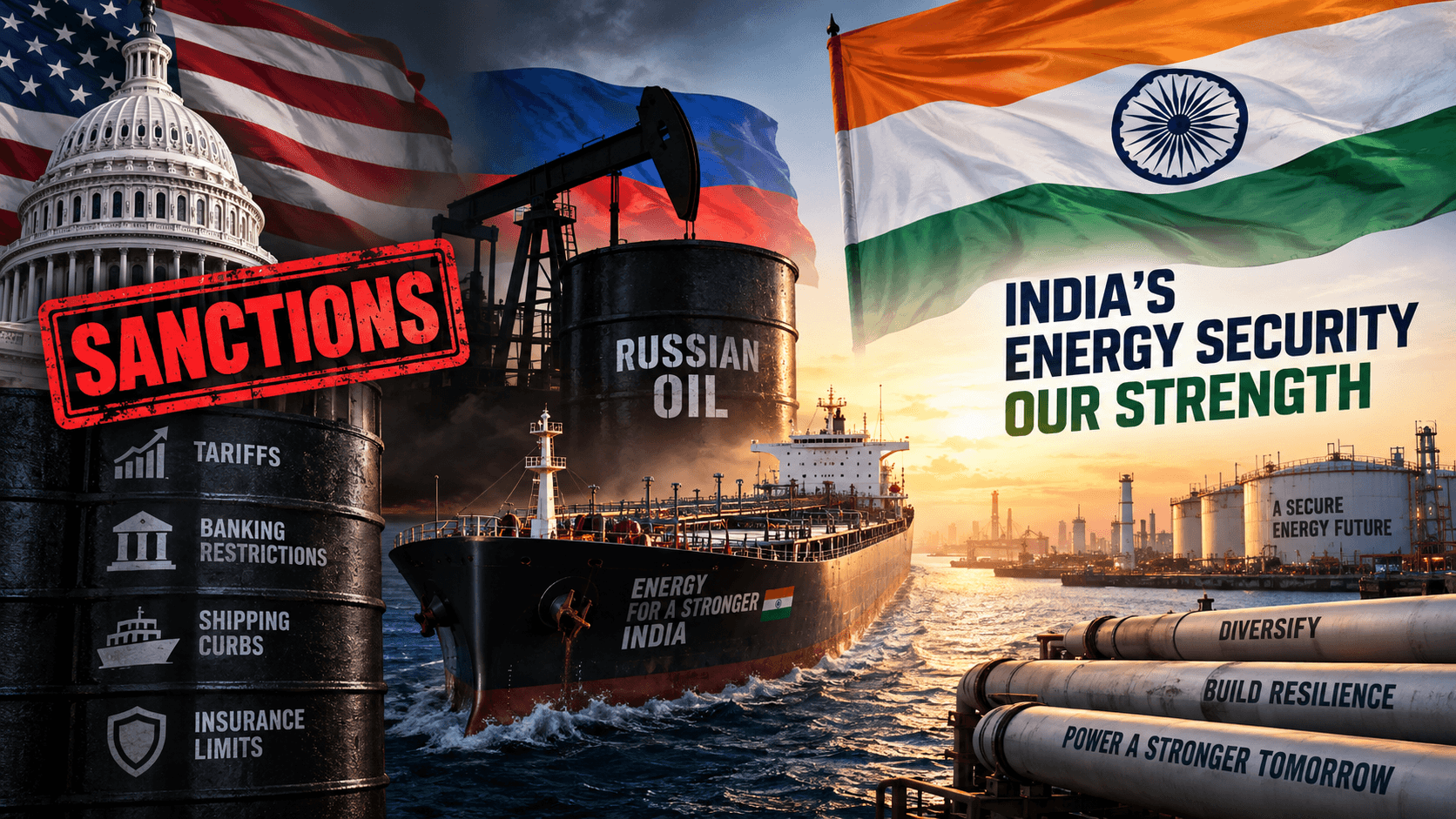
India has reiterated that it is firmly committed to ensuring energy security for its 1.4 billion people and will continue to source crude oil based on diversified supplies and market dynamics. This comes after the US Congress passed the Sanctioning Russia and Iran Act of 2026, which authorizes up to 100% trade tariffs on major purchasers of Russian oil.
The development is significant because Russian crude accounted for over 51% of India's crude oil imports in July 2026. This has prompted calls for a centralized strategic "war room" to protect India's economic and energy interests from unilateral sanctions.
KEY POINTS PERPETUATING TO IMPACT ON INDIA
Risk of Secondary Sanctions: The US Act targeting Russian oil buyers could expose India to secondary sanctions, high tariffs, and disruptions in banking, shipping, and insurance. This shows weakness in India's energy security system.
Need for Stronger Resilience: India needs to build economic resilience by diversifying oil suppliers, strengthening Strategic Petroleum Reserves, achieving maritime self-reliance, developing alternative payment systems, and speeding up the clean energy transition.
What are India's vulnerabilities to unilateral sanctions?
Dollar Clearing and Over-Compliance Trap: Global energy trade is indexed to the US dollar and routed through Western clearinghouses and SWIFT. Indian and foreign banks in India often practice over compliance by rejecting even lawful non-dollar transactions like SRVA and UAE Dirham settlements due to fear of losing US correspondent banking licenses.
Maritime Logistics and P&I Insurance Chokepoint: Over 90% of global maritime P&I coverage is underwritten by the London-based International Group of P&I Clubs. Sanctions on insurers invalidate vessel cover. Without sovereign guarantees, tankers carrying crude to India risk being denied entry at chokepoints like the Danish Straits, Bosphorus, and at domestic ports.
Collateral Damage to Strategic Projects: The constant threat of secondary sanctions under CAATSA stalls critical defense acquisitions like S-400 and connectivity projects like Chabahar Port and INSTC.
Human Capital Exposure: India is the world's 2nd largest supplier of seafarers, with 311,936 professionals, accounting for 12.16% of the global workforce, as per the BIMCO-ICS Report 2026. Blacklisting of shadow fleet tankers leads to vessel seizures, unpaid wages, and abandonment of Indian crew.
Siloed Governance: When sanctions hit, the impact spreads across markets, shipping, insurance, and banking. But India's governance is siloed: MEA handles diplomacy, RBI handles banking, and the Ministry of Shipping handles vessels. This fragmentation prevents early warnings to domestic companies about vulnerable payment channels or targeted ports.
What are India's vulnerabilities to unilateral sanctions?
Dollar Clearing and Over-Compliance Trap: Global energy trade is indexed to the US dollar and routed through Western clearinghouses and SWIFT. Indian and foreign banks in India often practice over-compliance by rejecting even lawful non-dollar transactions like SRVA and UAE Dirham settlements due to fear of losing US correspondent banking licenses.
Maritime Logistics and P&I Insurance Chokepoint: Over 90% of global maritime P&I coverage is underwritten by the London-based International Group of P&I Clubs. Sanctions on insurers invalidate vessel cover. Without sovereign guarantees, tankers carrying crude to India risk being denied entry at chokepoints like the Danish Straits, Bosphorus, and at domestic ports.
Collateral Damage to Strategic Projects: The constant threat of secondary sanctions under CAATSA stalls critical defense acquisitions like S-400 and connectivity projects like Chabahar Port and INSTC.
Human Capital Exposure: India is the world's 2nd largest supplier of seafarers, with 311,936 professionals, accounting for 12.16% of the global workforce, as per the BIMCO-ICS Report 2026. Blacklisting of shadow fleet tankers leads to vessel seizures, unpaid wages, and abandonment of Indian crew.
Siloed Governance: When sanctions hit, the impact spreads across markets, shipping, insurance, and banking. But India's governance is siloed: MEA handles diplomacy, RBI handles banking, and the Ministry of Shipping handles vessels. This fragmentation prevents early warnings to domestic companies about vulnerable payment channels or targeted ports.
Key Provisions of the Sanctioning Russia and Iran Act of 2026:
Targeting the Shadow Fleet: The law aims to choke Russia's energy revenue by targeting the shadow fleet of tankers transporting Russian crude outside the G7 price cap mechanism.
Secondary Sanctions and Tariffs: It empowers the US administration to levy tariffs of up to 100% on exports from countries that are major buyers of Russian energy, directly threatening nations like India and China.
Extraterritorial Reach: The sanctions target not just the buyer and seller but the entire transaction ecosystem. It restricts foreign banks, maritime insurers, and ship managers from accessing the US financial system if they facilitate these trades.
Extension of Iran Sanctions: Along with Russia, it broadens enforcement against Iran's military and energy trade and extends the duration of the Iran Sanctions Act of 1996 for five more years till 2031.
Presidential Waiver: The Act includes a provision allowing the US President to waive these tariffs if required for US national security interests, providing some diplomatic room.
How Significant is Russian Oil to India's Energy Security?
Record Supply Dependency: Driven by heavy discounts, Russia has become India's largest crude supplier, with imports reaching 2.6 million barrels per day in July 2026.
Anchoring Affordability and Inflation: India imports over 85% of its crude, and energy security rests on availability, affordability, accessibility, and sustainability. Russian oil has anchored affordability and availability. Discounted oil has kept domestic retail fuel prices stable and checked inflation.
Macroeconomic Stability: India saved around USD 13 billion by importing discounted crude from Russia in FY23 and FY24. This compressed the current account deficit by 15-22 basis points in FY24, protected the rupee from depreciation, and curbed capital flight.
Refining Arbitrage: Indian refiners earned an estimated USD 16 billion windfall by processing discounted Urals crude. Refined petroleum exports reached ~USD 60 billion in FY25, paradoxically supplying Western markets like the EU and the US that had sanctioned Russian energy.
Assertion of Strategic Autonomy: Procurement showed India's independent foreign policy, adhering only to UNSC-mandated sanctions while exercising strategic autonomy outside unilateral regimes to safeguard the energy security of 1.4 billion people.
How Can India Strengthen Economic Security and Resilience Against Sanctions?
Establish a Sanctions War Room: India needs an Economic Security and Sanctions Office under the Cabinet Secretariat or NSCS. It should be integrated into Allocation of Business Rules, 1961, to issue binding inter-agency directives. It should map supply chain vulnerabilities, monitor foreign sanctions, guide banks and firms, and coordinate maritime risk management.
Achieving Maritime Atmanirbharta: Fast-track Indian-owned P&I Club and expand Bharat Maritime Insurance Pool to guarantee coverage during geopolitical stress. Incentivize acquisition of Indian-flagged VLCCs and LNG carriers.
De-Dollarization and Financial Interoperability: Deepen local currency settlement, link RBI's CBDC architecture with trade partners, and leverage platforms like Project Nexus for instant cross-border payments. Establish bilateral non-dollar clearing corridors and use BRICS to co-develop decentralized trade architecture.
Augmenting Strategic Buffers: Accelerate Phase II of Strategic Petroleum Reserve at Chandi Khol and Padur to insulate the economy from sudden supply blockades.
Structural Demand Substitution: Mitigate long-term vulnerability by accelerating green transition through the National Green Hydrogen Mission, E20 biofuel blending, and industrial-scale battery storage.
Strengthening Strategic Diplomacy and Diversification: Pursue multi-vector diplomacy and diversify crude imports across the US, Brazil, Canada, and Africa; secure long-term contracts with OPEC+; and expand LNG, gas pipelines, and biofuel alternatives.
Conclusion:
India's growing dependence on Russian crude, over 51% of imports in July 2026, has secured affordability and macroeconomic stability but has also exposed it to risks from unilateral sanctions like the US Sanctioning Russia and Iran Act of 2026. To protect the energy security of 1.4 billion people, India must move from ad hoc responses to structured resilience through a centralized Sanctions War Room, maritime Atmanirbharta, de-dollarized payment systems, stronger Strategic Petroleum Reserves, and accelerated clean energy transition. This will ensure that India's strategic autonomy is backed by economic resilience and not vulnerable to extraterritorial pressures.