Sengol Controversy: The NCERT Debate
Why in the news?
A new NCERT Class 9 Social Science textbook has reignited the debate over the historical significance of the Sengol and its alleged role in India’s transfer of power from British rule in 1947.
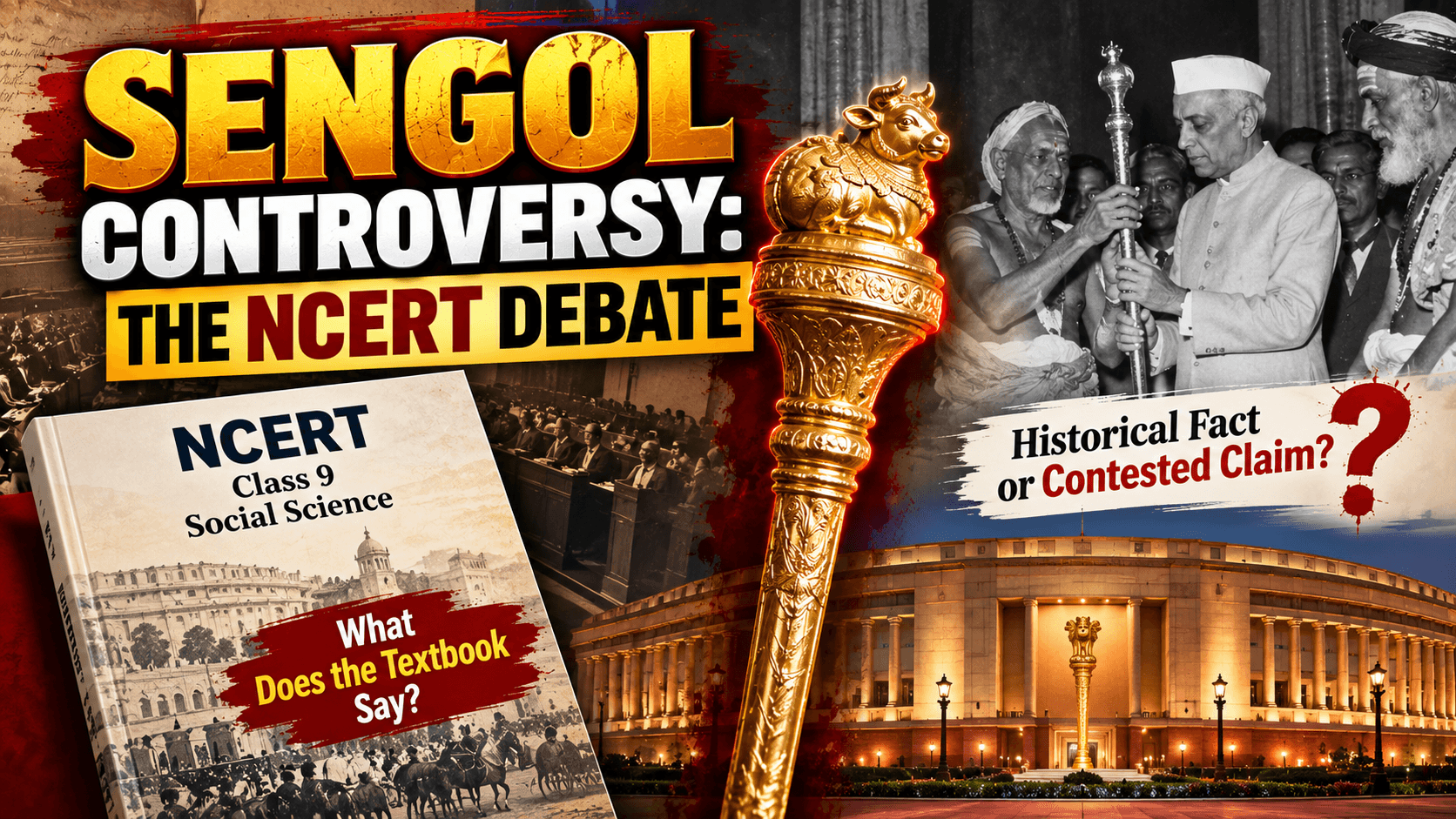
The textbook claims that Jawaharlal Nehru received the Sengol from Shaivite religious leaders from Tamil Nadu at midnight on August 14–15, 1947, as a symbol of the transfer of power.
However, this particular narrative has been strongly questioned by historians and scholars, who argue that there is no clear contemporary historical evidence showing that the Sengol was officially used as a symbol of the transfer of power.
What Is Sengol?
The Sengol is a ceremonial sceptre associated with Tamil traditions of kingship and Shaivite religious institutions. The word is derived from the Tamil tradition and is generally associated with authority, justice and righteous rule. The controversy, however, is not about the existence or cultural importance of the Sengol. The main question is: Was the Sengol actually used in 1947 as an official symbol of the transfer of political power from the British to independent India?
What Does the New NCERT Textbook Say About Sengol?
The claim appears in the Class 9 Social Science textbook Understanding Society: India and Beyond – Part 2, in the chapter dealing with Governance and Public Policy.
According to the textbook:
- Nehru received the Sengol from the Adheenam saints of Tamil Nadu at the time of Independence.
- The Sengol represented righteous governance and good administration.
- The tradition of using the Sengol as a symbol of legitimate rule dates back more than 1,000 years to the Chola period.
- The Sengol was later installed in the new Parliament building in 2023.
This presentation gives the Sengol a much larger political and historical significance than simply being a religious or cultural artefact.
How Did the 1947 Sengol Story Begin?
The Sengol became a major political issue in 2023, just before the inauguration of the new Parliament building.
Then Union Home Minister Amit Shah announced that the Sengol would be installed in the new Parliament building. He described it as a sacred symbol of the transfer of power from the British to India.
According to Shah's account, on the night of August 14, 1947, Nehru received the Sengol from religious leaders from Tamil Nadu.
Shah also linked the episode to C. Rajagopalachari (Rajaji), saying that he had played an advisory role in arranging the Sengol ceremony.
The Sengol was subsequently installed in the new Parliament building in May 2023.
Why Have Historians Questioned This Claim?
The historical interpretation of the Sengol has been challenged by several scholars.
Historian Aditya Mukherjee, former professor of contemporary history at Jawaharlal Nehru University, said that he could not find historical evidence establishing the Sengol as an official symbol of the transfer of power.
The argument is that contemporary newspapers, writings of important leaders and major documents from the period do not clearly describe the Sengol as representing the formal transfer of sovereignty.
Critics therefore distinguish between two claims:
- The Sengol was presented to Nehru: there is evidence and historical discussion around this.
- The Sengol officially symbolised the transfer of power: This interpretation remains disputed.
What About Rajagopalachari's Role?
Another disputed aspect concerns C. Rajagopalachari.
Amit Shah had said that Rajagopalachari played an important advisory role in the Sengol episode.
However, Rajmohan Gandhi, Rajagopalachari's grandson and biographer, said that he had never heard of Rajaji's alleged role in the Sengol story.
This has added another layer to the historical debate over how the 1947 episode should be interpreted.
Why Is the NCERT Textbook Creating Debate?
The controversy has now shifted from a political debate to an issue of how history is presented in school textbooks.
Critics argue that when a contested historical interpretation is presented as an established fact, students may not understand that historians have different views about the episode.
Educationist Ashok Agrawal has also questioned the description of the Sengol as a symbol of “good governance”.
According to this criticism, a sceptre is historically associated with monarchical authority, whereas modern India is a democratic republic based on constitutional governance.
Sengol: Symbol of Good Governance or Monarchical Authority?
This is at the heart of the wider debate. Supporters of the Sengol narrative see it as a representation of:
- Justice and righteous rule
- India's civilisational traditions
- Tamil cultural heritage
- Continuity of India's historical traditions
- The transfer of authority from colonial rule to Indians
Critics, on the other hand, argue that the Sengol represents traditional kingship and religious authority, and therefore its direct association with India's democratic transfer of power needs stronger historical evidence.
Why Does the Sengol Debate Matter?
The controversy is important because it raises a larger question about how India's history should be interpreted and taught.
The Sengol has now become more than a historical object. It sits at the intersection of history, culture, religion, politics and India's understanding of democracy.
For students and competitive-exam aspirants, the key point is to distinguish between established historical facts and contested interpretations.
Conclusion
The Sengol controversy is not simply about a historical sceptre; it is about how India remembers and interprets its transition from colonial rule to a democratic republic. While the Sengol has cultural and historical significance, its specific role as an official symbol of the 1947 transfer of power remains contested. Therefore, textbooks should clearly distinguish between documented historical facts and later interpretations, allowing students to understand the debate through evidence rather than presenting a disputed narrative as settled history.