RBI’s Inflation Battle: Who Can Help?
Why in News?
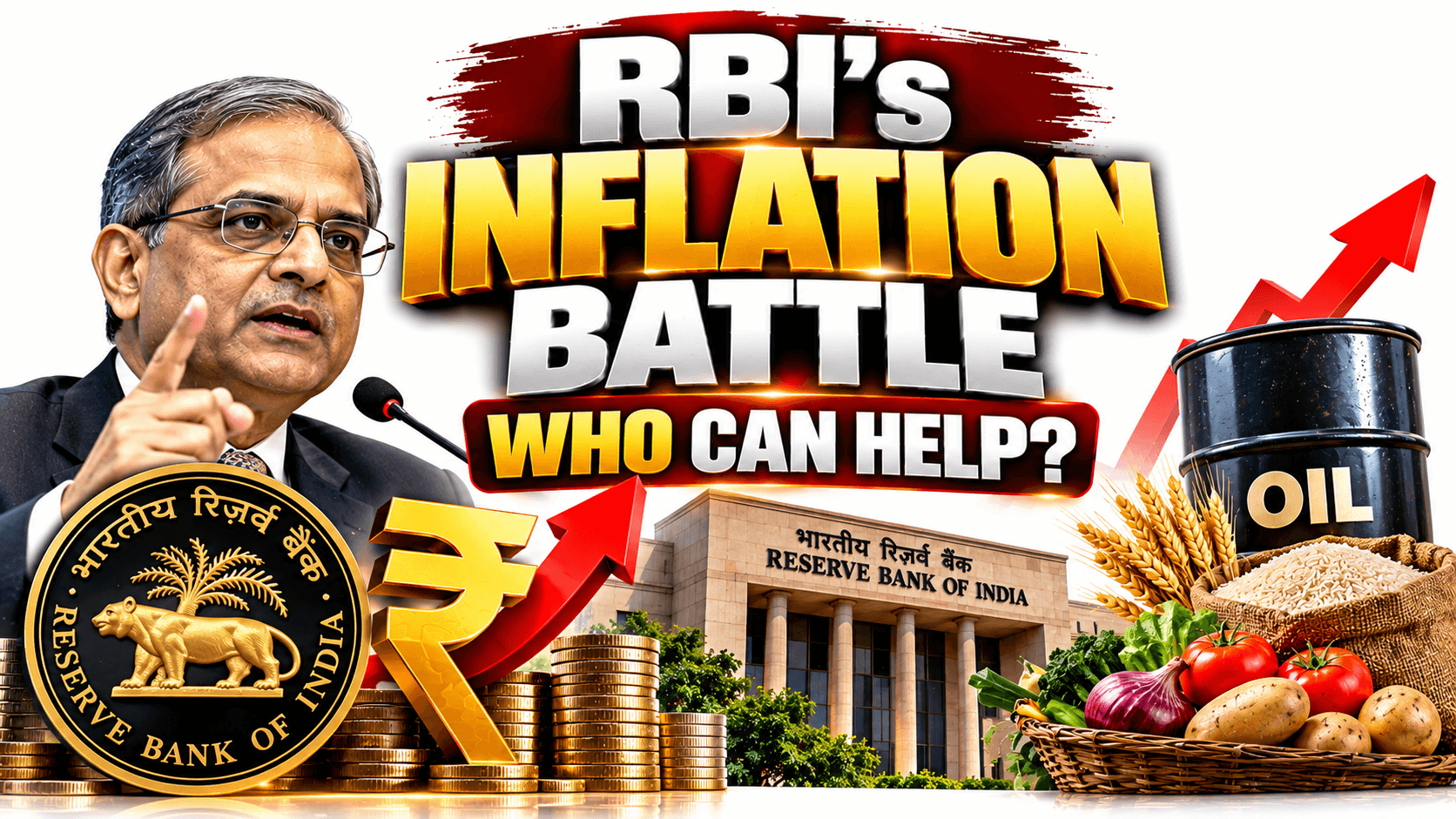
Recently, the Reserve Bank of India (RBI) has raised interest rates by 25 basis points (bps) to control rising inflation. However, with global crude oil prices increasing and a weak monsoon pushing up food prices, monetary policy alone may not be enough to bring inflation under control.
The RBI’s latest policy decision highlights the need for better coordination between the central bank and the government to tackle rising prices without slowing down economic growth.
Why Is Inflation Rising in India?
Inflation refers to the general rise in the prices of goods and services over time, which reduces the purchasing power of money. In India, the current inflationary pressure is largely driven by rising fuel costs and food prices.
Two major factors are contributing to the problem:
1. Rising Crude Oil Prices: Global crude oil prices have crossed $100 per barrel again after a brief period of relief. Since India imports a significant share of its crude oil requirements, higher international prices can increase domestic fuel costs. So far, oil marketing companies have absorbed much of the increase instead of passing the entire burden on to consumers. However, this cannot continue indefinitely.
- Higher crude oil prices increase the cost of petrol and diesel.
- Expensive fuel raises transportation and production costs.
- Businesses may pass these additional costs on to consumers.
- As a result, the prices of essential goods and services may rise further.
2. Weak Monsoon and Rising Food Prices: A deficient monsoon can affect agricultural production and reduce the supply of essential food items. When food supplies become limited, prices tend to rise. This is particularly concerning for Indian households, where food accounts for a significant share of everyday expenditure.
- Lower agricultural output can increase the prices of vegetables, cereals, and other essential food items.
- Higher food prices put additional pressure on household budgets.
- Continued supply shortages may keep inflation elevated for several months.
RBI’s Interest Rate Hike: What Does It Mean?
The RBI has increased interest rates by 25 basis points, equivalent to 0.25 percentage points. The objective is to moderate inflation and prevent expectations of rising prices from becoming entrenched.
When inflation remains high, people may expect prices to continue increasing. Businesses may raise prices in advance, while workers may demand higher wages to compensate for rising living costs. This can create a cycle of persistent inflation. By raising interest rates, the RBI aims to manage these expectations and keep inflation under control.
Key Takeaways from the RBI’s Monetary Policy
| Interest rate hike: | The RBI increased rates by 25 basis points to address inflationary pressures. |
| Inflation forecast: | Retail inflation is projected at 4.9% in the second quarter, rising to 6% in the third quarter before easing to 5.7% in the fourth quarter. |
| Policy stance: | The MPC shifted from a ‘neutral’ stance to ‘calibrated tightening,' signaling a stronger focus on controlling inflation. |
| Future rate decisions: | The change in stance suggests that further rate hikes remain possible, depending on how inflation evolves. |
What is the Monetary Policy Committee (MPC)?
The Monetary Policy Committee (MPC) is a committee set up by the Central Government and headed by the RBI Governor. Its main aim is to fix the benchmark policy rate, the repo rate , to keep inflation within a set target. Earlier, interest rate decisions were taken by the RBI governor alone. To make the process more transparent and accountable, the MPC was created under the Reserve Bank of India Act, 1934. The Committee meets at least 4 times a year, and after every meeting, the monetary policy decision is published along with the views of each member.
Why Raising Interest Rates May Not Be Enough
Interest rate hikes are an important tool for controlling inflation, but their effectiveness depends on what is causing prices to rise. When inflation is driven by excessive demand, higher interest rates can make borrowing more expensive, reduce spending, and ease price pressures. However, the situation becomes more complicated when inflation is caused by supply-side problems, such as expensive crude oil or poor agricultural output.
In such cases:
- Higher interest rates cannot directly increase food production.
- They cannot reduce international crude oil prices.
- Their impact on supply-driven inflation may be limited and delayed.
- Excessive tightening can make loans more expensive for households and businesses, potentially slowing economic activity.
Therefore, the RBI’s decision is not just about raising interest rates. It is also an attempt to signal that it is serious about preventing inflation from becoming persistent.
Inflation vs Economic Growth: A Difficult Balancing Act
The RBI must control inflation without unnecessarily slowing down economic growth. This creates a difficult policy trade-off.
The central bank has revised its GDP growth forecast for 2026–27 upward to 7.1% from 6.7%, indicating confidence in the economy’s ability to withstand tighter monetary conditions. However, a slowdown in economic activity remains a concern.
Higher interest rates can increase borrowing costs for businesses and individuals, potentially affecting investment, consumption, and job creation. At the same time, allowing inflation to remain high can weaken household purchasing power and increase uncertainty for businesses.
The RBI must therefore strike a careful balance between price stability and economic growth.
How Can the Government Help Control Inflation?
Since the current inflationary pressure is partly driven by supply-side factors, the government has an important role to play. Fiscal and administrative measures can complement the RBI’s monetary policy.
Important Government Measures
- Maintain strategic food reserves: Release essential food stocks when supplies are tight to prevent sudden price increases.
- Use import and export policies effectively: adjust trade restrictions and import duties, where appropriate, to improve domestic availability of essential commodities.
- Prevent hoarding: Take action against the artificial creation of shortages and the illegal stockpiling of essential goods.
- Conduct open market operations: Sell food stocks, such as wheat and rice, through appropriate channels to increase market supply and moderate prices.
- Address fuel price pressures: Consider suitable fiscal measures to reduce the transmission of high international oil prices to domestic consumers.
These steps can address the immediate causes of inflation more directly than interest rate changes alone.
What Is the Way Forward?
The RBI has taken action to contain inflation and manage public expectations. However, monetary policy cannot solve every inflation-related problem, particularly when rising prices are driven by shortages of essential goods and higher global energy costs.
A coordinated response is needed. The RBI should continue to monitor inflation and growth, while the government should focus on ensuring adequate food supplies, improving market availability, and limiting avoidable price pressures.
The key message is clear: controlling inflation requires more than higher interest rates. It requires effective coordination between monetary policy, fiscal measures, and supply management.
Conclusion
The RBI’s interest rate hike is a cautious step towards controlling inflation, but the challenge goes beyond monetary policy. Rising crude oil prices and weather-related pressures on food supplies require direct and timely intervention. For India, the real test is to bring inflation under control while protecting economic growth and household purchasing power. The RBI has taken the monetary policy route; now, effective government action on food supplies, fuel costs, and market stability is equally important.
UPSC Prelims 2017 Question:
Question: Which of the following statements is/are correct regarding the ‘Monetary Policy Committee (MPC)?
- It decides the RBI’s benchmark interest rates.
- It is a 12-member body including the Governor of RBI and is reconstituted every year.
- It functions under the chairmanship of the Union Finance Minister.
Select the correct answer using the code given below:
- 1 only
- 1 and 2 only
- 3 only
- 2 and 3 only
Answer:
Correct Answer: Option 1
Statement 1: It decides the RBI’s benchmark interest rates. — Correct
The Monetary Policy Committee (MPC) determines the policy repo rate, which is the benchmark interest rate used by the Reserve Bank of India (RBI) to implement monetary policy. Its decisions aim to maintain price stability while keeping the objective of growth in mind.
Statement 2: It is a 12-member body and is reconstituted every year. — Incorrect
The MPC consists of six members, not twelve. Three members are from the RBI, including the Governor, and three external members are appointed by the Central Government. The external members serve for four years, not one year.
Press Information Bureau
Statement 3: It functions under the chairmanship of the Union Finance Minister. — Incorrect
The RBI Governor is the ex-officio Chairperson of the MPC, not the Union Finance Minister.