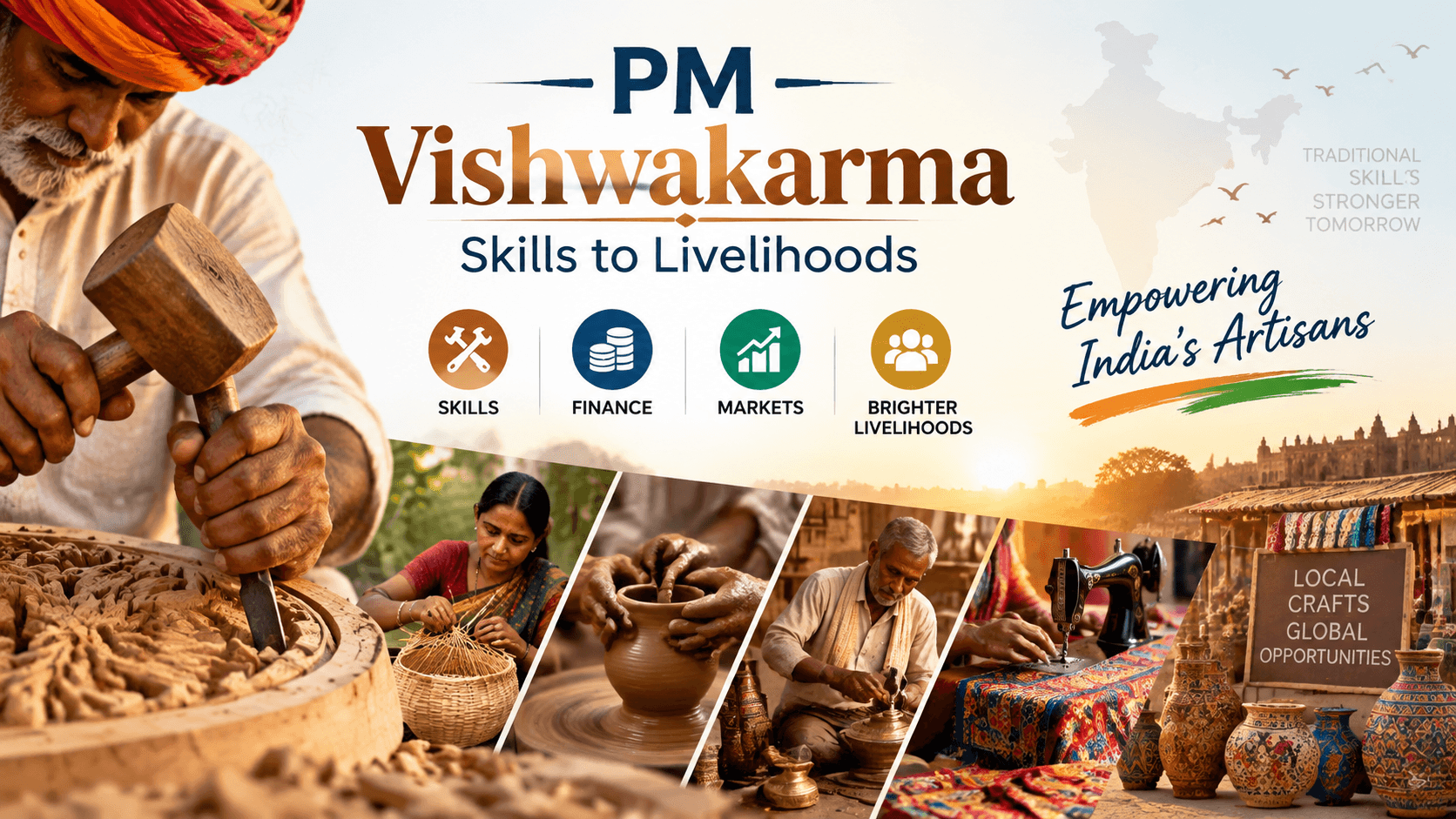
PM Vishwakarma: Skills to Livelihoods
Why in News?
The PM Vishwakarma Scheme has completed nearly three years of implementation, and its target of registering 30 lakh beneficiaries has already been achieved. Launched on 17 September 2023, the scheme aims to provide end-to-end support to traditional artisans and craftspeople by combining skill development, financial assistance, modern tools, digital empowerment, and market access.
The scheme has gained importance as it attempts to address the long-standing challenges faced by artisans working in the informal sector, such as limited access to credit, outdated tools, weak market connectivity, and lack of formal recognition.
By connecting artisans with platforms like the Udyam Assist Platform, Government e-Marketplace (GeM), e-commerce platforms, trade fairs, and exhibitions, PM Vishwakarma seeks to integrate traditional occupations with the modern economy.
Background: Need for Supporting Traditional Artisans
India’s traditional artisans represent both an economic resource and a cultural legacy. Many occupations are based on manual skills, family-based knowledge systems, and traditional methods passed from one generation to another. However, these artisans often operate as small self-employed workers in the unorganized sector and face difficulties in accessing technology, finance, and wider markets.
To strengthen this important section of society, the government introduced PM Vishwakarma on 17 September 2023 as a comprehensive support mechanism for artisans and craftspeople engaged in traditional trades.
Overview of PM Vishwakarma Scheme
PM Vishwakarma is a Central Sector Scheme with a financial outlay of ₹13,000 crore for the period FY 2023-24 to FY 2027-28. The scheme covers 18 traditional trades and aims to improve the quality of artisan products, enhance productivity, and connect craftsmen with domestic as well as global supply chains.
The scheme is based on three major principles: Samman (respect), Samarthya (capability), and Samriddhi (prosperity). It also focuses on strengthening the Guru-Shishya Parampara, through which traditional skills are preserved and transferred within families and communities.
Key Features of PM Vishwakarma
Recognition of Artisans
One of the first steps under PM Vishwakarma is providing formal recognition to artisans. After completing the registration and verification process, beneficiaries receive a PM Vishwakarma Certificate and ID Card, which helps them gain visibility and access to government support systems.
Skill Development and Capacity Building
A major focus of the scheme is upgrading the skills of traditional workers according to changing market requirements. Through skill training, artisans are introduced to modern tools, improved techniques, innovative designs, digital transactions, marketing practices, and entrepreneurial skills. The scheme provides basic training of 5–7 days and advanced training of 15 days or more, during which trainees receive a stipend of ₹500 per day.
Digital Empowerment and Marketing Support
The scheme also encourages artisans to adopt digital payment systems and formal business practices. Beneficiaries receive ₹1 incentive per eligible digital transaction, up to a maximum of 100 transactions per month.
Along with financial assistance, PM Vishwakarma provides marketing support through trade fairs, exhibitions, branding activities, advertising, and online platforms such as GeM. These initiatives help artisans move beyond local markets and reach wider consumer groups.
Eligibility Criteria
The scheme is designed for artisans aged 18 years or above who work with their hands and tools in one of the 18 notified traditional trades. The beneficiary must be engaged in the unorganized sector on a self-employment basis.
Only one member from a family, consisting of husband, wife, and unmarried children, can receive benefits under the scheme. Government employees and their family members are not eligible.
Trades Covered Under PM Vishwakarma
The scheme covers traditional occupations such as carpenter, boat maker, armourer, metalsmith, hammer and toolkit maker, locksmith, goldsmith, potter, sculptor, stone breaker, cobbler, mason, basket and mat maker, doll and toy maker, barber, garland maker, washerman, tailor, and fishing net maker.
Implementation and Formalization of Artisans
Applications under PM Vishwakarma are submitted through Common Service Centres (CSCs). The selection process follows a three-level verification system: verification at the Gram Panchayat or Urban Local Body level, recommendation by the District Implementation Committee, and final approval by the Screening Committee.
After approval, beneficiaries are onboarded on the Udyam Assist Platform, which helps informal micro-enterprises become part of the formal MSME ecosystem and access government benefits.
Progress and Achievements
The scheme has shown significant progress in skill development and financial inclusion. As of 15 September 2026, more than 24.37 lakh artisans had received basic skill training, while more than 18.16 lakh beneficiaries had received toolkits.
In terms of credit support, more than 6.19 lakh loans worth around ₹5,316 crore have been sanctioned, helping artisans purchase raw materials, upgrade equipment, and expand their businesses.
The scheme has also promoted digital inclusion, with more than 8.11 lakh beneficiaries receiving digital incentives and over ₹42 crore disbursed under this component. Additionally, more than 12,000 artisans have been trained in AI tools for branding, product design, packaging, and marketing.
Significance of PM Vishwakarma
PM Vishwakarma represents an effort to combine traditional knowledge with modern economic opportunities. By providing recognition, skills, finance, technology, and market access, the scheme aims to transform artisans from isolated traditional workers into active participants in the formal economy.
For India, where millions depend on traditional occupations, such initiatives are important for preserving cultural heritage while promoting livelihood security and inclusive growth.