Nobel Prize in Medicine, 2026 : Light Controls Brain
Why in News?
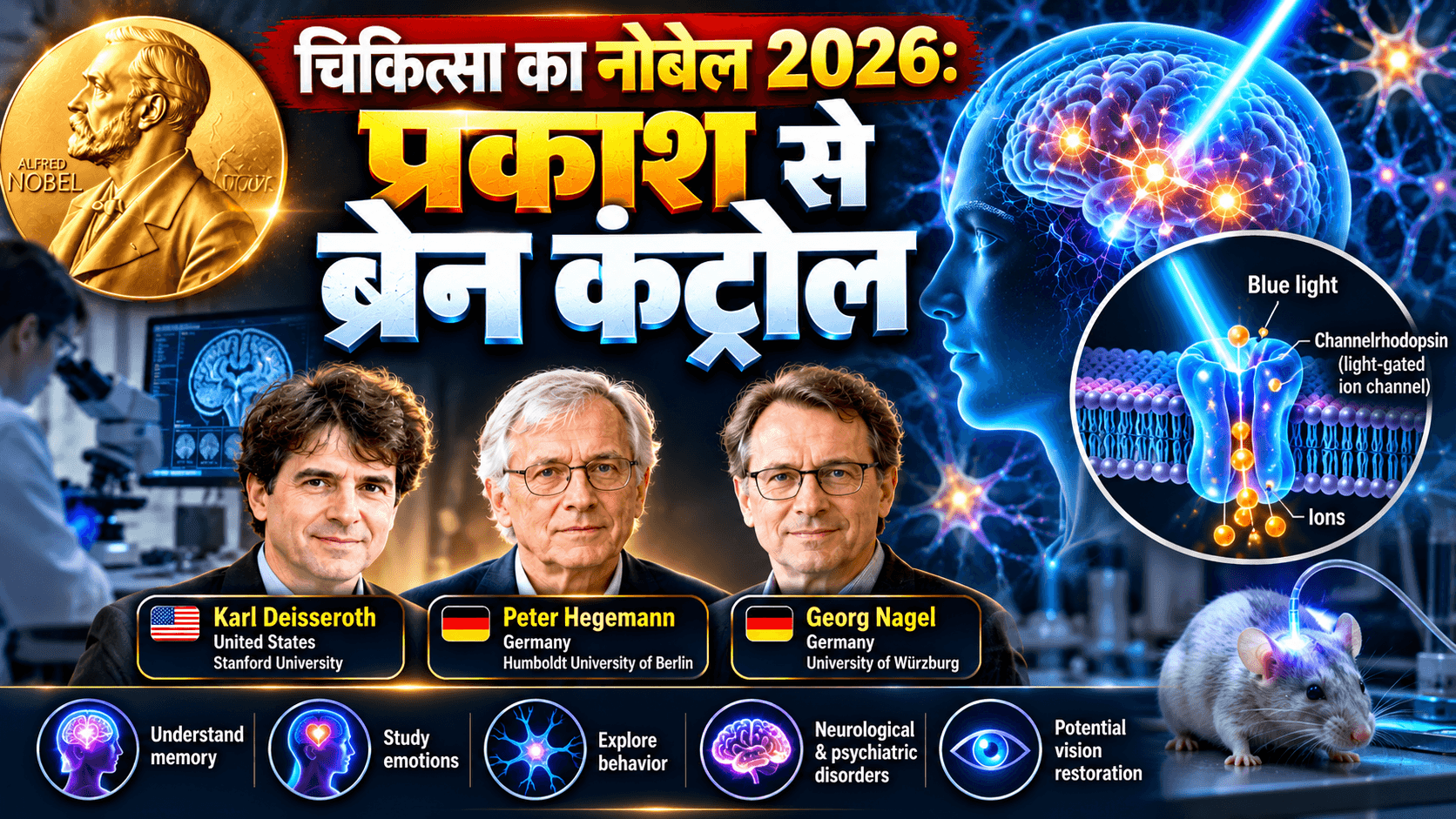
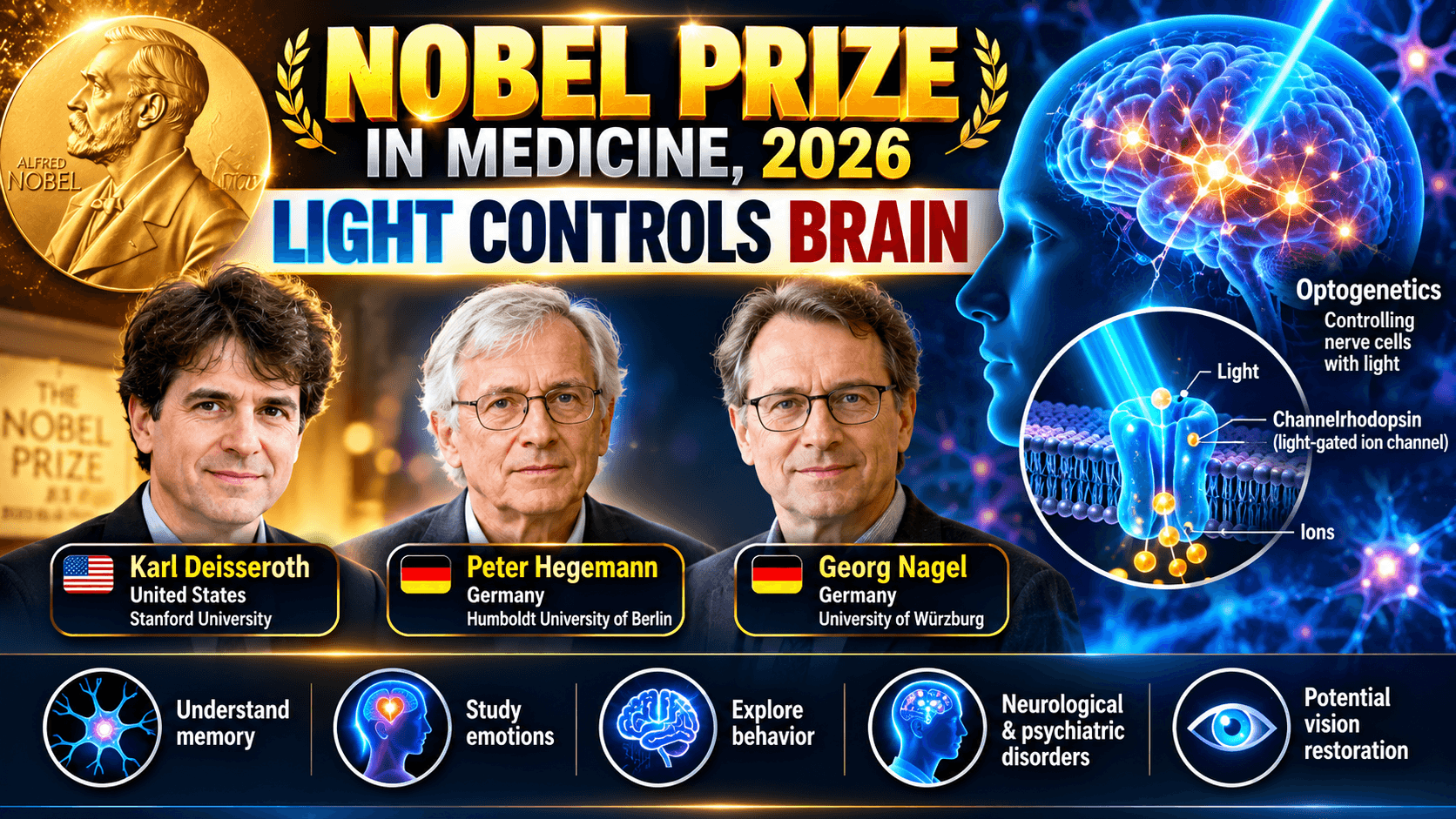
The 2026 Nobel Prize in Physiology or Medicine has been awarded jointly to Karl Deisseroth, Peter Hegemann, and Georg Nagel for their groundbreaking discoveries concerning light-gated ion channels and optogenetics.
Karl Deisseroth (United States) is an American neuroscientist and psychiatrist based at Stanford University.
Peter Hegemann (Germany) is a German biophysicist based at the Humboldt University of Berlin.
Georg Nagel (Germany) is a German biophysicist based at the University of Würzburg.
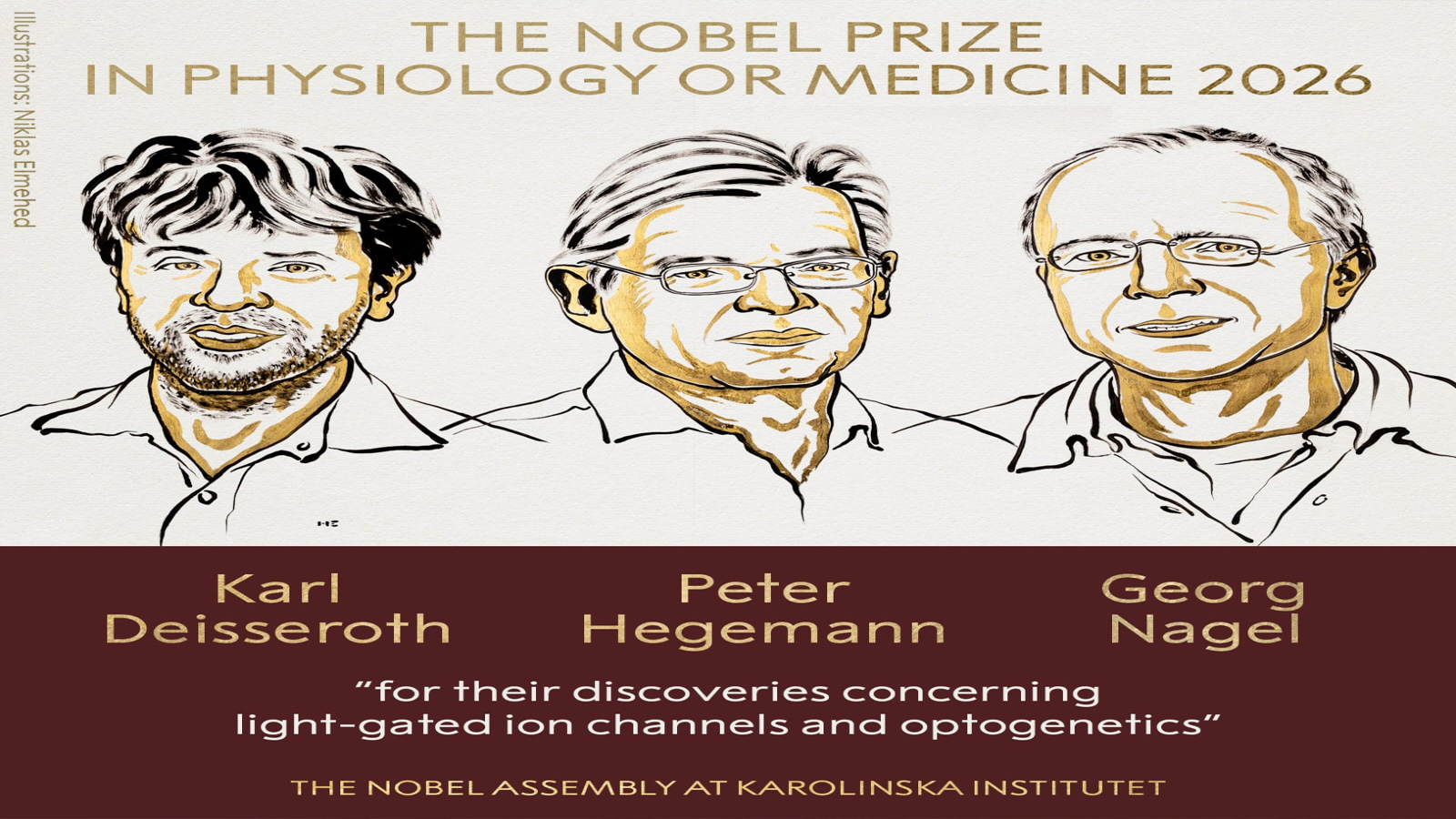
Their research has transformed neuroscience by giving scientists a powerful way to control specific nerve cells using light. It has helped researchers understand how the brain influences memory, emotions, and behavior and opened new possibilities for studying neurological and psychiatric disorders.
What is optogenetics?
It is a technique that combines genetics and light to control the activity of specific cells, particularly nerve cells.
In simple terms, scientists can make selected neurons sensitive to light and then use light to switch their activity on or off. This allows researchers to study individual brain circuits with much greater precision than many older techniques.
What Did the Three Scientists Discover?
The work developed through contributions from all three laureates.
- Peter Hegemann studied how a single-celled alga called Chlamydomonas responds to light.
- Georg Nagel worked with Hegemann to identify channelrhodopsin, a light-sensitive protein found in the alga.
- When exposed to blue light, channelrhodopsin opens an ion channel and allows charged particles to flow across the cell membrane, producing an electrical signal.
- Karl Deisseroth later introduced the gene for channelrhodopsin into nerve cells, making it possible to control neuronal activity with light.
- His research demonstrated that this light-controlled mechanism could be used in living brains, helping establish optogenetics as a major neuroscience research tool.
How Does Optogenetics Work?
The process can be understood in three simple steps:
- Introduce a light-sensitive gene into selected nerve cells.
- The cells produce a light-sensitive protein such as channelrhodopsin.
- When light is delivered to these cells, the protein acts like a molecular switch, changing the activity of the neurons.
This gives scientists precise control over specific groups of nerve cells.
Why is the Discovery Important?
Before optogenetics, scientists could observe brain activity but often struggled to establish exactly which neurons caused a particular behavior or response.
Optogenetics changed this by allowing researchers to manipulate specific neural circuits and observe the resulting effects.
It has helped scientists investigate:
- How memories are formed
- How emotions and behavior are controlled
- Brain circuits involved in neurological disorders
- Mechanisms behind psychiatric conditions
- The functioning of specific neural pathways
The Nobel Committee described optogenetics as a method that has opened a new era in neuroscience and improved understanding of how nerve cells shape memories, feelings, and behavior.
Medical Applications of Optogenetics
Although optogenetics remains primarily a research technology, its potential medical applications are significant.
1. Understanding Brain Disorders
Researchers are using optogenetics to study neural circuits associated with conditions such as epilepsy, depression, and other neurological and psychiatric disorders.
2. Restoring Vision
Scientists are also exploring optogenetic approaches for people with certain forms of severe visual impairment. The idea is to make surviving retinal cells responsive to light when normal photoreceptor cells have been damaged.
3. Targeted Neurological Therapies
The ability to control specific neural circuits could eventually contribute to more precise treatments for disorders involving abnormal brain activity. However, many such applications are still under research.
Nobel Prize 2026: Categories & Announcement Dates
| Nobel Prize Category | Announcement Date | Announcement Venue |
|---|---|---|
| Physiology or Medicine | October 5, 2026 | Nobel Assembly at Karolinska Institute |
| Physics | October 6, 2026 | Royal Swedish Academy of Sciences |
| Chemistry | October 7, 2026 | Royal Swedish Academy of Sciences |
| Literature | October 8, 2026 | Swedish Academy |
| Peace | October 9, 2026 | Norwegian Nobel Institute |
| Economic Sciences | October 12, 2026 | Royal Swedish Academy of Sciences |
Conclusion
The 2026 Nobel Prize in Physiology or Medicine highlights how a discovery rooted in the study of a tiny single-celled alga eventually transformed the study of the human brain.
By turning light-sensitive proteins into tools for controlling nerve cells, Deisseroth, Hegemann, and Nagel helped scientists move from simply observing brain activity to experimentally controlling specific neural circuits. Their work has fundamentally changed neuroscience and could contribute to new approaches for treating neurological and psychiatric disorders in the future.