Namami Gange Programme (NGP)
Why in News?
Recently the government says the real magic of the Namami Gange Programme lies in Jan Ganga which is its people’s movement. It has turned river conservation from a file in a government office into a mission in people’s hearts.
What are the key facts about the Namami Gange Programme (NGP)?
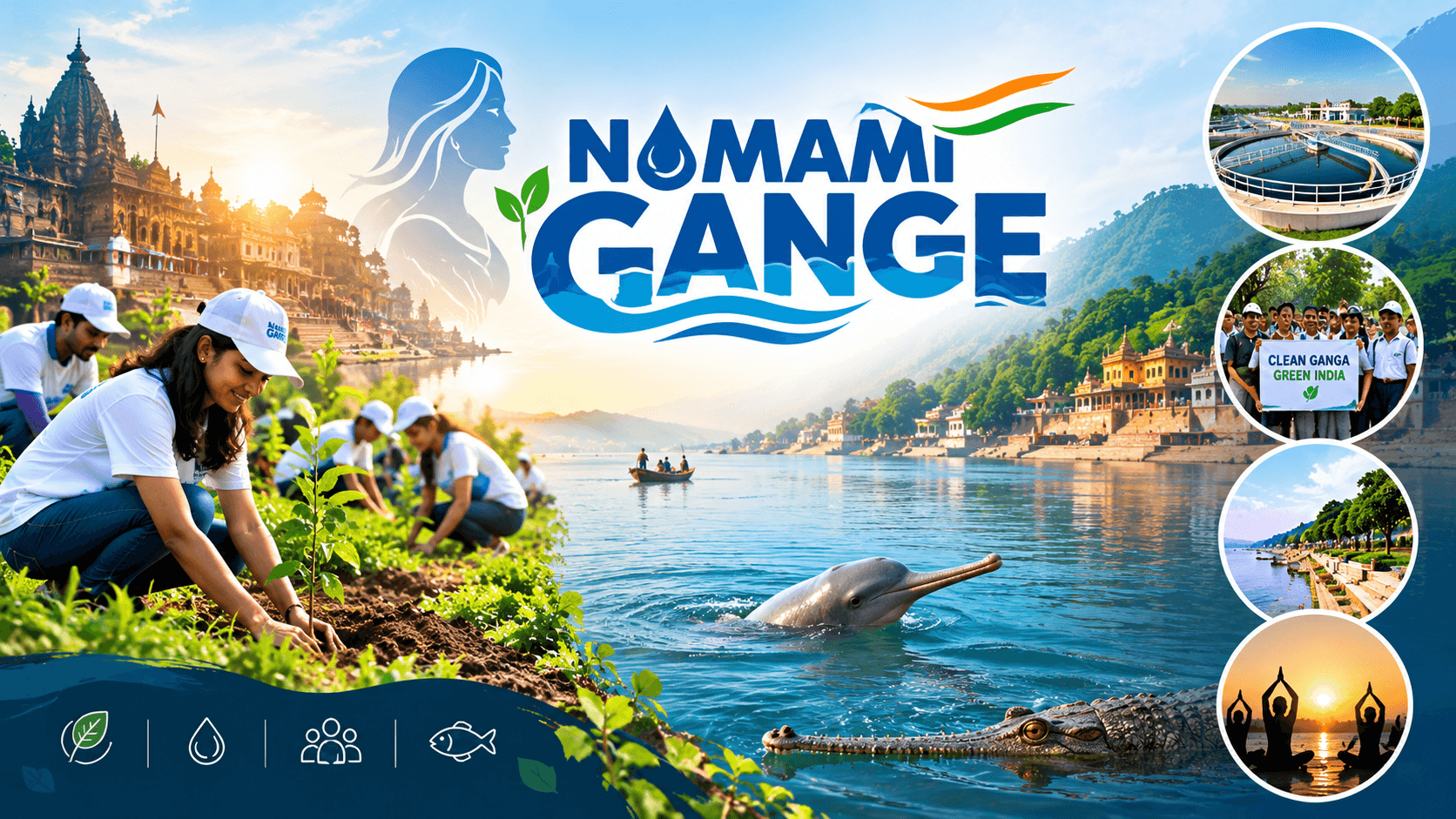
About: Launched in 2014, the Namami Gange Programme is India's flagship mission to clean, conserve, and rejuvenate the National River Ganga and its tributaries. It is not just as a river but as a lifeline.
Integrated Approach: It goes far beyond just cleaning. The program is about healing the entire river ecosystem, restoring its ecology, protecting its biodiversity, managing it sustainably, and bringing back its overall health.
Implementation Framework: To make the change visible and lasting, the program works in three phases, such as entry-level activities for quick, visible impact, medium-term activities, and long-term activities for deep, comprehensive rejuvenation.
Community-Centric Approach: The government realized that a river cannot be saved by the government alone. So, NGP built its heart around Jan Ganga, based on Jan Bhagidari. This approach has beautifully transformed river conservation from a government scheme into a true people’s movement.
Major Focus Areas: The work is spread across many fronts, such as building sewage treatment infrastructure, developing clean riverfronts, massive afforestation drives, scientific monitoring of water quality, and strong public awareness campaigns.
Key Achievements Under the Namami Gange Programme
Project Implementation: The scale is huge. Out of 524 projects sanctioned under NGP for river rejuvenation and pollution control, 355 have already been completed and are showing results on the ground.
Biodiversity Conservation: The river is alive again. Focused scientific efforts have helped protect and revive its most precious inhabitants, such as the Gangetic Dolphin, Gharial, turtles, Hilsa fish, and otters, through dedicated rescue, rehabilitation, and conservation programs.
Ecosystem Restoration: To protect the river, its banks are being protected too. Forestry interventions have led to the afforestation of nearly 33,024 hectares across the Ganga basin, which has significantly improved the riverine ecology.
River Health Improvement: The efforts are reflected in the data. As per CPCB monitoring, the water quality of the Ganga has improved, with pH and Dissolved Oxygen (DO) levels now meeting the bathing criteria at all monitored locations.
When Cleaning a River Became a People's Movement
For centuries, the Ganga has not just been a river for India, but she has been our culture, our civilization, and our everyday life. She has fed us, given us livelihoods, and been a part of our prayers and stories.
But with time, growing cities, pollution, and unplanned urbanization put immense pressure on her. It became clear that just cleaning the water was not enough. We needed to heal our relationship with the river.
This realization gave birth to the Namami Gange Programme (NGP) in 2014.
Jan Ganga
The Heart of the Mission: Jan Ganga is People's Participation Inspired by the vision of Jan Bhagidari. Jan Ganga puts people at the center of conservation. Here, Namami Gange stops being just a government scheme and becomes a people's story, which is a journey from awareness to participation and finally, to ownership.
United by the River: Where Cleanliness Becomes a Celebration
A river's bank is not just soil and water. It is a meeting place. Jan Ganga uses this power to bring people together through cleanliness drives, plantation campaigns, and educational activities.
| 1. | Ganga Swachhta Pakhwada | Observed every year from 16th to 31st March, this fortnight-long drive is a festival of cleanliness. It spreads across the five main Ganga basin states, such as Uttarakhand, Uttar Pradesh, Bihar, Jharkhand, and West Bengal, along with Delhi and towns on the Ganga's tributaries. Thousands of students, volunteers, and community groups join hands. This spirit is kept alive through regular weekly cleanliness drives on the Yamuna in Delhi, making river cleaning a habit, not just an annual event. |
| 2. | Greening the Banks | When people start caring for the river, they also care for its banks. Planting trees has become a key part of Jan Ganga. Healthy vegetation stabilizes riverbanks and prevents soil erosion. The beautiful campaign 'Ek Ped Maa Ke Naam' has added emotion to this. People plant a tree as a tribute to their mothers, connecting personal love with responsibility for nature. Similarly, World Environment Day is celebrated with plantation drives that bring entire communities together. |
Investing in the Future: The Power of Youth A movement is truly successful when the next generation owns it. In schools and colleges, students explore river conservation through essays, paintings, posters, debates, and interactive sessions.
University Ganga Clubs take learning beyond classrooms with lectures, field visits, and volunteering.
Platforms like Eco-clubs and NCC units ensure that this engagement is continuous. This is how we are creating not just aware students but responsible citizens.
Festivals of the River: Culture Meets Conservation
Namami Gange has smartly woven river conservation into our yearly calendar. Ganga Utsav is the flagship event. It celebrates the Ganga being declared India's National River. It’s a vibrant mix of performances, exhibitions, art contests, and public dialogues. Other occasions like Swachhta Hi Seva and the International Day of Yoga on the Ganges River remind us of our deep cultural bond with rivers.
One of the most inspiring examples was the BSF's all-women river rafting expedition from the upper reaches of the Ganga to the sea. It was a powerful display of courage and environmental commitment, sparking conversations with students and locals all along the way.
The Real Heroes: Ganga Praharis and Ganga Seva Doots On the ground, the real change is being led by volunteers.
| Ganga Praharis: | Dedicated grassroots volunteers who work with locals to spread awareness, promote responsible practices, and protect aquatic biodiversity. |
| Ganga Seva Doots: | They take the message to schools, institutions, and neighborhoods, making river conservation a part of everyday life. |
They are the true example of Jan Bhagidari, showing how an informed community can become the lifelong guardian of its river.
Beyond Engineering: Creating a Culture of River Stewardship, which is the biggest lesson of Namami Gange. We can build treatment plants, we can use technology to monitor pollution, and science can help restore ecosystems. But a river cannot be saved by engineering alone. Its long-term future depends on love, respect, and a sense of ownership. Namami Gange is far more than an environmental mission. It is proof that when a government’s vision meets people’s participation, it can become the foundation of sustainable development. Because in the end, a cleaner Ganga is not just about a healthier river: it is about a healthier relationship between the river and its people.
Conclusion
The Namami Gange Programme proves that a river cannot be revived by technology alone, but it needs people’s emotion. What started in 2014 as a mission to clean the Ganga has today become much larger. With 355 projects completed, 33,024 hectares of green cover restored, aquatic species like dolphins and gharials returning, and water quality meeting bathing standards, the results are visible. But its biggest achievement is Jan Ganga. By turning conservation from a government duty into a people’s movement, it has created a culture of river stewardship. In the end, Namami Gange is not just about saving a river. It is about reconnecting India with its lifeline and ensuring that this lifeline flows clean and healthy for generations to come.
The Namami Gange Programme (NGP) falls under the Environment, Ecology, and Water Resources conservation sections of the BPSC syllabus.