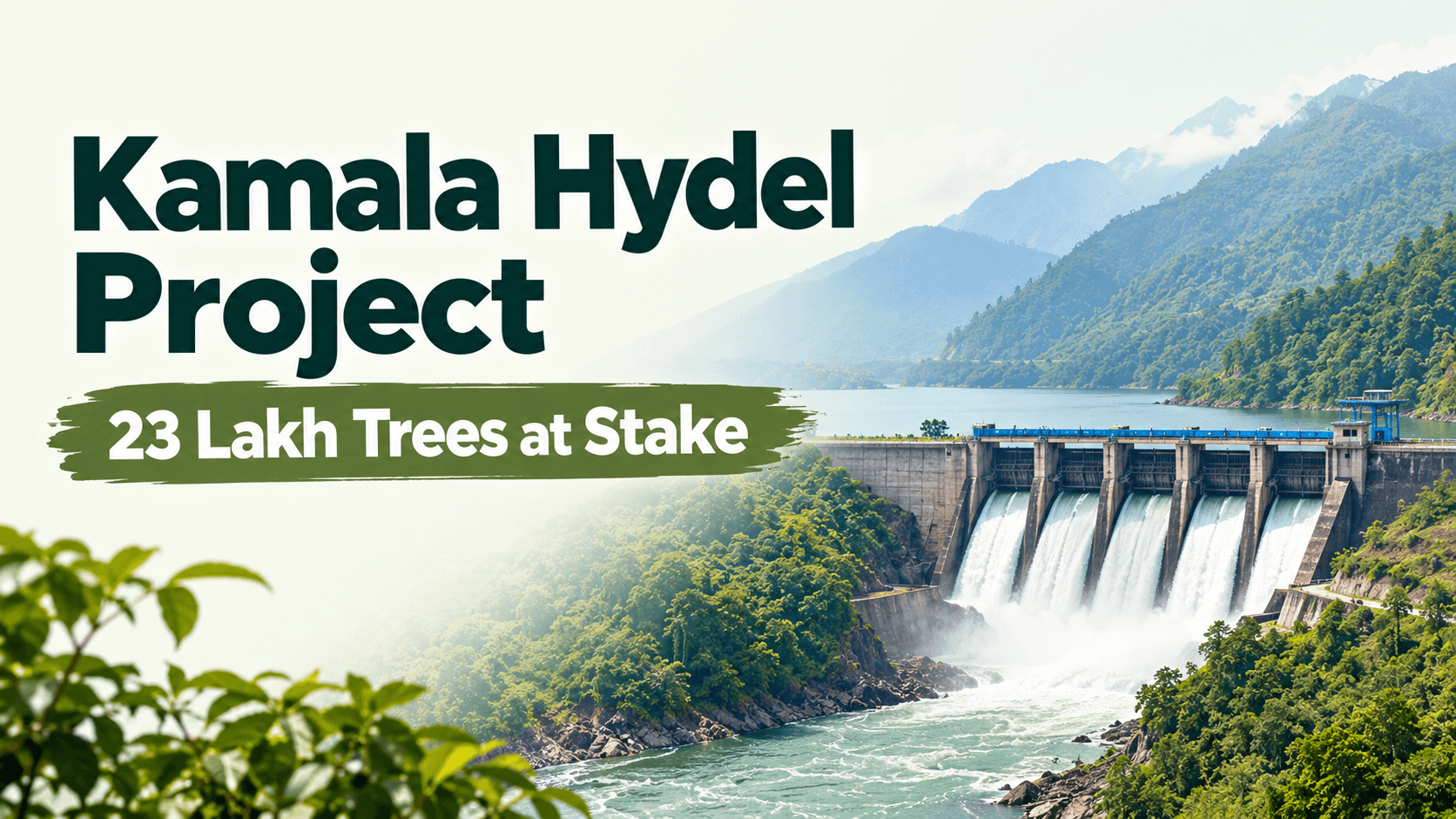
Kamala Hydel Project: 23 Lakh Trees at Stake
This topic is directly related to UPSC General Studies Papers 2 & 3 and BPSC General Studies Paper 2 (Section 2—Geography, Economy, and Environment).
Why in News?
Recently, NHPC sought permission from the Union Environment Ministry to divert 3,278 hectares of forest land in Arunachal Pradesh for non-forest purposes. The proposed Kamala Hydroelectric Project in Arunachal Pradesh has brought the debate over development and environmental protection back into focus. If approved, the proposal could involve the felling of approximately 23.4 lakh trees.
According to the proposal documents, the diversion could lead to the felling of 2,340,213 trees across various districts.
The project is expected to contribute to India's growing energy needs. However, its potential impact on Himalayan forests, biodiversity, wildlife habitats, and local communities has raised important environmental concerns.
Key Facts About the Kamala Hydroelectric Project
Project Capacity and Agency: The project has a proposed installed capacity of 1,720 MW and is being developed by the National Hydroelectric Power Corporation (NHPC).
| Location and River: | The project is located in Arunachal Pradesh and will harness the waters of the Kamala River, a right-bank tributary of the Subansiri River. |
| Affected Districts and Communities: | The project covers the districts of Kra Daadi, Kurung Kumey, and Kamle. Around 5,440 families across 126 villages may be affected. |
| Compensatory Afforestation: | Afforestation has been proposed over 7,018 hectares across several districts of Madhya Pradesh to compensate for the diversion of forest land. |
| Environmental Concerns: | The major concerns include forest loss, biodiversity degradation, disruption of wildlife movement, and the potential impact on local communities and their livelihoods. |
Environmental Impact of the Kamala Hydroelectric Project.
| Threat to Biodiversity: | The hilly, forested Kamala Valley hosts 155 plant species across 69 families. Large-scale landscape changes could lead to forest loss, habitat fragmentation, and impact on native flora and fauna. |
| Disruption of Wildlife Movement: | Though not in a national park or wildlife corridor, the project will submerge a large area, making it difficult for animals to cross the river. A wildlife mitigation and biodiversity conservation plan is needed. |
| Impact on Local Communities: | Around 5,440 families in 126 villages may be affected. It could impact land, livelihoods, and traditional life, requiring proper rehabilitation, fair compensation, and community consultation. |
| Changes to Forest and River Ecosystems: | Nearly 2,960.49 hectares of forest land will be involved. Reservoir creation may affect habitats, river flow, sediment movement, and aquatic ecosystems. |
What is Compensatory Afforestation?
It means planting trees to compensate for forest land diverted for non-forest use, as per legal requirements. For the Kamala project, compensatory afforestation has been proposed over 7,018 hectares in several districts of Madhya Pradesh. Usually, non-forest land is used for this purpose. If such land is not available, degraded forest land, often double the diverted area, is used for plantation. Since Arunachal Pradesh already has high forest cover, the plantation is proposed in another state.
However, new plantations cannot immediately replace an old natural forest. Natural forests support complex ecosystems, wildlife, carbon storage, and water regulation. So, success should not be judged only by the number of saplings planted but by their survival rate, ecological suitability, and long-term protection.
Forest Clearance vs Environmental Clearance: What's the Difference?
These two approvals serve different purposes and should not be confused.
Forest Clearance: Permission needed for diversion of forest land for non-forest purposes under forest conservation laws.
Environmental Clearance: Approval given after assessing a project's likely environmental impacts and its compliance with environmental norms.
In January 2026, the Environment Ministry's expert panel on river valleys and hydroelectric projects recommended the Kamala project for environmental clearance, but with the condition that final clearance will be given only after in-principle forest clearance. This shows that large infrastructure projects require multiple regulatory approvals.
Why Is the Subansiri River Basin Important for Hydropower?
The Kamala project is one of several hydropower projects planned in the Subansiri River basin. The Himalayan region has huge hydropower potential due to its steep terrain and river systems. Hydropower can help generate electricity and support India's shift towards cleaner, low-carbon energy.
However, multiple projects in the same river basin can have cumulative impacts, such as changes in river flow, habitat fragmentation, changes in sediment movement, and impact on aquatic ecosystems. Therefore, environmental assessment should look not just at individual projects but also at their combined impact on the entire river basin.
Development vs Environmental Protection: The Way Forward
1. Need for Balanced Development: India needs reliable electricity for economic growth and rising energy demand, and hydropower can support clean energy goals. However, large dams like Kamala also create ecological and social challenges, including forest loss, impact on wildlife, and displacement of communities. So, energy development should not come at an avoidable cost to fragile Himalayan ecosystems and local people.
2. Measures for a Sustainable Approach: A balanced approach requires scientific assessment to minimize forest diversion, effective biodiversity conservation plans, fair compensation and rehabilitation for affected families, monitoring of compensatory afforestation for survival and suitability, assessment of cumulative impacts of all projects in the Subansiri basin, and transparent decision-making by making environmental reports accessible to the public.
About NHPC Limited
NHPC Limited (formerly National Hydroelectric Power Corporation) is a Mini Ratna Category-I PSU under the Ministry of Power. It was incorporated in 1975 under the Companies Act, 1956 to develop hydroelectric power in India. It is headquartered in Faridabad, Haryana, with an authorized capital of Rs. 15,000 crore and is a premier organization for hydropower development.
Key functions and operations:
Planning, execution, operation, and maintenance of hydroelectric projects.
Exploring new sites for hydropower and developing small hydro projects.
Research and development in hydropower and planning of wind and tidal projects.
Selling electricity to state utilities and private discoms through long-term PPAs on wholesale basis.
Mandated to promote integrated and efficient development of power from conventional and non-conventional sources in India and abroad, with several projects under construction and development.
Conclusion
The Kamala Hydroelectric Project highlights India's key development challenge of expanding energy infrastructure while protecting ecologically sensitive regions. With 1,720 MW capacity, it can contribute significantly to electricity generation. But the potential felling of 23.4 lakh trees and impact on thousands of families requires careful scrutiny. Sustainable development means meeting present energy needs without harming ecosystems, livelihoods, and future generations, which will need transparent approvals, rigorous assessments, and effective safeguards.
Reference: