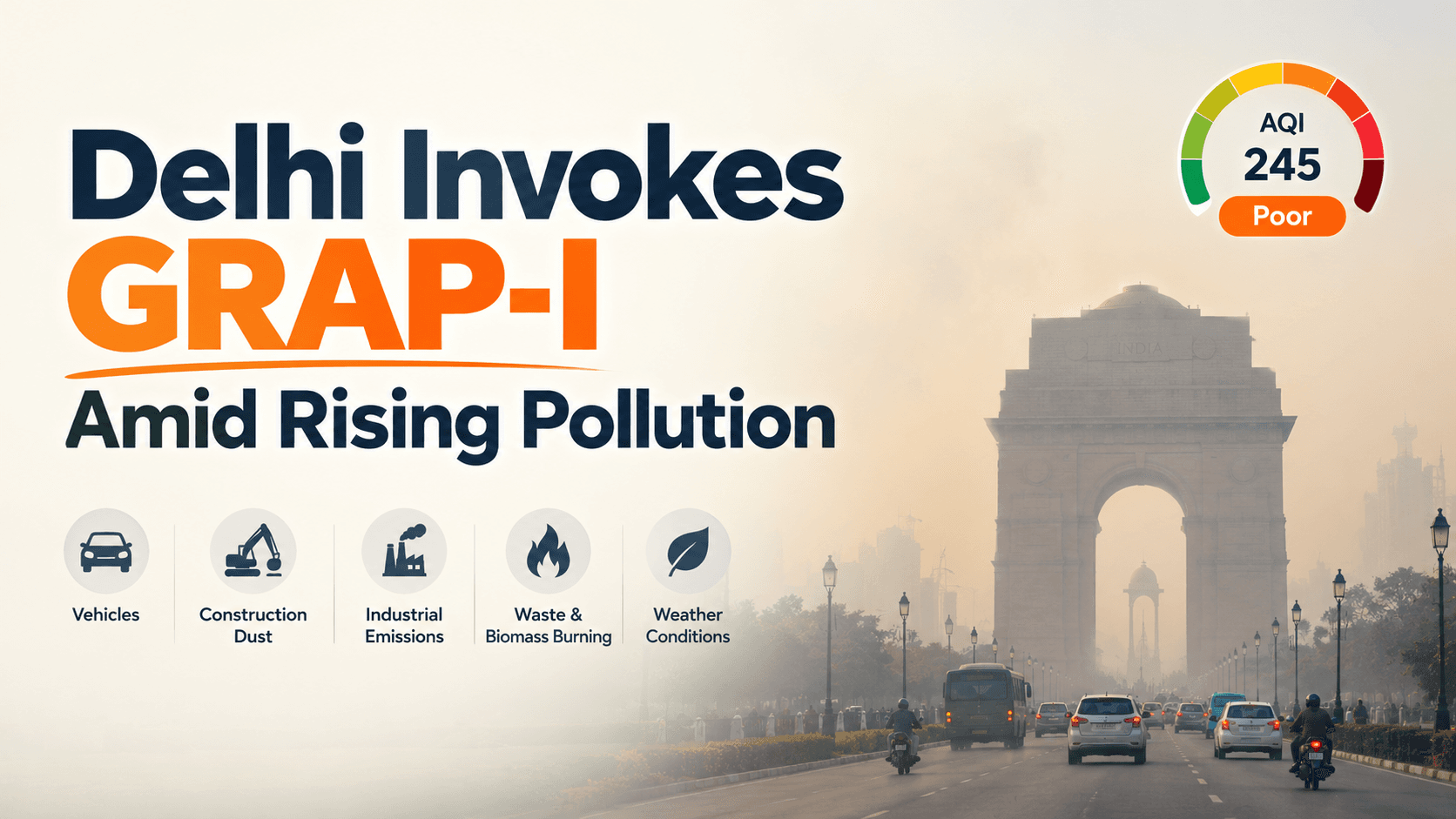
Delhi Invokes GRAP-I Amid Rising Pollution
Why in News?
Recently, the Commission for Air Quality Management (CAQM) invoked Stage-I of the Graded Response Action Plan (GRAP) across Delhi-NCR after Delhi’s Air Quality Index (AQI) entered the ‘Poor’ category.
Authorities took this step to prevent further deterioration in air quality, as forecasts indicated that pollution levels could remain in the ‘Poor’ category over the following days.
What Is GRAP?
GRAP stands for Graded Response Action Plan. It is a framework of pollution-control measures designed to address worsening air quality in Delhi-NCR. The Graded Response Action Plan (GRAP) was prepared for implementation under different Air Quality Index (AQI) categories pursuant to the Hon’ble Supreme Court’s Order dated December 02, 2016.
Following Supreme Court directions in December 2016, the Ministry of Environment, Forest and Climate Change notified the Graded Response Action Plan (GRAP) on January 12, 2017, assigning its implementation to the Environment Pollution (Prevention and Control) Authority (EPCA).
Under this plan, restrictions become progressively stricter as pollution levels increase. The objective is to control pollution at an early stage and reduce its harmful effects on public health.
Four Stages of GRAP: AQI Categories
| GRAP Stage | AQI Range | Air Quality |
| Stage I | 201–300 | Poor |
| Stage II | 301–400 | Very Poor |
| Stage III | 401–450 | Severe |
| Stage IV | Above 450 | Severe Plus |
These stages help authorities determine the level of intervention required according to the severity of air pollution. The Commission for Air Quality Management (CAQM) oversees the implementation of GRAP across Delhi-NCR.
The Indian Air Quality Index (AQI) tracks 6 gases out of a total of 8 pollutants (the remaining 2 are particulate matter and heavy metal).
The 6 gases included in the AQI calculation are nitrogen dioxide, sulfur dioxide, carbon monoxide, ground-level ozone, and ammonia. Common gases like carbon dioxide and methane are not included in the AQI calculation.
About Commission for Air Quality Management (CAQM)
It is a statutory body set up under the Commission for Air Quality Management in the National Capital Region (NCR) and Adjoining Areas Act, Mandate: Its main job is to ensure better coordination, research, identification, and resolution of problems related to the air quality index and all matters connected to it.
Function: It takes necessary actions for the prevention and control of air pollution in Delhi-NCR and adjoining areas.
Coordination: It has to coordinate its air quality monitoring efforts with the Delhi government and the governments of adjoining states, including Punjab, Haryana, Rajasthan, and Uttar Pradesh.
Major Measures Under GRAP Stage-I
| Dust and Construction Pollution Control | Authorities have been directed to strengthen dust-control measures at construction sites and on roads. These include mechanized road sweeping, water sprinkling, covering construction materials, and proper disposal of construction waste. |
| Restrictions on Polluting Vehicles | Authorities will strictly enforce Pollution Under Control (PUC) requirements and applicable restrictions on older, polluting vehicles. Under the prescribed rules, certain interstate buses entering Delhi-NCR must meet specified cleaner fuel or emission standards. |
| Ban on Coal and Firewood in Eateries | The prescribed restrictions prohibit the use of coal and firewood in tandoors at hotels, restaurants, and open eateries, requiring the use of electricity, gas, or other permitted clean fuels. |
| Control of Industrial Emissions | Industries, brick kilns, hot-mix plants, and thermal power plants must comply with applicable emission standards and fuel regulations. |
| Better Public Transport | Authorities have been instructed to strengthen public transport services, including CNG and electric buses and Metro and Regional Rapid Transit System (RRTS) services. The aim is to reduce traffic congestion and vehicular emissions. |
| Control of Waste Burning | Open burning of biomass and municipal solid waste is prohibited under the applicable rules. Authorities have also been directed to monitor landfill and dumping sites to prevent fires. |
Why Is Delhi's Air Quality Deteriorating?
Several factors contribute to air pollution in Delhi-NCR:
- Vehicular emissions: Cars, buses, and trucks release pollutants into the atmosphere.
- Construction and road dust: Dust from construction sites and roads increases particulate pollution.
- Industrial emissions: Industrial units and power plants can release harmful pollutants.
- Waste and solid-fuel burning: Burning waste, coal, and firewood adds to air pollution.
- Weather conditions: Low wind speeds and certain atmospheric conditions can trap pollutants near the ground.
- Firecrackers: Firecracker emissions can contribute to short-term increases in particulate pollution.
The contribution of each source varies according to location, weather, and time of year.
What Are PM2.5 and PM10?
PM2.5 refers to fine particulate matter with a diameter of 2.5 micrometers or less. These particles can penetrate deep into the lungs and may enter the bloodstream.
PM10 refers to particulate matter with a diameter of 10 micrometers or less. These particles can enter the respiratory tract and affect human health.
Both are important indicators for assessing air pollution and its potential health impacts.
What Is the Air Quality Index (AQI)?
The Air Quality Index (AQI) is a numerical indicator that communicates the quality of air and its potential health effects. India classifies AQI into six categories:
| AQI Range | Category |
| 0–50 | Good |
| 51–100 | Satisfactory |
| 101–200 | Moderately Polluted |
| 201–300 | Poor |
| 301–400 | Very Poor |
| 401–500 | Severe |
A higher AQI generally indicates greater pollution and a higher risk of adverse health effects.
Why Is GRAP Important for Environmental Governance?
GRAP is an example of a coordinated response to an environmental challenge. It links air pollution levels with specific administrative actions and brings multiple agencies together to control emissions.
However, emergency restrictions alone cannot solve the problem permanently. Long-term solutions require cleaner public transport, better urban planning, strict industrial emission control, effective waste management, and sustained dust suppression.
Conclusion
The implementation of GRAP Stage-I highlights the continuing challenge of air pollution in Delhi-NCR. While emergency measures can help prevent further deterioration, lasting improvement requires effective enforcement, cleaner transport, better waste management, and coordination among government agencies. For India, the objective should be to move beyond emergency responses and make clean air a consistent priority in urban development.
Reference:
PYQ (UPSC 2016)
Which of the following atmospheric gases are normally considered in calculating the value of the Air Quality Index?
- Carbon dioxide
- Carbon monoxide
- Nitrogen dioxide
- Sulfur dioxide
- Methane
Select the correct answer using the code given below.
A) 2, and 3 only B) 2, 3, and 4 only C) 1, 4, and 5 only D) 1, 2, 3, 4, and 5