Montreal Protocol: The Journey Begins
Why in News?
On 16th September, World Ozone Day (International Day for the Preservation of the Ozone Layer) was observed. On this occasion, global attention was focused on the historic success story of the Montreal Protocol, which is considered one of the most successful environmental treaties in the world.
What is the Montreal Protocol?
The Road to the Montreal Protocol
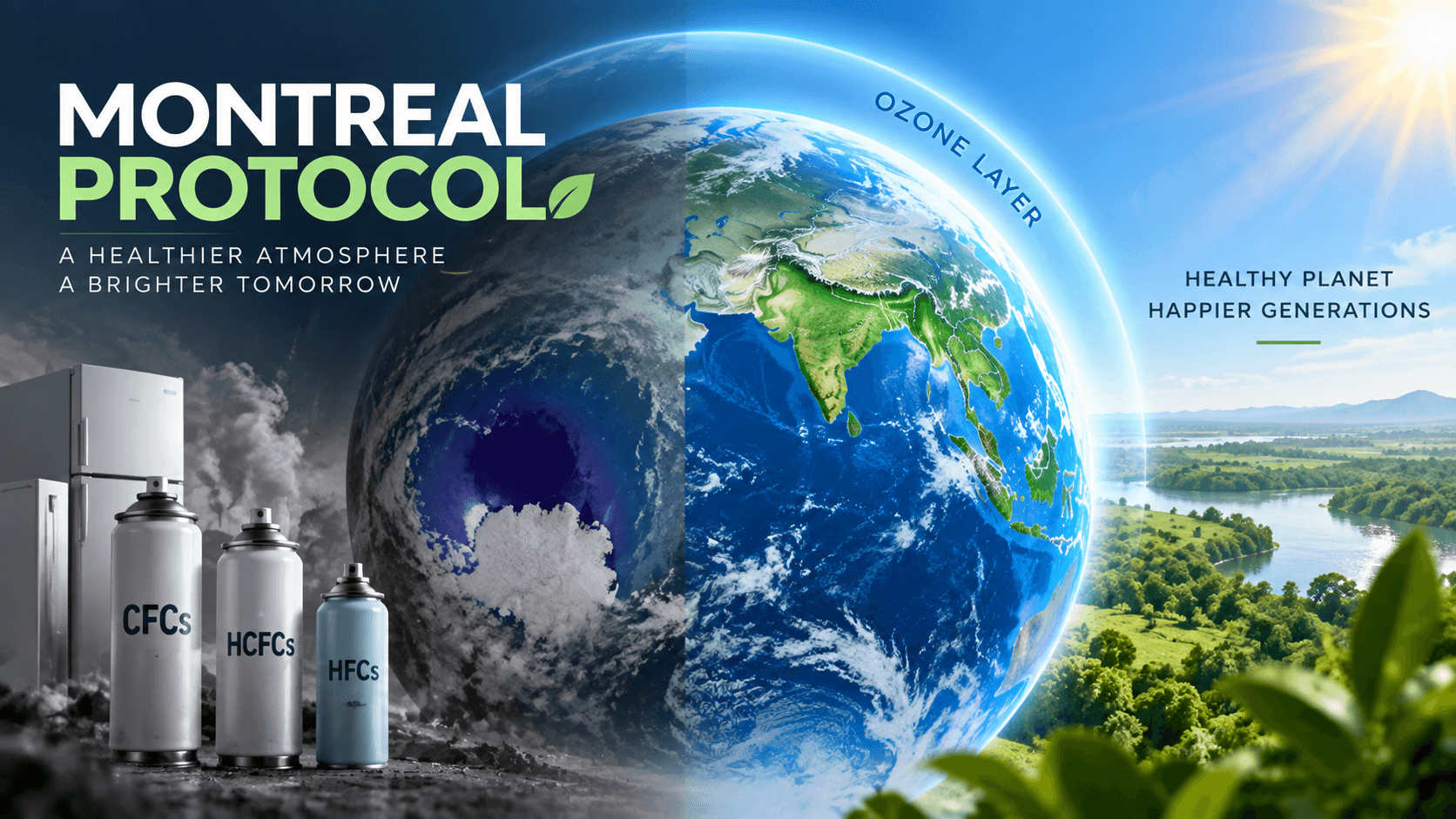
In the 1970s and 80s, scientists discovered that chemicals like CFCs used in refrigerators and aerosol sprays were reaching the stratosphere, which is 12 to 50 km above the earth. There, they were destroying ozone molecules and had created a massive ozone hole over Antarctica.
Vienna Convention (1985):
This was the first step taken after the discovery. It was not a strict treaty but a framework for countries to cooperate, do scientific research, and monitor the ozone layer. It laid the foundation for the Montreal Protocol. India became a party to it in 1991.
Montreal Protocol (1987):
This is a legally binding agreement to protect the ozone layer. Its main goal is to regulate the production and consumption of nearly 100 man-made chemicals called Ozone Depleting Substances (ODS), such as CFCs and HCFCs. India joined it in June 1992.
Regulatory Metric: Under this protocol, consumption is calculated as Production + Imports - Exports - Verified Destruction.
Phasing Out: The treaty fixes different timelines for developed and developing countries to completely stop using these harmful chemicals.
Why It Is a Success:
It is often called the world's most successful environmental treaty because it has phased out 99% of ODS in the world. India has also met its targets. It has completely phased out CFCs, CTC, and halons and phased out HCFC-141b from 1st January 2020. By 2025, India achieved a 67.5% reduction in HCFCs.
Universal Ratification:
On 16th September 2009, both the Vienna Convention and the Montreal Protocol created history by becoming the first treaties in UN history to be ratified by all 198 countries.
Kigali Amendment (2016):
After CFCs were banned, industries shifted to HFCs as an alternative. While HFCs do not damage the ozone layer, they are very potent greenhouse gases and cause severe global warming. To solve this, the Kigali Amendment was adopted in 2016 in Kigali, Rwanda. It expanded the Montreal Protocol from an ozone protection treaty to a climate protection treaty by deciding to phase down HFCs.
India's Commitment: India ratified it in 2021. It will freeze HFC consumption in 2028 and reduce it by 85% by 2047 in four stages: 10% by 2032, 20% by 2037, 30% by 2042, and 85% by 2047.
Climate Impact: If implemented successfully, it can avoid up to 0.3-0.5°C of global warming by the end of this century.
What is World Ozone Day?
Background:
In 1994, the United Nations General Assembly (UNGA) declared 16th September as the International Day for the Preservation of the Ozone Layer. This date was chosen because the landmark Montreal Protocol was signed on this day in 1987.
Objective:
The day reminds us how important the ozone layer is in protecting all life on Earth from the sun's harmful ultraviolet (UV) radiation. It also highlights the need to continue protecting the environment.
2026 Theme & Focus:
Theme: "Global action for a cooler planet: Celebrating 10 years of sustainable cooling under the Kigali Amendment to the Montreal Protocol." Focus: As global temperatures are rising, the demand for cooling is also increasing. This theme calls for energy-efficient and climate-friendly cooling solutions and marks 10 years of efforts to phase down powerful greenhouse gases under the Kigali Amendment. India's New Initiatives:
On this occasion, India launched two digital platforms to track its climate actions:
1. Net Zero Portal: This portal allows industries, organizations, and government bodies to voluntarily register and report their progress towards achieving net-zero emissions.
2. NAPCC Dashboard: This is a centralized platform that shows the progress and updates of all the National Missions under India's National Action Plan on Climate Change (NAPCC).
Conclusion:
The journey from the Vienna Convention to the Montreal Protocol and now the Kigali Amendment shows what global cooperation can achieve. It is the best example of how science, policy, and collective action can heal the planet. The ozone layer is now on the path to recovery by 2066. World Ozone Day is not just a celebration of this success but also a reminder for the future. As the world gets hotter, sustainable cooling is the next big challenge. With initiatives like the Net Zero Portal and the NAPCC Dashboard, India has shown its commitment to both protecting the ozone layer and fighting climate change. The message is clear: what we did for the ozone layer, we can do for the climate too if we act together.