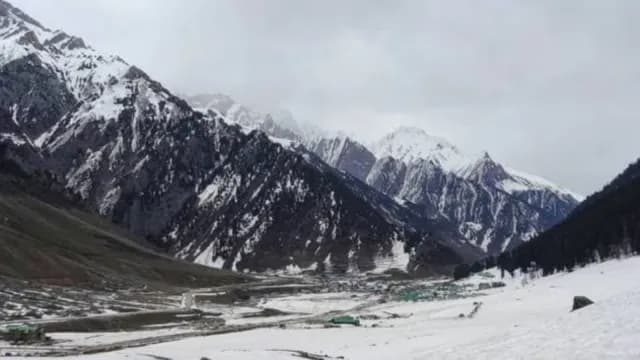
Melting Himalayan Glaciers: India’s Economy at Risk
Why in News?
Recent floods in Nepal have once again drawn attention to the growing threat of climate change in the Himalayas. However, the impact of melting glaciers goes far beyond floods and other visible disasters. It also creates a slow economic crisis by making water supplies less reliable and disrupting the rivers that support agriculture, industries, cities, and hydropower projects.
A new report titled A Resilient Himalaya: Protecting a Region at Risk and Securing Future Prosperity estimates that around 21.5% of India’s GDP depends on the Himalayan region. The report was prepared by global consultancy Systemiq in partnership with the Integrated Mountain Initiative, with support from ICIMOD, Nepal, and the GB Pant National Institute of Himalayan Environment.
The International Centre for Integrated Mountain Development (ICIMOD) is a regional intergovernmental learning and knowledge sharing centre founded in 1983, serving the eight regional member countries of the Hindu Kush Himalaya region, such as Afghanistan, Bangladesh, Bhutan, China, India, Myanmar, Nepal, and Pakistan.
The report highlights an important concern: protecting the Himalayas is not just an environmental priority; it is also essential for India's long-term economic security.
How Much of India's Economy Depends on the Himalayas?
According to the report, approximately ₹64.8 lakh crore, equivalent to 21.5% of India's GDP in FY 2023–24, is linked to the Himalayan region.
However, this figure needs to be understood correctly. It does not mean that glacier melting will directly destroy 21.5% of India's GDP. Rather, it represents the economic activities that depend on Himalayan resources, particularly water. This shows how deeply the Himalayan ecosystem relates to India's economy, including regions located far away from the mountains.
Why Are Himalayan Glaciers So Important?
- Glaciers act as natural water reservoirs. They store water in the form of ice and gradually release it into rivers, especially during dry periods when rainfall is limited.
- The Himalayas are the source of three major river systems: the Indus River System, the Ganga River System, and the Brahmaputra River System.
- These rivers support millions of people and sustain agricultural production, industrial activities, urban settlements, and hydropower generation.
- For instance, Himalayan water supports wheat and rice cultivation across the Indo-Gangetic Plains, tea production in Assam and West Bengal, and hydropower projects in the Northeast.
- Therefore, any major change in the Himalayan water cycle can have consequences for food production, energy security, and economic activities across several Indian states.
What Is 'Peak Water' and Why Does It Matter?
One of the most important concerns highlighted in the report is the possibility of Himalayan river basins reaching Peak Water around the middle of this century.
"Peak water" refers to the stage when melting glaciers release the maximum amount of water into rivers. After this point, glacier water contributions gradually decline because the ice reserves become smaller.
In simple terms, glaciers may initially release more water as temperatures rise and melting accelerates. But this increase cannot continue forever. Once the ice reserves shrink significantly, the amount of meltwater available to rivers begins to fall.
According to the report, the Hindu Kush Himalaya region could lose up to 80% of its present glacier volume by 2100 under current trajectories.
Such a decline could increase pressure on water availability, particularly during dry seasons, affecting agriculture, drinking water supplies, and other economic activities.
Himalayas: A Major Disaster Hotspot in India
The Himalayan region is already highly vulnerable to natural disasters.
The report highlights that the Himalayas account for approximately 18% of India's geographical area but around 35% of its disasters.
Floods, landslides, and other extreme events can damage infrastructure, disrupt transport networks, displace communities, and affect agricultural production.
The economic consequences can extend far beyond the affected areas. Disasters may interrupt supply chains, increase food and water insecurity, and place additional pressure on government finances.
Repeated reconstruction costs can also reduce the funds available for long-term disaster preparedness and climate resilience.
Thus, protecting the Himalayan ecosystem is closely connected with India's economic stability and development planning.
Black Carbon: A Major Contributor to Glacier Melting
Apart from global warming, the report draws attention to another important contributor to Himalayan glacier loss: black carbon.
Black carbon is a form of air pollution produced by the incomplete combustion of fuels. It is commonly released by brick kilns, vehicles, traditional cookstoves, and the burning of agricultural residues.
When black carbon particles settle on snow and ice, they darken the surface. As a result, the snow absorbs more sunlight and reflects less heat. This process accelerates melting.
According to the report, recent modelling attributes approximately one-third of Himalayan glacier mass loss to South Asian black carbon.
The report also identifies industry, particularly brick kilns, as a significant source. Brick kilns contribute around 32–42% of South Asian anthropogenic black carbon deposition across the region, according to the estimates cited in the report.
This makes black carbon reduction an important opportunity because it can help address both air pollution and glacier melting.
How Can Modernizing Brick Kilns Help?
A brick kiln is a thermally insulated furnace or oven used to bake, harden, and dry clay bricks. The report proposes a targeted financial mechanism to modernize India's brickmaking sector. Its recommendations include:
- Upgrading brick kilns that can be made more efficient.
- Replacing highly polluting and outdated kilns.
- Supporting cleaner brick production technologies.
- Reducing dependence on fired bricks by encouraging alternatives where suitable.
One promising technology is the zigzag kiln, which improves the movement of air and fuel during brick firing. This allows fuel to burn more efficiently and reduces harmful emissions.
According to experts, converting traditional kilns to zigzag technology can reduce black carbon and particulate emissions by roughly 70% while cutting fuel consumption by 20–30%.
However, adoption remains uneven across India. The expert cited in the article stated that Punjab and Haryana have completed the transition to zigzag kilns, while Uttar Pradesh, India's largest brick-producing state, has reached around 56% adoption. These figures highlight the need to accelerate the modernization of the brick industry.
Why Is a Wider Strategy Needed?
Although modernizing brick kilns can deliver measurable benefits, experts caution that brick kilns are not the only source of black carbon.
Other major sources, including traditional cookstoves, transport emissions, and crop-residue burning, also need attention.
Therefore, reducing black carbon requires a coordinated approach across the entire air basin, commonly referred to as an airshed-based approach.
Instead of focusing only on individual cities or industrial units, this approach considers how air pollution moves across geographical regions and state boundaries.
Coordinated action can help reduce pollution at its source and deliver wider environmental and public health benefits.
Conclusion: Protecting the Himalayas Is Protecting India's Economy
The Himalayan region is much more than a geographical boundary in northern India. It is a vital natural system that supports the country's rivers, agriculture, energy production, and economic activities. The estimated 21.5% GDP dependence highlighted in the report underlines the economic importance of protecting this fragile ecosystem.
While global climate action remains essential, India can also take meaningful steps at the domestic level. Modernizing brick kilns, reducing black carbon emissions, adopting cleaner technologies, and controlling pollution from other sources can contribute to this effort. The key lesson is clear: protecting the Himalayas is not only about conserving glaciers and biodiversity; it is also about securing India's water resources, livelihoods, and future economic prosperity.
Reference: