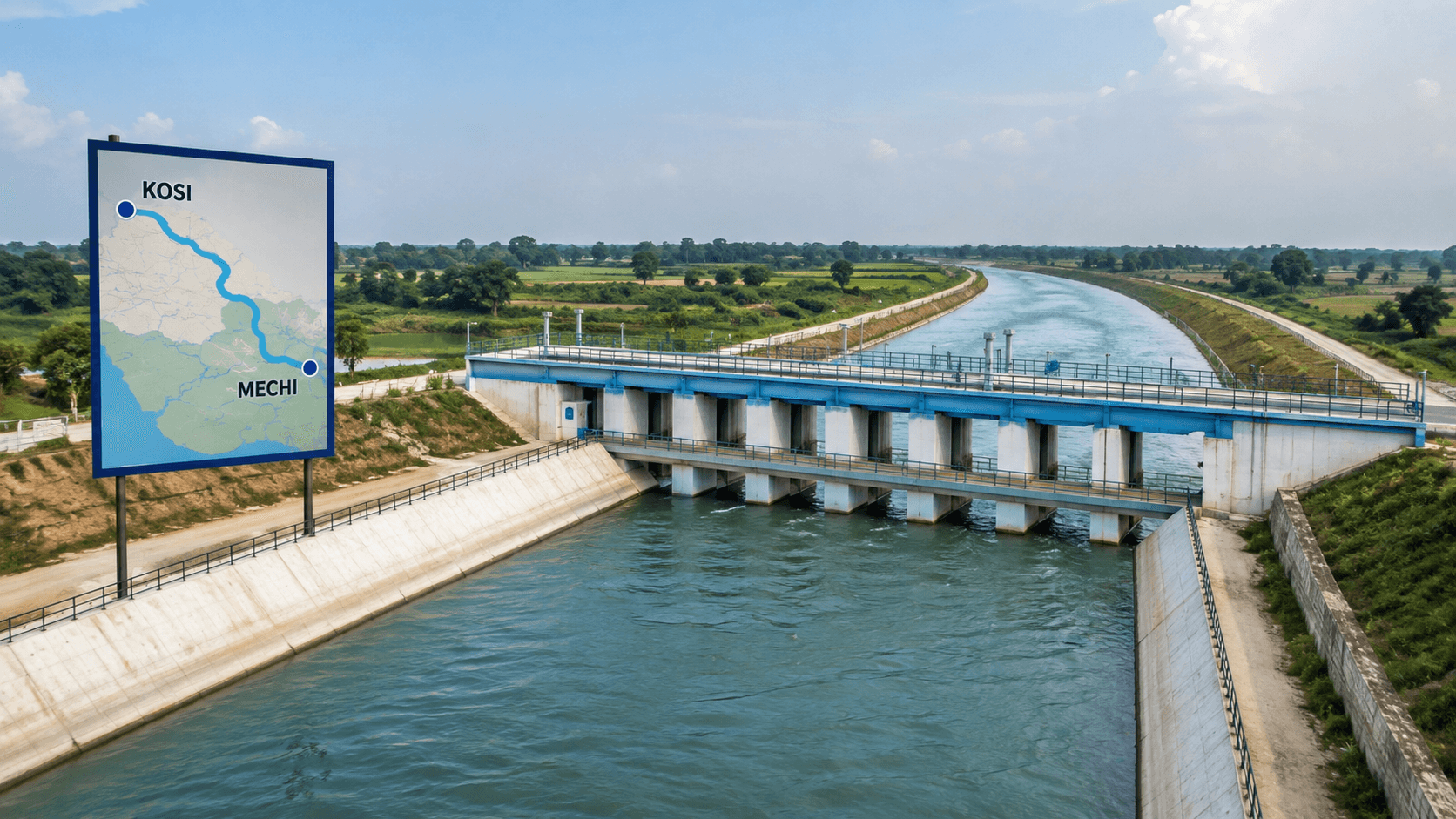
KOSI-MECHI INTRA-STATE LINK PROJECT
Recently, the Minister of State for Jal Shakti, Shri Raj Bhushan Chaudhary, said in a written reply to a question about the Kosi-Mechi Intra-State Link Project in the Rajya Sabha that the project has been included under the Pradhan Mantri Krishi Sinchayee Yojana and is scheduled for completion by March 2029.
It will be accelerated Irrigation Benefit Programme (PMKSY-AIBP) furtherance cost of works of Rs. 6,143.22 crore, with central assistance of Rs. 3,652.56 crore.
Central assistance of Rs. 206.77 Crore has been released to the State of Bihar under the Flood Management and Border Areas Programme during last three years.
Key Facts About the Kosi-Mechi River Linking Project
About the Project
Objective: Link the Kosi River with the Mechi River, a tributary of the Mahananda River.
Regions Covered: Parts of Bihar, India and Nepal.
Implementing Agency: National Water Development Agency (NWDA), under the Union Ministry of Jal Shakti.
Benefits / Aims
Irrigation: Provide annual irrigation to 4.74 lakh hectares total. Out of this, 2.99 lakh hectares are in Bihar . Specifically targets 2.15 lakh hectares of agricultural land in the Mahananda river basin during the Kharif season.
Water Supply: Provide 24 million cubic meters (MCM) of water for domestic and industrial use annually.
Additional Release: Expected to release an additional 5,247 cusecs of water from the Kosi barrage after completion.
Major Concerns
Limited Flood Control: The project is designed mainly for irrigation. It does not have a significant flood control component, which is critical for this flood-prone region.
Negligible Impact on Floods: The additional 5,247 cusecs release is very small compared to the Kosi barrage's total capacity of 9,00,000 cusecs. Locals argue this won't prevent annual flooding.
Local Impact: Flooding and land erosion continue to destroy homes, inundate crops, and affect livelihoods of people living between embankments.
Gap in Focus: The irrigation-centric design does not address the immediate and recurring flood-related challenges faced by the region.
Key Facts About Kosi River and Mechi River
Kosi River
Nickname: "Sorrow of Bihar" - due to frequent floods and course changes.
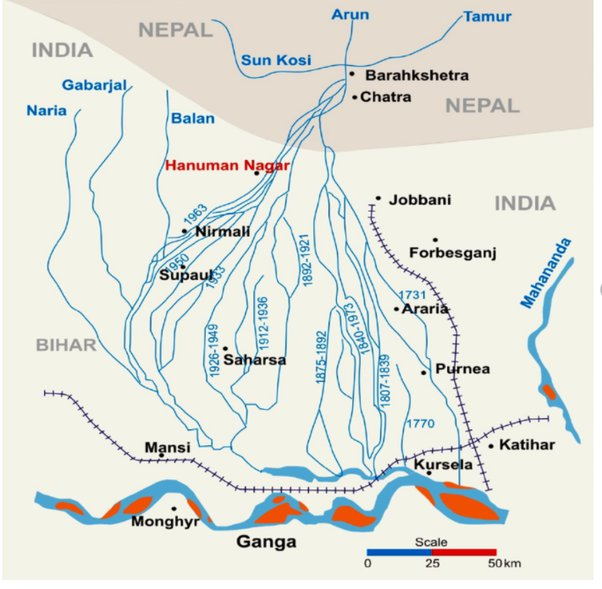
Origin & Course Origin: Rises at over 7,000 metres above sea level in the Himalayas, in the catchment area of Mount Everest and Kanchenjunga.
Countries: Flows through China, Nepal, and India.
Entry into India: Enters India near Hanuman Nagar.
Mouth: Merges with the Ganga River near Kursela in Katihar district, Bihar.
Formation Formed by the confluence of 3 main streams: Sun Kosi, Arun Kosi, and Tamur Kosi.
Key Characteristics
Course Shifting: Known for shifting westward. Has moved 112 km in the last 200 years.
Impact: Devastates agricultural lands in Darbhanga, Saharsa, and Purnea districts.
Major Tributaries:
Trijunga, Bhutahi Balan, Kamla Balan, and Bagmati - all join the Kosi in the plains.
Mechi River
Type: A trans-boundary river flowing through Nepal and India.
River System: A tributary of the Mahananda River.
Origin & Course Origin: Rises as a perennial river in the inner Himalayan valley, in the Mahabharat range of hills in Nepal.
Flow: Flows through the Indian state of Bihar.
Mouth: Joins the Mahananda River in Kishanganj district, Bihar.
The Government of India is engaged in regular dialogue with the Government of Nepal regarding construction of dams on the Kosi River for the mutual benefit of both countries, including flood control.
Further, no meeting of Indo-Nepal Joint Committee was held during 2025-26. No proposal for a permanent Kosi-Gandak basin authority is under consideration of the Government of India.
- The remodeling work of Eastern Kosi Main Canal from K.M. 0.00 to 41.30 has been taken up at an awarded contract value Rs. 2639.80 crore. Physical progress of 8.5% has been achieved so far.
- The remodeling work of Eastern Kosi Main Canal from K.M. 0.00 to 41.30 has been taken up at an awarded contract value Rs. 2639.80 crore. Physical progress of 8.5% has been achieved so far.
Background
A Joint Project Office (JPO-SKSKI) was constituted in 2003 with the mandate to prepare the Detailed Project Report (DPR) for the Sapta-Kosi Multipurpose Project and Sun-Kosi Kamla Diversion Multipurpose project. The status of preparation the DPRs of these projects is as under.
- Sapta Kosi Multipurpose Project: The work of topographical surveys, construction material survey, water quality survey, inland navigation studies, hydrological studies, seismological studies, drilling (1,258m), communication survey, glacial lake outburst flood (GLOF) studies have been completed.
- Sun-Kosi Kamla Diversion Multipurpose project: The work of topographical surveys, water quality survey, hydrological studies, seismological studies, drilling (1,549m), communication survey, glacial lake outburst flood (GLOF) studies have been completed for Sun-Kosi Kamla Diversion Multipurpose project.
It falls under General Studies Paper I (Bihar Geography), General Studies Paper II (Indian Economy and Polity), and the dynamic Bihar Current Affairs.
REFERENCE:
What is the Kosi-Mechi Intra-State Link Project?
It is a project to link the Kosi River with the Mechi River, a tributary of the Mahananda River, covering parts of Bihar and Nepal. It is implemented by the National Water Development Agency (NWDA) under the Union Ministry of Jal Shakti.
By when is the Kosi-Mechi project scheduled for completion?
The Minister of State for Jal Shakti, Raj Bhushan Chaudhary, told the Rajya Sabha that the project is scheduled for completion by March 2029 and has been included under the Pradhan Mantri Krishi Sinchayee Yojana.
What is the cost and central funding for the project?
The works are estimated to cost Rs 6,143.22 crore under PMKSY-AIBP, with central assistance of Rs 3,652.56 crore.
How much irrigation will the Kosi-Mechi project provide?
It aims to provide annual irrigation to 4.74 lakh hectares in total, including 2.99 lakh hectares in Bihar, and specifically targets 2.15 lakh hectares in the Mahananda basin during the Kharif season.
Why do critics say the project will not meaningfully reduce flooding?
The project is designed mainly for irrigation and lacks a significant flood control component. The additional 5,247 cusecs it will release from the Kosi barrage is negligible compared to the barrage's total capacity of 9,00,000 cusecs.
Why is the Kosi River called the 'Sorrow of Bihar'?
It earned this nickname due to frequent floods and course changes. It has shifted westward by 112 km over the last 200 years, devastating agricultural lands in Darbhanga, Saharsa and Purnea districts.
Where does the Kosi River originate and how is it formed?
It rises at over 7,000 metres above sea level in the Himalayas, in the catchment area of Mount Everest and Kanchenjunga, and is formed by the confluence of the Sun Kosi, Arun Kosi and Tamur Kosi.
Where does the Mechi River join the Mahananda?
The Mechi is a trans-boundary river flowing through Nepal and Bihar, and it joins the Mahananda River in Kishanganj district, Bihar.
What progress has been made on the Eastern Kosi Main Canal remodeling?
Remodeling work from K.M. 0.00 to 41.30 has been taken up at an awarded contract value of Rs 2,639.80 crore, with physical progress of 8.5% achieved so far.
Is the Kosi-Mechi Link Project relevant to the BPSC/UPSC syllabus?
Yes, since its category is Geography it maps mainly to General Studies Paper I. The article itself also notes relevance to GS Paper II (Indian economy and polity) and Bihar Current Affairs.