Indo-Pacific Regional Dialogue 2026
Why in News?
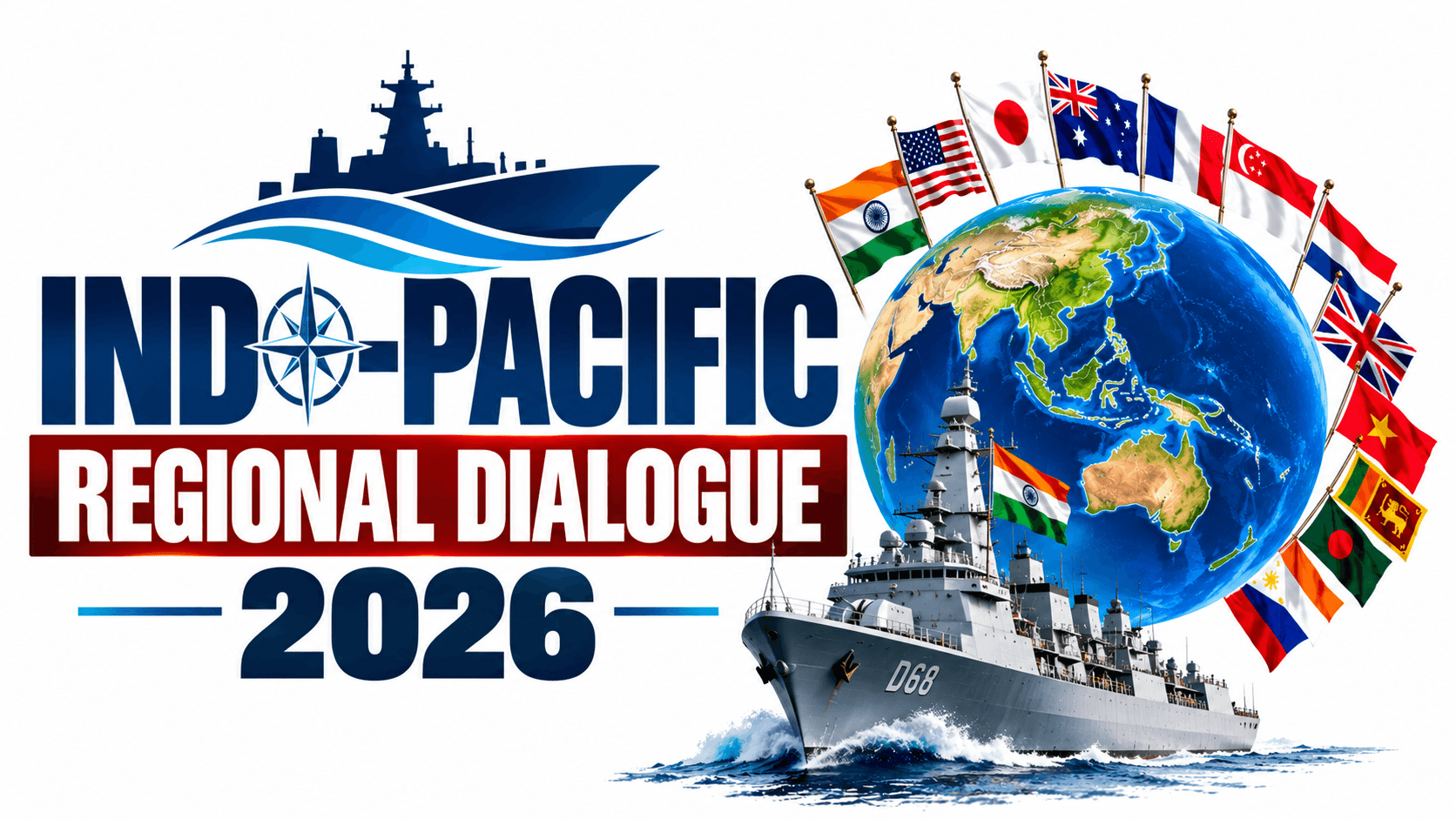
The Indian Navy will host the 2026 edition of the Indo-Pacific Regional Dialogue (IPRD) in New Delhi from November 3 to 5, 2026. The event will bring together maritime practitioners, scientists, academics, policymakers, and experts from 18 countries to discuss cooperation in science, technology, and research.
The Indo-Pacific Regional Dialogue is the Indian Navy’s principal strategic outreach initiative. It provides a platform for discussions on maritime security, regional cooperation, and emerging challenges in the Indo-Pacific region.
About Indo-Pacific Region
The Indo-Pacific is the vast region covering the Indian Ocean and the western and central Pacific Ocean, along with the seas and straits connecting them. It stretches from the east coast of Africa to the west coast of the Americas and from the Arctic to the Antarctic. The term has become prominent in recent years, especially in geopolitics and regional security. It is also rich in diversity, home to varied cultures and ecosystems like coral reefs, tropical rainforests, and arid deserts.
Significance of Indo-Pacific for India
1. Maritime Security & Strategic Autonomy: India's security depends on the Indo-Pacific, as most trade and energy flows through its Sea Lines of Communication (SLOCs). With growing Chinese assertiveness in the South China Sea and Indian Ocean, securing these waters is vital. India's SAGAR doctrine reflects this maritime-first approach. Over 95% of India's trade by volume passes through the Indian Ocean, and India has increased patrols near the Hormuz and Malacca straits.
2. Economic Growth & Trade Diversification: Indo-Pacific is key to India's growth through partnerships and supply chains. Under the China+1 strategy, India is using it to attract manufacturing and diversify trade. Joining IPEF in 2022 and FTAs with Australia and the UAE are part of this. Focus is on resilient supply chains and a green/digital economy.
3. Technology & Connectivity: India is promoting infrastructure and digital connectivity through its DPI model. It launched the Global Digital Public Infrastructure Repository (GDPIR) under the G20 presidency to share best practices. The India-Middle East-Europe Economic Corridor (IMEEEC), launched in Sept 2023, also links India to Europe via the Indo-Pacific.
4. Climate & Blue Economy: The region faces cyclones, sea-level rise, and coral loss. India is leading climate resilience through IORA, CDRI(Coalition for Disaster Resilient Infrastructure), and blue economy initiatives. This boosts soft power and opens green finance opportunities.
5. Diplomatic Leadership: Indo-Pacific helps India project itself as a democratic leader of the Global South. With IORA chairmanship (2025-27), India shapes norms of inclusivity and sovereignty. Hosting the Voice of the Global South Summit in 2024 and pushing the New Delhi Leaders Declaration under the G20 shows this leadership.
Key Initiatives Taken by India in Indo-Pacific
| HACGAM 2022: | Hosted the 18th Heads of Asian Coast Guard Agencies Meeting in New Delhi on Oct 15, 2022—reaffirmed stand for open and rule-based maritime borders. |
| SAGAR Initiative: | Security and Growth for All in the Region. Mechanism to expand strategic partnerships with Indian Ocean littorals in Asia and Africa. |
| Indo-Pacific Regional Dialogue (IPRD): | Track 1.5 dialogue encouraging public policy discussions with balanced representation of govt and non-govt agencies. |
| Indo-Pacific Oceans Initiative (IPOI): | Launched in 2019 with 7 pillars—Maritime Security, Ecology, Resources, Capacity Building & Resource Sharing, Disaster Risk Reduction, Science-Tech & Academic Cooperation, and Trade, Connectivity & Maritime Transport. |
| QUAD: | Member of the Quadrilateral Security Dialogue with the US, Japan, and Australia for regional security, vaccines, critical tech, and economic cooperation. |
| Indo-Pacific Division in MEA: | A dedicated division was created in the Ministry of External Affairs to handle all Indo-Pacific matters and ensure policy coherence. |
Key Issues Hindering India's Engagement in Indo-Pacific
1. Resource Constraints: India's power projection is limited by naval capacity, budget, and logistics. It lacks overseas bases and long-range deployment ability compared to US and China.
2. No Unified Doctrine: India has no single institutionalized Indo-Pacific policy. SAGAR, Act East, and IPOI exist, but without a unified framework like the US Indo-Pacific Strategy (2022) or Japan's FOIP, messaging remains fragmented and leadership perception weak.
3. Balancing Dilemma: Quest for strategic autonomy limits full alignment with the Quad, IPEF, or AUKUS. Engaging China simultaneously in SCO/BRICS creates ambiguity. A cautious stance on AUKUS and the S-400 deal with Russia shows this balancing act.
4. Economic Hesitancy: Withdrawal from RCEP in 2019 and limited FTAs (only 13 active as of 2024) hurt economic integration. Data localization clauses and trade caution reduce credibility as a long-term partner, while ASEAN-China trade doubled from $235B in 2010 to $507B in 2019.
5. Weak Institutional Capacity: Influence in IORA, BIMSTEC, and IPOI suffers due to weak secretariats, low funding, and slow delivery. IORA's budget is just a few million, while the Indian Ocean Commission, with only 5 members, has a $1.3B budget for 2020-25.
6. Domestic & Regional Disruptions: Border tensions, economic issues, the Gaza conflict (2023-25), Red Sea Houthi disruptions, and diplomatic spats with Canada/Maldives in 2024 divert focus and naval resources.
7. Maritime Infrastructure Gaps: Ports, coastal logistics, and shipbuilding remain underdeveloped. India ranks 38th in the World Bank Logistics Index (2023). Sagar Mala is delayed, Chabahar is only partially operational, while China's Gwadar got $2.5B under CPEC.
Measures for India to Enhance Indo-Pacific Engagement
1. Formulate a Grand Strategy: Integrate SAGAR, Act East, IPOI, and IPEF into one National Indo-Pacific Strategy defining interests, red lines, and priorities across maritime, economic, and normative spheres. A single doctrine will improve internal coherence and project India as a net security provider.
2. Expand Naval Reach: Increase footprint through logistics-sharing pacts, forward facilities, and fleet modernization. Strengthen mission-based deployments, underwater domain awareness, and access to island territories. Fast-track deep-sea ports, MDA networks, and coastal radar chains to shift from coastal to Indo-Pacific power.
3. Strengthen Mini-laterals: Deepen role in Quad, IORA, IPOI, BIMSTEC, and trilaterals like India-France-Australia for maritime security, tech, and disaster response. Mini laterals are agile and help shape norms. Better coordination among groupings will reduce duplication.
4. Deliver Connectivity Projects: Scale up Chabahar, Kaladan, and IMEC with time-bound, quality-driven execution and local ownership. Expand Project Delivery Units. As infrastructure is the new currency of influence, delivery matters more than announcement.
5. Lead Blue Economy & Climate Agenda: Focus on sustainable fisheries, marine conservation, ocean energy, and island livelihoods. Link IORA and IPOI with CDRI and ISA. This combines maritime diplomacy with climate justice and sustainable growth.
6. Reinvent Trade Diplomacy: Take a forward-leaning approach—deepen FTAs with ASEAN, Australia, and the UAE, and engage actively in IPEF's trade, digital, and supply chain pillars. Build value chains in semiconductors, rare earths, green tech, and pharma as trusted alternatives to China, backed by customs reforms.
7. Operationalize IPOI: Move IPOI from vision to action with roadmaps, anchor countries, and project pipelines for each pillar. Create a secretariat, funding mechanism, and expert task forces to lead maritime governance.
8. Use Soft Power: Build long-term links through education, culture, digital ties, and diaspora. Create maritime research hubs, scholarships on the blue economy, cultural exchanges, and Indo-Pacific chairs at universities. Diasporas in SE Asia, Australia, and the Gulf can be a strategic asset.
Conclusion
The Indo-Pacific is not just an ocean space for India; it is the core of its security, economy, and global leadership. With over 95% of trade flowing through it, securing sea lanes, balancing China, and building partnerships via SAGAR, IPOI, Quad, and IPEF is vital for India's rise. The challenges, lack of unified doctrine, limited naval reach, trade hesitancy, and weak maritime infrastructure are real but addressable.
Reference: