India and Seychelles: Cooperation in Blue Economy
Why in News?
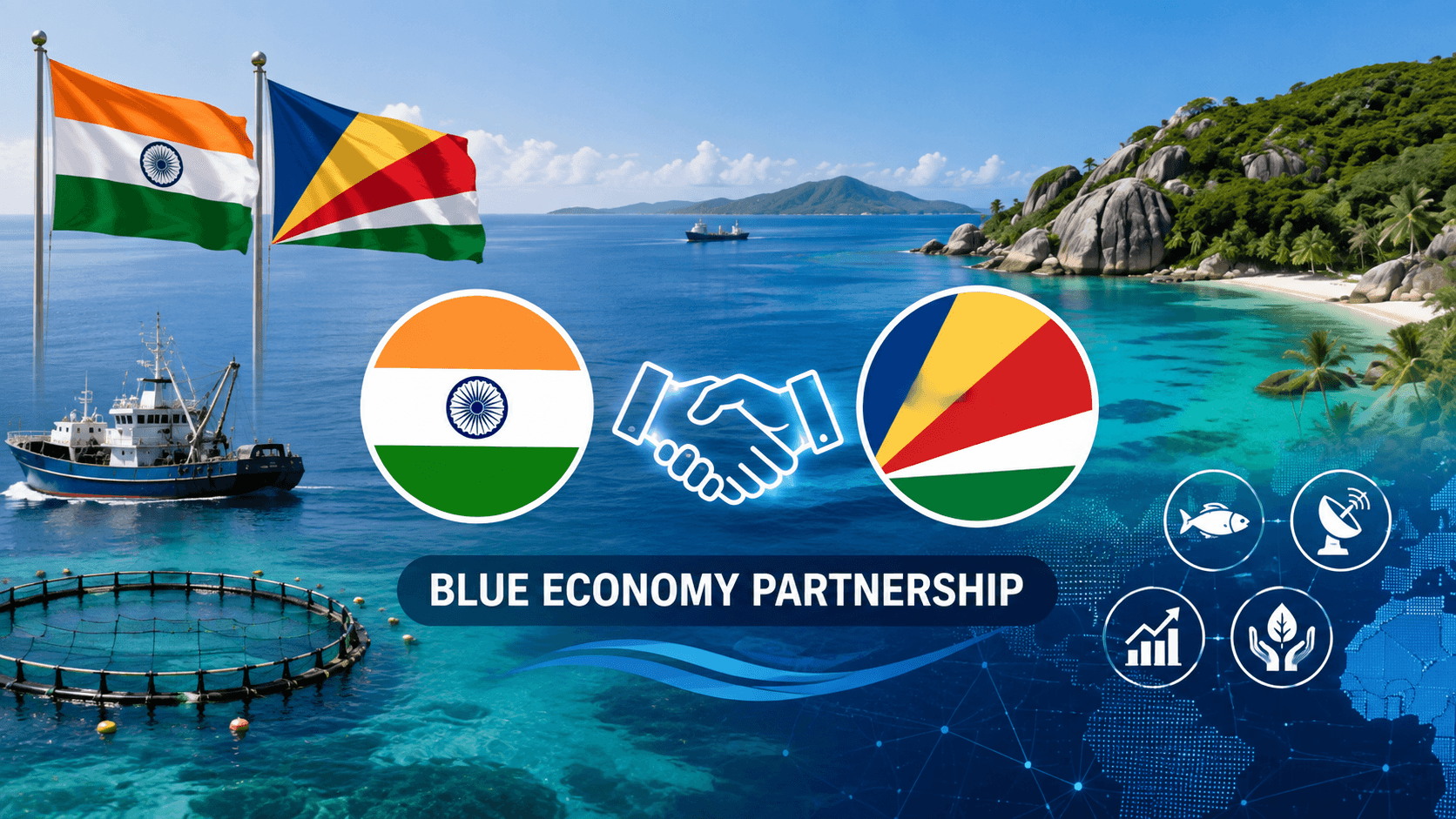
Recently, the Department of Fisheries, Ministry of Fisheries, Animal Husbandry, and Dairying hosted a high-level bilateral meeting with the Seychelles delegation in New Delhi. Focus was on fisheries and blue economy cooperation.
Key Highlights of the Meeting
Both countries recognized fisheries and the blue economy as critical pillars for economic growth, rural employment, and sustainable development. India shared its achievements—national fish production has reached a record 19.7 million tonnes, and seafood exports are worth USD 8.46 billion. India also highlighted its push for sustainable fisheries management, responsible harvesting, and technology-driven infrastructure.
The agenda covered wide technical areas—marine aquaculture (mariculture), modern hatchery establishment, tuna fisheries optimization, stock assessment, post-harvest engineering, and marine conservation. Special focus was on innovation and digital transformation—fisheries data systems, Monitoring, Control, and Surveillance (MCS) infrastructure, and use of AI in harvest management.
Both sides also discussed value chain development, especially tuna processing, product diversification, and sustainable fish waste management.
For long-term progress, both agreed on the need for a structured annual work plan, regulatory alignment, commercialization of joint research, reciprocal laboratory access, and joint pilot projects through knowledge transfer, extension services, and institutional training.
Seychelles expressed keen interest in signing a dedicated bilateral MoU in fisheries and aquaculture with an advanced work plan and institutionalized framework for continuous engagement between administrators, researchers, and technical experts.
India-Seychelles Relations Briefly
India and Seychelles share ties since 1976, when Seychelles got independence and INS Nilgiri took part in its Independence Day.
Defense is the strongest pillar. India has set up six Coastal Radar Systems to help Seychelles guard its huge EEZ and both conduct joint exercises, LAMITYE, every two years. Seychelles also joins India's MILAN naval exercise.
Trade is small, around USD 73 million in 2024-25, mostly in India's favor, with exports of rice, medicines, and vehicles. The main problem is no direct shipping line.
The real strength is people-to-people. Over 1% of Seychelles' population has studied under India's ITEC program, and almost 10% of its 1.2 lakh population is of Indian origin—5,000 PIOs and 7,000 NRIs—giving India huge soft power.
On climate change, both work together as founding members of the International Solar Alliance, which is crucial for an island nation facing sea-level rise. Seychelles may be small, but it is big for India's SAGAR vision, maritime security, and gateway to Africa.
Why is Seychelles strategically important for India?
| 1. | Strategic Location in the Indian Ocean | Seychelles sits right on key Sea Lanes of Communication (SLOCs) and close to major chokepoints like the Mozambique Channel, Bab-el-Mandeb, and Cape of Good Hope. These are lifelines for global oil and trade. Whoever has presence here controls maritime surveillance and trade security of the western Indian Ocean. For India, it is eyes and ears beyond the Arabian Sea. |
| 2 | Countering China's String of Pearls | China is expanding its footprint in the western Indian Ocean through ports and bases in Djibouti, Gwadar, and Hambantota. A strong partnership with Seychelles helps India counter the String of Pearls strategy and prevent a strategic vacuum in a region that is our extended neighborhood. |
| 3 | Strengthening Maritime Security | Seychelles is part of India's Coastal Surveillance Radar Network (CSRN). Its radar data is linked to the Information Fusion Centre - Indian Ocean Region (IFC-IOR) in Gurugram. This gives India real-time maritime domain awareness to jointly fight piracy, maritime terrorism, IUU fishing, and drug trafficking—all major threats near the Horn of Africa. |
| 4 | Advancing SAGAR and MAHASAGAR Vision | Seychelles is a key partner in implementing India's SAGAR—Security and Growth for All in Region and MAHASAGAR—Mutual and Holistic Advancement for Security and Growth Across Regions initiatives. It helps in capacity building, blue economy cooperation, and sustainable management of its huge 1.3 million sq km EEZ, which is 3 times India's land area. |
| 5 | Gateway to Africa | Seychelles is a member of the African Union (AU) and the Indian Ocean Commission (IOC). It acts as a strategic bridge for India's diplomatic, economic, and security engagement with East Africa. It also hosts a large Indian diaspora and is crucial for India's outreach to the Global South. |
What are the challenges?
| 1. | First is geopolitical competition. The Assumption Island naval project remains stalled due to sovereignty concerns raised by opposition in Seychelles, while China is increasing its economic and maritime presence in the western Indian Ocean. This creates a strategic contest. |
| 2. | Second, maritime security constraints. Seychelles has a huge EEZ of 1.4 million sq km but a very small navy and manpower to monitor it. So, it remains vulnerable to IUU fishing, piracy, and drug trafficking, despite India's radar and patrol support. |
| 3 | Third, limited economic engagement. Bilateral trade is just USD 73 million due to small market and poor shipping connectivity. Plus, delays in implementing Indian-funded projects affect India's credibility and give space to other powers. |
| 4 | Fourth, limited institutional capacity. Seychelles has a small administrative workforce, so large projects get slowed down. |
| 5. | Fifth, supply chain vulnerability. As an island nation, Seychelles depends heavily on external supplies. Any crisis in West Asia directly hits its food and construction material supply, putting extra pressure on India to provide emergency aid. |
What Measures Can Strengthen Ties?
| Enhance Maritime Domain Awareness: | Deepen real-time intelligence sharing through IFC-IOR to tackle IUU fishing, piracy, and drug trafficking more effectively. |
| Scientific Diplomacy: | Link India's Deep Ocean Mission and CSIR-NIO with Seychelles for sustainable bioprospecting. Joint research in marine genomics can help discover novel compounds from deep-sea organisms for pharma and biomaterials. This will transform blue economy from traditional fisheries to a high-value IP-driven biotech partnership under the Nagoya Protocol. |
| Climate Finance Innovation: | Instead of only grants, India can provide technical and geospatial expertise to audit and convert Seychelles' mangroves and seagrass into sovereign blue carbon credits. Linking this to India's carbon market and Article 6 of the Paris Agreement will help Seychelles earn independent non-debt capital. |
| Energy and Climate Mapping: | ISRO can provide dedicated telemetry to map Ocean Thermal Energy Conversion (OTEC) potential—generating power from the temperature difference between deep and shallow waters. Also, real-time mapping of coral bleaching and marine heatwaves will make India an indispensable tech partner for Seychelles' environmental survival. |
Conclusion
The India-Seychelles relationship is a textbook case of SAGAR and MAHASAGAR in action. For Seychelles, India is a first responder and net security provider; for India, Seychelles is eyes and ears in the western Indian Ocean, a guardian of crucial SLOCs, and a gateway to Africa. Challenges like Assumption Island delay, small trade, and China's presence are real, but India has advantages no one else has—trust, diaspora, ITEC alumni, radar network, and cultural goodwill since 1976. The future lies not in big infrastructure alone but in high-value blue economy—from tuna processing and AI-based fisheries management to marine biotech, blue carbon credits, and OTEC energy mapping. If India moves from a donor model to a co-creator model with joint research, real-time data sharing through IFC-IOR, and a dedicated MoU on fisheries, Seychelles can become the anchor of India's Indian Ocean strategy. In short, Seychelles may be a small island state with 1.2 lakh people, but its strategic value for India's maritime security, energy, and Africa outreach is disproportionately large.