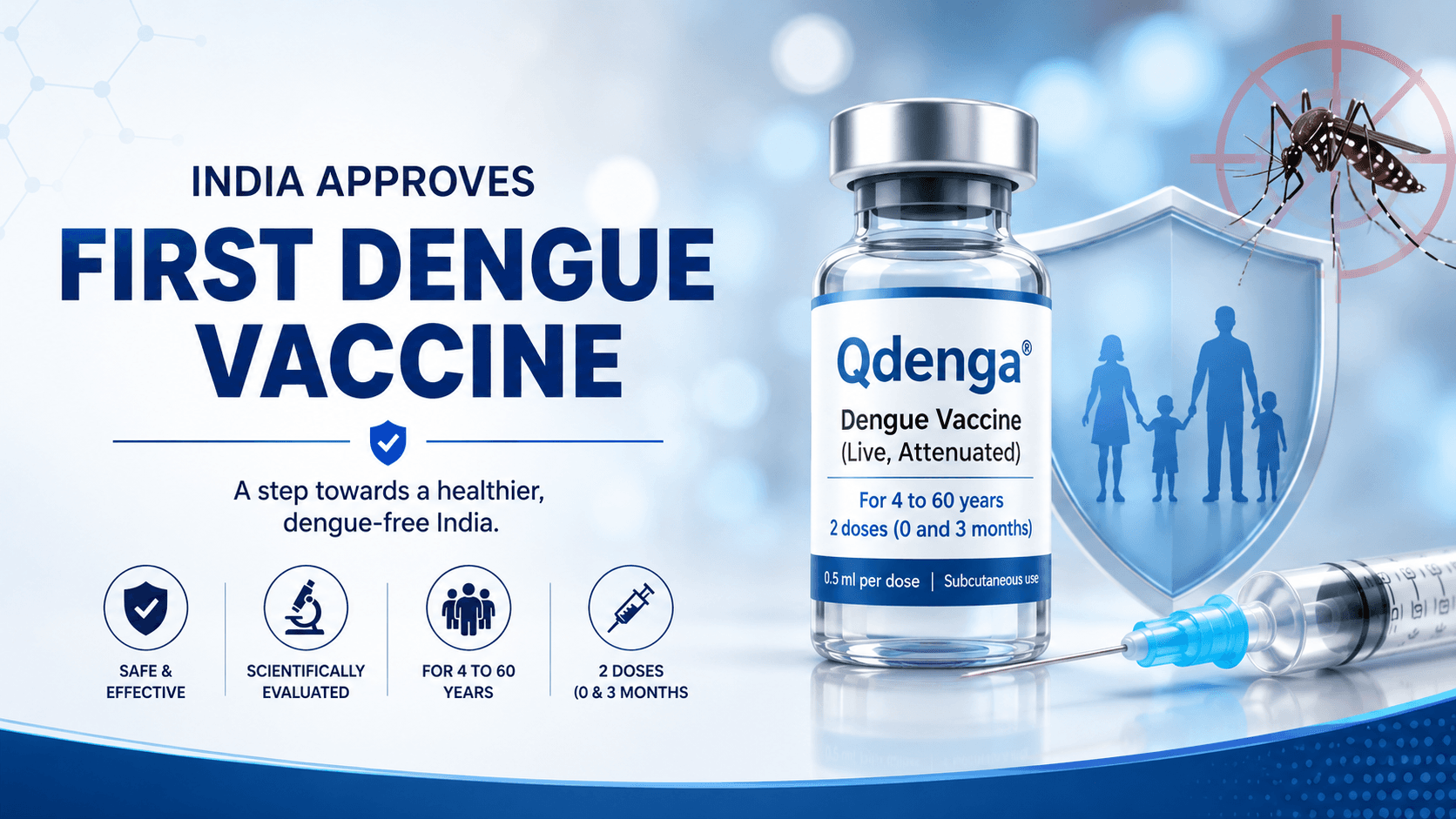
The Central Drugs Standard Control Organisation (CDSCO), under the Ministry of Health and Family Welfare has approved first dengue vaccine for the prevention of dengue disease.
The approval has been granted after a comprehensive scientific evaluation of the vaccine's quality, safety and efficacy in accordance with the provisions of the Drugs and Cosmetics Act, 1940 and the Drugs Rules, 1945.
About Qdenga®
Qdenga® is a live, attenuated tetravalent dengue vaccine developed using recombinant DNA technology. The vaccine is produced in Vero cells, with genes encoding serotype-specific surface proteins engineered into a dengue virus type-2 backbone.
The product contains genetically modified organisms (GMOs). It is supplied as a freeze-dried powder for reconstitution and is administered as a subcutaneous injection.
The vaccine is indicated for the prevention of dengue disease in individuals 4 to 60 years of age. The recommended immunisation schedule consists of two doses of 0.5 ml each, administered at an interval of three months (0 and 3 months).
About Central Drugs Standard Control Organisation(CDSCO)
- It is the National Regulatory Authority (NRA) of India for the medical devices industry under the provisions of the Drugs and Cosmetics Act 1940.
- It is responsible for overseeing the import, manufacture, sale, and distribution of medical devices in the country. The CDSCO ensures that medical devices comply with safety, quality, and efficacy standards.
- It works under the Directorate General of Health Services, Ministry of Health & Family Welfare, Government of India. The Drugs Controller General of India (DCGI) is the head of the CDSCO.
- Under the Drugs and Cosmetics Act, CDSCO is responsible for, Approval of new drugs; Conduct of clinical trials; Laying down the standards for drugs; Control over the quality of imported drugs in the country; Coordination of the activities of State Drug Control Organizations;
- CDSCO, along with state regulators, is jointly responsible for the grant of licenses for certain specialized categories of critical drugs such as blood and blood products, I. V. Fluids, Vaccine, and Sera.
- It's headquarter in New Delhi.
Global clinical development programme
The approval is supported by evidence generated through an extensive global clinical development programme evaluating the vaccine's safety, immunogenicity and efficacy across both dengue-endemic and non-endemic regions.
Clinical studies were conducted in participants from more than eight countries, including Brazil, Thailand and Sri Lanka. The evaluation also included a pivotal Phase III safety and immunogenicity study conducted in the Indian population covering individuals aged 4 to 60 years.
The vaccine has already received regulatory approval in 42 countries, including the European Union, the United Kingdom, Switzerland, Indonesia, Malaysia and Thailand, and has also received World Health Organization (WHO) prequalification. Globally, more than 24 million doses of the vaccine have been distributed.
About Dengue
Dengue is a mosquito-borne viral disease caused by the dengue virus of the Flavivirus genus. It is primarily transmitted by the bite of infected female Aedes mosquitoes, with Aedes aegypti being the main vector.
- Its symptoms are Severe headache and pain behind the eyes Intense bone, joint and muscle pain – often called “breakbone fever” Nausea, vomiting, fatigue and skin rash In severe cases: bleeding, organ damage and plasma leakage. The same mosquito species also spreads chikungunya, yellow fever and Zika virus.
According to the World Health Organization (WHO), dengue cases have increased sharply in recent decades. Many infections go unreported due to mild or asymptomatic presentation.
Conclusion
This vaccine marks an important milestone in India's public health response to dengue and is expected to complement the ongoing vector control, surveillance, early diagnosis and case management measures being implemented under the National Vector Borne Disease Control Programme.
This topic is equally significant for BPSC’s General Studies (GS) Paper (PT) and General Studies (GS) Paper II (Mains) as well.
Sources :- PIB
What did CDSCO approve regarding dengue?
The Central Drugs Standard Control Organisation (CDSCO) approved India's first dengue vaccine for the prevention of dengue disease.
What kind of vaccine is Qdenga and how is it made?
Qdenga is a live, attenuated tetravalent dengue vaccine developed using recombinant DNA technology and produced in Vero cells, with genes for serotype-specific surface proteins engineered into a dengue virus type-2 backbone.
Who can receive the Qdenga vaccine and what is its dosing schedule?
Qdenga is indicated for individuals aged 4 to 60 years, administered as two doses of 0.5 ml each, three months apart, at 0 and 3 months.
What is CDSCO and who heads it?
CDSCO is India's National Regulatory Authority for the medical devices industry under the Drugs and Cosmetics Act 1940, working under the Directorate General of Health Services; it is headed by the Drugs Controller General of India (DCGI) and headquartered in New Delhi.
In which countries were Qdenga's clinical studies conducted before Indian approval?
Clinical studies were conducted in participants from more than eight countries including Brazil, Thailand and Sri Lanka, along with a pivotal Phase III study conducted specifically in the Indian population.
How widely is Qdenga approved and used globally?
Qdenga has already received regulatory approval in 42 countries, including the EU, UK, Switzerland, Indonesia, Malaysia and Thailand, has WHO prequalification, and more than 24 million doses have been distributed globally.
What causes dengue and how is it transmitted?
Dengue is caused by the dengue virus of the Flavivirus genus and is primarily transmitted through the bite of infected female Aedes mosquitoes, mainly Aedes aegypti.
What are the common symptoms of dengue?
Symptoms include severe headache, pain behind the eyes, intense bone, joint and muscle pain known as breakbone fever, nausea, vomiting, fatigue and skin rash, with severe cases involving bleeding, organ damage and plasma leakage.
What other diseases does the Aedes mosquito responsible for dengue also spread?
The same mosquito species that spreads dengue also spreads chikungunya, yellow fever and Zika virus.
Is the Qdenga vaccine approval part of the BPSC/UPSC syllabus?
Yes, this topic is significant for BPSC's General Studies Paper in both the Preliminary exam and the Mains GS Paper II.