
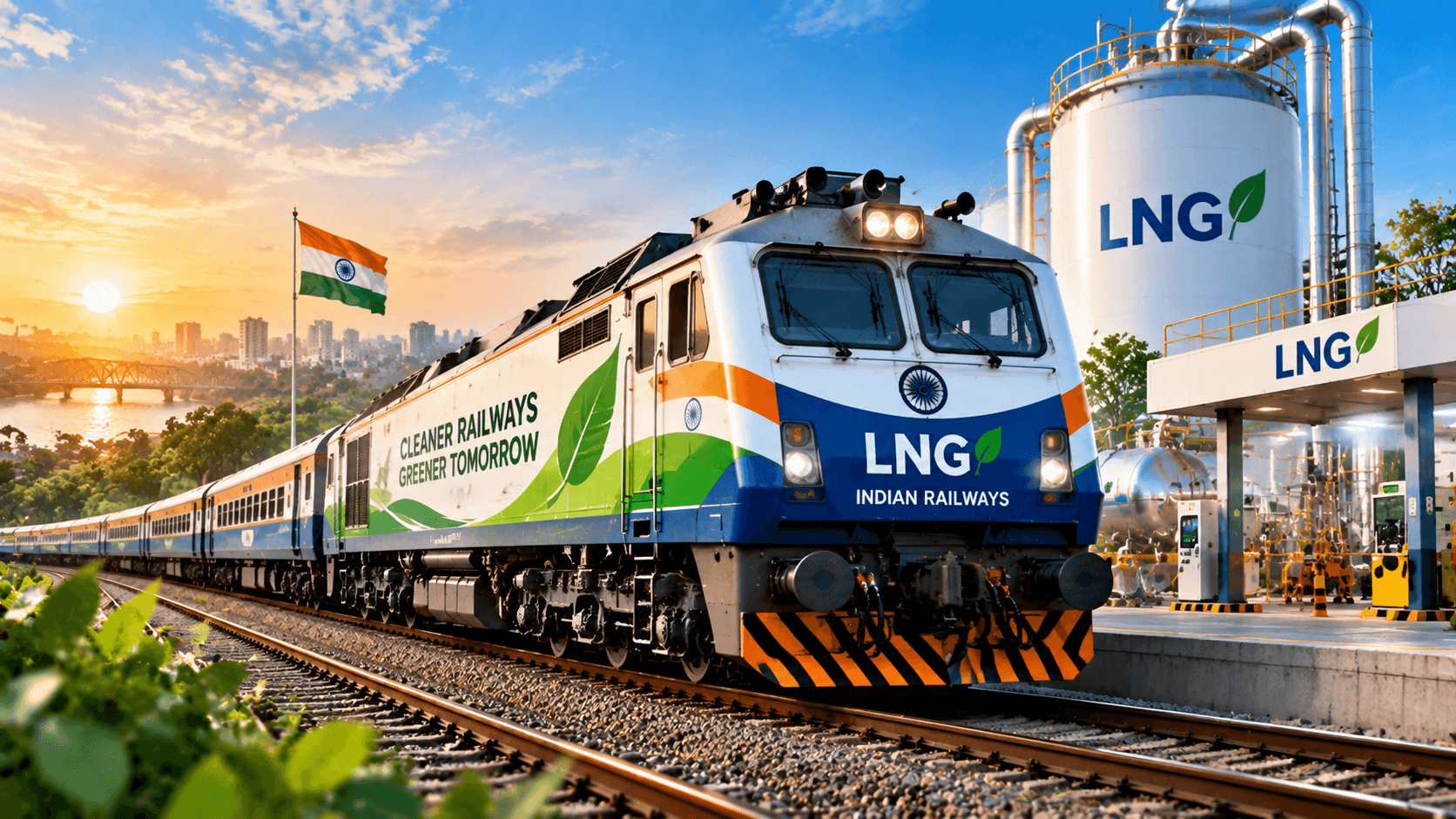
India’s first LNG-powered train
Why in News?
Recently, Indian Railways has taken a step towards cleaner and more fuel-efficient transportation with the launch of India’s first LNG-powered train.
Union Home and Cooperation Minister Amit Shah flagged off the train from Sabarmati Station. The initiative introduces Liquefied Natural Gas (LNG) as an alternative fuel to diesel and is aimed at reducing fuel consumption, emissions, and operating costs.
For Indian Railways, which has been exploring cleaner energy options, the project marks an important move towards greener railway operations.
What Makes This Train Different?
The train uses a dual-fuel LNG-diesel technology in its Driving Power Cars (DPCs).
This means the engine does not have to rely entirely on LNG. It can use:
- LNG as the primary alternative fuel
- Diesel when LNG is unavailable
- Both fuels depend on operational requirements. This flexibility allows the train to continue operating even when LNG is not readily available.
Two 1,400 HP Engines Converted to LNG
- Under the project, two Driving Power Cars, each having a capacity of 1,400 HP, have been converted to operate using the LNG-diesel dual-fuel system.
- The technology has already undergone more than 2,000 km of field trials to test its performance and reliability.
- According to Indian Railways, LNG can replace up to around 40% of diesel consumption in the system.
How Does the LNG-Diesel Train Work?
- The basic idea is simple: instead of depending only on diesel, the engine can use LNG along with diesel.
- Depending on fuel availability and operating conditions, the system can switch between the two fuels. This provides greater flexibility while reducing dependence on conventional diesel.
- Another advantage is that LNG can help the train travel a considerable distance before refueling.
LNG-Powered Train: How Will It Reduce Pollution?
One of the biggest objectives of the project is to make railway transportation cleaner.
Replacing a portion of diesel with LNG can help reduce emissions and pollutants such as
- Carbon dioxide (CO₂)
- Nitrogen oxides (NOx)
- Particulate matter (PM)
The initiative therefore fits into Indian Railways’ broader efforts to promote energy-efficient and environment-friendly transportation.
LNG Can Also Reduce Fuel Costs
The project is not only about reducing emissions. It is also expected to lower fuel expenditure.
Based on trial data, Indian Railways estimates:
- Around ₹11.9 lakh annual savings per DPC
- Around ₹23.9 lakh annual savings for an 8-coach rake
This could make LNG-based technology economically useful if it is expanded across more railway operations.
How Much LNG Can the Train Carry?
Each driving power car has been equipped with an LNG tank of approximately 2,200 liters.
The tank can hold around 950–1,000 kg of usable LNG.
According to the approved design, a fully loaded LNG tank in one DPC can support approximately 444 km of daily operation, reducing the need for frequent refueling.
Will LNG Reduce the Train’s Performance?
Indian Railways says that the dual-fuel system has been designed to maintain the power, reliability, and operating performance of conventional diesel engines. In other words, the objective is to achieve:
Lower diesel consumption + lower emissions + lower fuel costs
without compromising the train’s operational performance.
Why Is India’s LNG-Powered Train Important?
The introduction of LNG-powered technology highlights the growing focus on alternative fuels in Indian Railways.
The project could help India:
- Reduce dependence on diesel.
- Improve fuel efficiency
- Lower railway operating costs
- Reduce harmful emissions.
- Promote cleaner transportation.
- Explore wider use of alternative fuels in the railway sector
Conclusion
India’s first LNG-powered train represents an important experiment in making railway transportation cleaner, more fuel-efficient, and cost-effective. While the technology is currently being tested through a dual-fuel system, its future expansion could contribute to India’s efforts to build a more sustainable transport network. For Indian Railways, the message is clear: the future of rail transport may not depend on a single fuel but on smarter and cleaner energy choices.