India has commissioned its first-ever geothermal wells in Ladakh
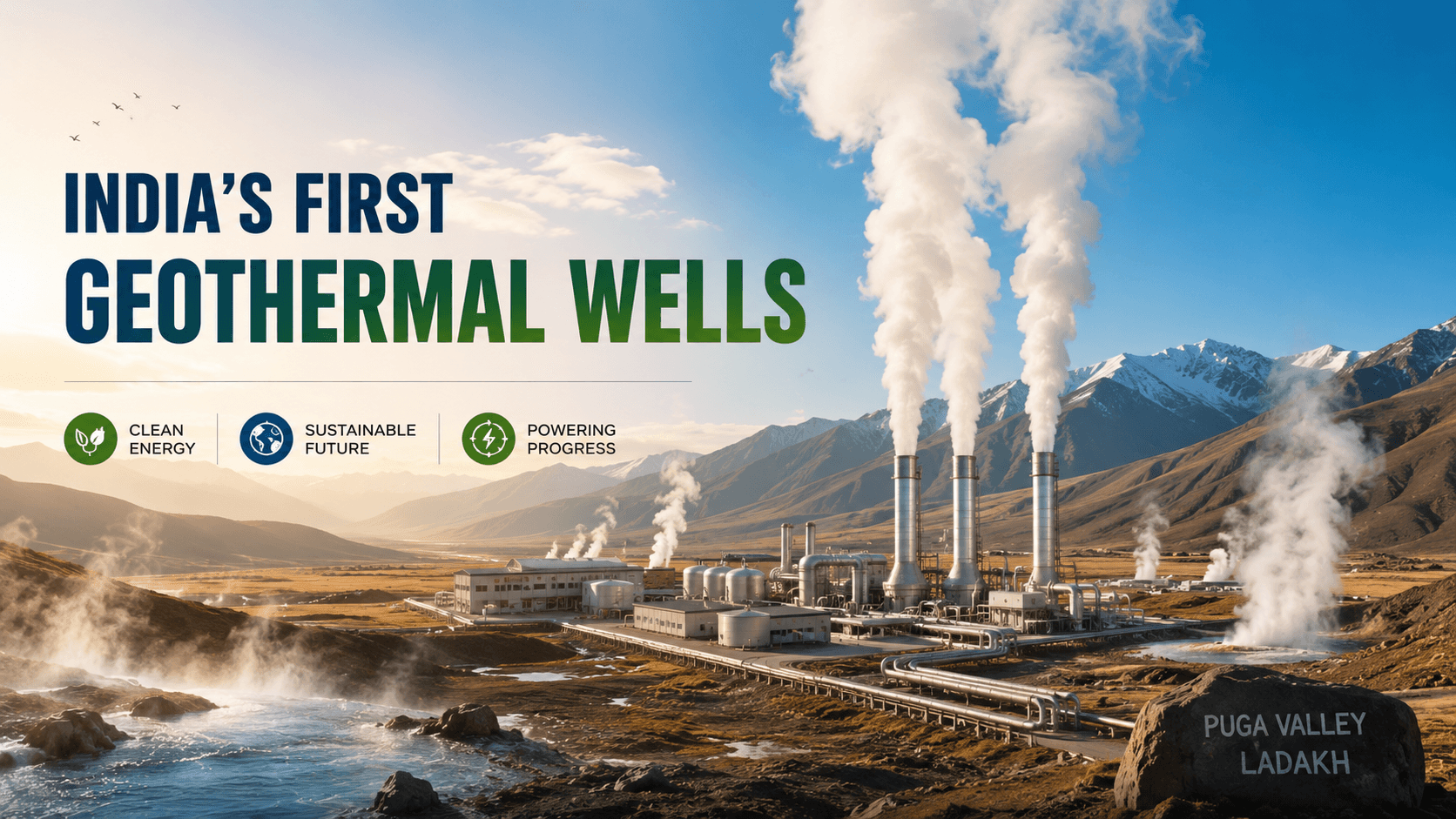
India has commissioned its first-ever geothermal wells at Puga Valley, Ladakh, paving the way for the country’s first 1 MW geothermal power project.
It has drilled one thousand meters deep at an altitude of over 14 thousand feet, these wells mark a major step towards harnessing the Earth’s natural heat for sustainable, round-the-clock Clean Energy.
This breakthrough strengthens the country’s Renewable Energy ambitions and supports the vision of a Net Zero and carbon-neutral future.

What is Geothermal Energy?
- Geothermal energy is a type of renewable energy taken from the Earth’s core. It comes from heat generated during the original formation of the planet and the radioactive decay of materials.
- Thermal energy is stored in rocks and fluids in the centre of the Earth and can be found from shallow depths right down to several miles below the Earth’s surface.
- The difference between the temperature in the Earth’s core and the surface drives a continuous conduction of thermal energy from the centre to the exterior of the planet.
About Puga Valley
Puga Valley is situated in the south-eastern Changchang region of Ladakh, about 22 km from Salt Lake Valley. It lies at a high altitude in one of India’s coldest and most remote desert zones. The valley is widely recognized for its active geothermal features. It has strong surface manifestations of heat, making it one of the most promising geothermal sites in India.
Puga is particularly famous for its natural hot sulphur springs. These springs release steam and mineral-rich water continuously, indicating the presence of shallow high-temperature geothermal reservoirs beneath the surface.
Advantages of Geothermal Energy
Environmentally Friendly: Geothermal energy is a clean and sustainable power source with an extremely low carbon footprint. It produces minimal emissions and does not rely on fossil fuels, making it one of the most eco-friendly energy options available.
Reliable Renewable Source: Unlike solar and wind, geothermal energy is not dependent on weather or time of day. It draws consistent heat from the Earth’s core, providing a steady and dependable source of renewable power year-round.
High Efficiency: Geothermal systems convert the Earth’s thermal energy into usable power with very high efficiency. They require less energy input compared to the output they deliver, which makes them cost-effective over the long term.
Flexible Design: Geothermal plants and systems can be adapted to a wide range of site conditions and scales. From large-scale power plants to residential heating and cooling, the technology can be customized to fit diverse geographical and structural needs.
Low Maintenance Cost: Geothermal systems have few moving parts and are built to last for decades. This results in minimal upkeep, fewer breakdowns, and significantly lower long-term maintenance expenses.
Heat Storage Capability: Geothermal heat pumps can store thermal energy and utilize it when needed. This storage ability adds flexibility to energy management and helps balance supply and demand efficiently.
Issues pertaining to Geothermal Energy
Greenhouse Gas Emissions: While geothermal energy is clean overall, the drilling and extraction process can release some greenhouse gases and trace gases that are trapped underground. These emissions are much lower than fossil fuels but are not zero.
Resource Depletion: Geothermal reservoirs are renewable, but they are not unlimited at a single site. Over time, excessive extraction without proper management can reduce underground heat and pressure, leading to a decline in output.
Cooling of Extraction Sites: Prolonged use of a specific geothermal field can cause the local rock and fluid temperatures to drop. If the heat is drawn faster than the Earth can replenish it, the site may become less productive.
Technological Challenges: Advanced geothermal methods, such as tapping magma or deep hot dry rock, involve extreme temperatures and pressures. Current technology still struggles with drilling, material durability, and system control at those depths.
High Capital Costs: The upfront investment for geothermal plants is substantial. Expenses include exploration, deep drilling, plant construction, and specialized equipment, which makes initial setup more expensive than many conventional systems.
Water Pollution Risk: Some geothermal plants use large volumes of water and bring dissolved minerals and chemicals to the surface. Without proper treatment and disposal, this can lead to contamination of local water sources.
Proximity to Volcanic Activity: The most viable geothermal resources are often located near tectonic plate boundaries and volcanic zones. This creates risks related to earthquakes, eruptions, and unstable ground that can affect plant operations.
Difficulty Locating Reservoirs: Suitable geothermal reservoirs are not easy to find and require detailed geological surveys. Additionally, installing large-scale geothermal systems in densely populated urban areas is challenging due to space, cost, and infrastructure limitations.
Huge Potentiality of Geothermal in India
Abundant Natural Hot Springs: India has around 381 identified hot springs with temperatures ranging from 35°C to 89°C. These sites represent a significant untapped reserve of geothermal energy across different regions of the country.
Estimated National Potential: According to the Geological Survey of India, the total geothermal potential of India is estimated at 10.6 GW. This potential is spread across 10 major geothermal provinces with varying geological conditions.
Key Geothermal Provinces: The most promising areas include the Himalayan Geothermal Province, the Cambay Graben in Gujarat, and the Andaman & Nicobar Islands. Each of these zones has unique thermal characteristics suitable for power generation and direct-use applications.
Global Context: The total installed geothermal power capacity worldwide is currently below 17 GW. The leading countries are the United States, Indonesia, and the Philippines, which gives India room to expand and become a key player in the sector.
Future Growth Projections: The Indian geothermal market is expected to reach 4.2 GW by 2035 and could scale up to nearly 100 GW by 2045. This growth will depend on policy support, investment, and technological development.
Pilot Projects Underway: In Ladakh, ONGC Energy Centre has successfully drilled two wells up to 1,000 meters deep. These wells are being used to support India’s first 1 MW pilot geothermal power project, marking a major step toward commercial deployment.

Government initiatives
National Policy on Geothermal Energy 2025: The Ministry of New and Renewable Energy has launched the National Policy on Geothermal Energy 2025 to promote the exploration and development of India’s untapped geothermal resources. The policy provides a clear framework for investment, research, and project execution.
Role in Renewable Energy & Net Zero Target: The policy positions geothermal energy as a key pillar of India’s renewable energy mix. It directly supports the country’s commitment to achieve the 2070 Net Zero goal while strengthening long-term energy security and reducing dependence on imports.
Financial Support Mechanisms: MNRE offers 100% funding support to government and non-profit research institutions for geothermal studies and pilots. For industry players, startups, and private developers, the support goes up to 70% to encourage commercial participation and innovation.
International Collaboration: Under the US-India Strategic Clean Energy Partnership, the Renewable Energy Technology Action Platform has been established. It focuses on joint R&D, technology transfer, and capacity building for geothermal exploration and deployment. Suggestions for Accelerating Growth
The way forward
Create Exploratory Risk Funds: A government-backed risk mitigation fund is needed to cover early-stage drilling failures. This will reduce financial uncertainty and encourage private developers to invest in high-risk geothermal exploration.
Invest in EGS & Closed-Loop Systems: Greater investment in Enhanced Geothermal Systems and closed-loop technologies can help tap deep hot-dry-rock formations, even in areas without natural hydrothermal reservoirs.
Develop Advanced Drilling Technology: India needs to design high-temperature, hard-rock drilling rigs capable of operating in the deep granite and complex metamorphic formations found in the Himalayas and other provinces.
Expand Non-Power Thermal Applications: Geothermal energy should be used beyond electricity generation. Applications like district heating, greenhouse farming, and cold-chain infrastructure in border and high-altitude regions can boost local economies in extreme climates while improving energy access.
This topic is covered under General Studies (GS) Paper II (Section II), which deals with Indian Economy, Geography, and Development, as well as the Science and Technology sections.
What is geothermal energy?
Geothermal energy is renewable energy taken from the Earth's core, generated during the planet's original formation and by radioactive decay of materials. It is stored as thermal energy in rocks and fluids from shallow depths down to several miles below the surface.
Where has India commissioned its first-ever geothermal wells?
India has commissioned its first-ever geothermal wells at Puga Valley in Ladakh, paving the way for the country's first 1 MW geothermal power project.
How deep were the Ladakh geothermal wells drilled?
The wells were drilled one thousand meters deep at an altitude of over 14,000 feet.
What makes Puga Valley suitable for geothermal energy?
Puga Valley is known for active geothermal features and natural hot sulphur springs that continuously release steam and mineral-rich water, indicating shallow high-temperature geothermal reservoirs beneath the surface.
What is India's total estimated geothermal potential?
According to the Geological Survey of India, the total geothermal potential of India is estimated at 10.6 GW, spread across 10 major geothermal provinces.
Which are the key geothermal provinces in India?
The most promising areas include the Himalayan Geothermal Province, the Cambay Graben in Gujarat, and the Andaman and Nicobar Islands.
How does India's geothermal capacity compare globally?
The total installed geothermal power capacity worldwide is currently below 17 GW, with the United States, Indonesia, and the Philippines leading, leaving India room to expand as a key player.
What growth is projected for India's geothermal market?
The Indian geothermal market is expected to reach 4.2 GW by 2035 and could scale up to nearly 100 GW by 2045, depending on policy support, investment, and technological development.
What financial support does the government offer for geothermal projects?
Under the National Policy on Geothermal Energy 2025, MNRE offers 100% funding support to government and non-profit research institutions, and up to 70% support for industry players, startups, and private developers.
Is geothermal energy relevant to the BPSC/UPSC syllabus?
Yes, as a Current Affairs topic it is covered under General Studies Paper II (Section II), dealing with Indian Economy, Geography, and Development, as well as the Science and Technology sections.