Delhi Tops NITI Aayog’s EV Index
Why in News?
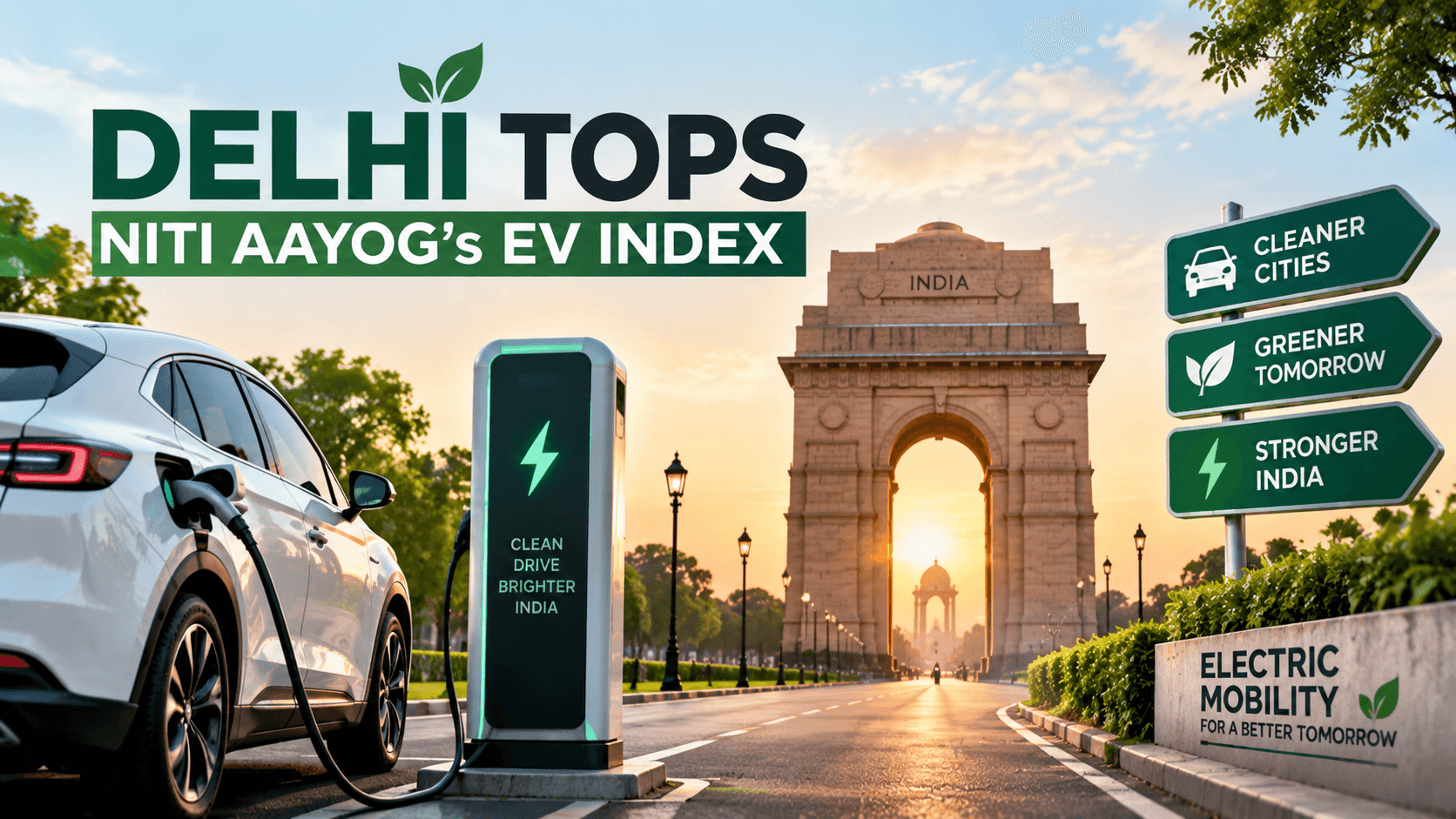
Recently, NITI Aayog released the 2nd edition of the India Electric Mobility Index (IEMI) 2025. In this index, Delhi has emerged as the top-performing state/UT with a score of 84 in India's transition towards electric mobility.
The index is developed by NITI Aayog in collaboration with WRI India, and it tracks how states are progressing on EVs across 3 themes, transport electrification, charging infrastructure, and EV research & innovation. Delhi improved its score from 77 last year to 84 this year, followed by Maharashtra (78) and Karnataka (73).
What is the India Electric Mobility Index (IEMI)?
IEMI is a composite index developed by NITI Aayog in collaboration with WRI India. It checks how states and UTs are performing in the shift to electric mobility. It looks at policy framework, infrastructure readiness, and actual implementation on the ground. The main aim is to create healthy competition among states and promote cooperative and competitive federalism for clean mobility.
Evaluation Framework:
The index gives scores from 0 to 100 based on 16 indicators divided into 3 themes:
1. Transport Electrification Progress (50% weightage): This measures how many EVs are adopted in private and commercial segments, plus how effective are government incentives, governance, and operational support.
2. Charging Infrastructure Readiness (30% weightage): This checks physical and policy support like charger-to-vehicle ratio, power availability, use of renewable energy, and capital subsidies for charging stations.
3. EV Research and Innovation Status (20% weightage): This assesses the innovation ecosystem, number of EV start-ups, patents filed, and R&D initiatives in the state.
Performance Categories:
Based on the overall score, states/UTs are divided into 4 tiers:
1. Top Performers: Score 65 and above
2. Frontrunners: Score 50 to 64
3. Emerging Performers: Score 35 to 49
4. Aspirants: Score below 35
Key Findings of IEMI 2025
Overall Top Performers: Delhi retained the top rank with a score of 84 (up from 77 in 2024), followed by Maharashtra (78) and Karnataka (73).
Hilly & North-Eastern States: Manipur emerged as the highest-scoring state in this group with 46 marks, followed by Tripura and Assam.
Thematic Leaders:
Electrification Progress: Delhi topped this category, followed by Chandigarh.
Charging Readiness: Karnataka led the nation, followed by Maharashtra and Haryana.
Research & Innovation: Delhi recorded the highest score, with strong performance from Maharashtra and Karnataka.
Most Improved State: Madhya Pradesh showed the biggest jump, climbing 16 positions from 23rd last year to 7th this year.
Surge in EV Adoption: EV sales have grown sharply from just 0.5% in 2018 to 8.25% in 2025-26. This growth is supported by central schemes like FAME, PM E-DRIVE, and the PLI scheme for auto.
Policy Momentum: Out of 36 states/UTs, 29 have now notified dedicated EV policies, showing strong administrative commitment.
Strategic Significance: The index works as an evidence-based roadmap for states to move from policymaking to effective implementation. Scaling e-mobility is crucial for the Viksit Bharat 2047 vision and to reduce India's 89% dependence on imported crude oil.
Environmental and Economic Imperative: Road transport contributes 12% of India's energy-related CO₂ emissions, so e-mobility is key for decarbonization. At the same time, the auto sector is economically vital; it contributes 7.1% to GDP and provides jobs to about 19 million people.
Conclusion
The 2nd edition of IEMI 2025 shows that India is steadily moving towards electric mobility, with Delhi, Maharashtra, and Karnataka leading the transition. The rise in median score from 36 to 40, EV share jumping to 8.25%, and 29 states having dedicated EV policies reflect strong policy momentum. However, wide gaps remain, especially in Hilly & North-Eastern states and in Research & Innovation, where 17 states are still aspirants. For Viksit Bharat 2047, IEMI will act as a practical roadmap for states to improve charging infrastructure, boost local manufacturing through PLI and FAME, and cut crude oil dependence and emissions. In short, competitive federalism driven by IEMI can help India become a global leader in clean and sustainable mobility.