
EU Kids Act: Under-15 Social Media Curbs
Why in News?
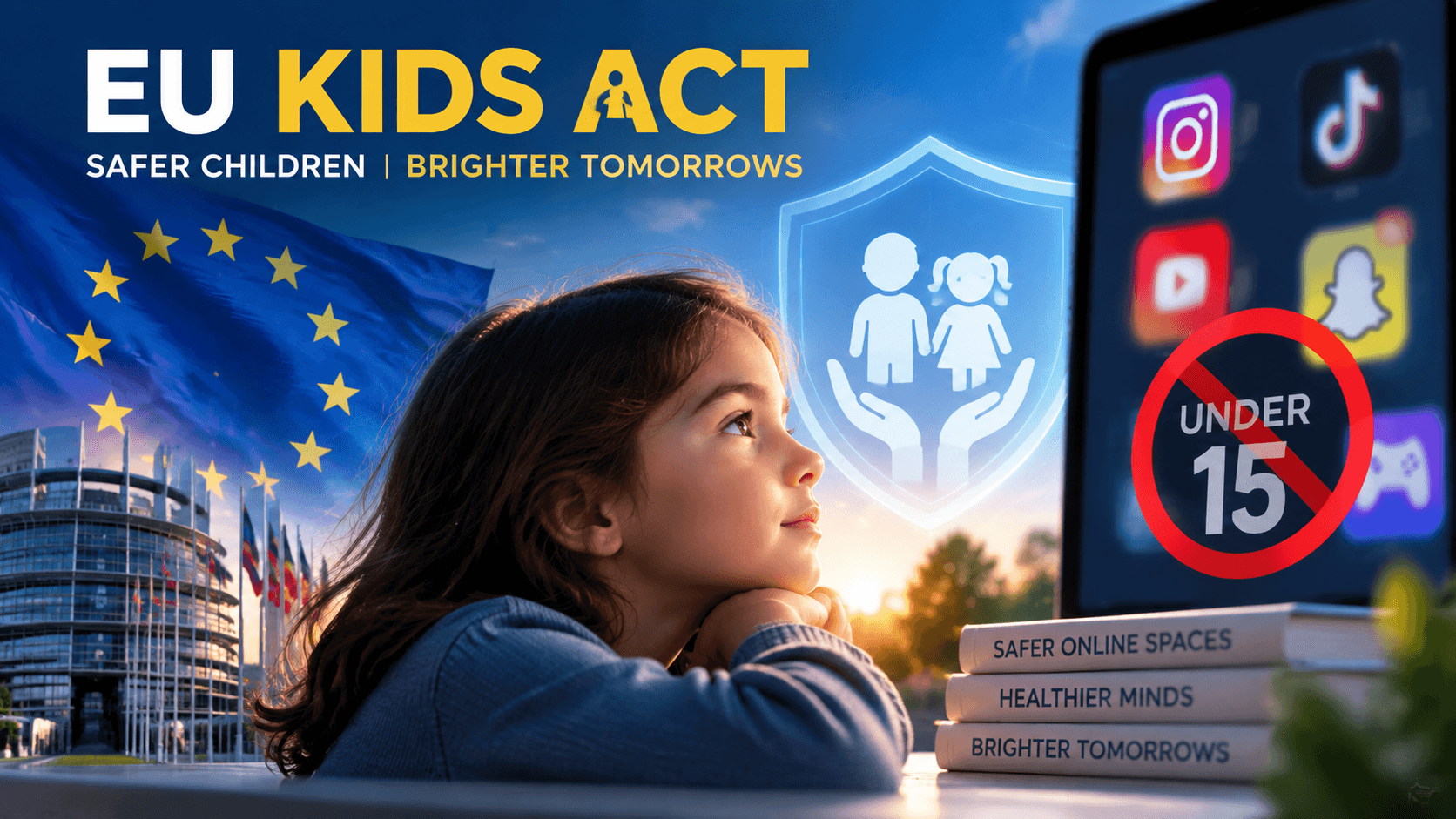
The European Union (EU) has proposed new rules to restrict social media access for children under the age of 15. The proposed EU Kids Act aims to create a safer digital environment for children by limiting their access to social media and requiring technology companies to make their platforms safer by design.
The proposal comes amid growing concerns over online bullying, addictive platform features, harmful content, and the impact of excessive social media use on children and teenagers.
What is the EU Kids Act?
The proposed EU Kids Act seeks to introduce an EU-wide framework for protecting children online.
Under the proposed approach:
| 1 | Children below 13 years would be prohibited from accessing social media platforms. |
| 2 | Children aged 13–15 would have restricted access, including a proposed one-hour daily limit through parent- or guardian-linked "mini accounts." |
| 3 | Children aged 15 and above would be allowed to create their own social media accounts. |
| 4 | Platforms would have to demonstrate that their services are safe by design for children. |
| 5 | Companies could face fines of up to 6% of their global turnover for serious violations. |
| 6 | The rules could cover not only platforms such as TikTok, Instagram, and Snapchat, but also YouTube, video-sharing services, online games, and AI chatbots. |
Why is the EU targeting social media for children?
Children are increasingly exposed to digital platforms at a very young age. While social media can provide opportunities for communication, learning, and entertainment, concerns have grown over the way some platforms are designed.
Features such as infinite scrolling, autoplay videos, and personalized recommendations can encourage prolonged or compulsive use.
The EU's broader concern is that children may encounter:
| Cyberbullying and online harassment |
| Harmful or inappropriate content |
| Excessive screen time |
| Addictive platform features |
| Online exploitation |
| Pressure linked to social comparison |
| Permanent digital footprints |
From Parental Control to Platform Responsibility
One of the important features of the proposed legislation is its emphasis on "safety by design."
This means platforms would not simply be expected to provide parental-control tools. They would also have to consider child safety while designing their products.
The proposed approach would seek to restrict features that may encourage excessive or compulsive use and require companies to prepare detailed child-safety plans.
In other words, the EU wants the responsibility for protecting children online to be shared between parents, governments, and technology companies.
How Would Age Verification Work?
Enforcing an age-based restriction is one of the biggest challenges.
Platforms would need to establish whether a user is old enough to access particular services. The European Commission has indicated that age verification could be carried out through the EU's existing age-verification system.
The Commission says the system would be designed so that personal information is not collected or shared unnecessarily.
However, privacy advocates have raised concerns that age verification could require children and teenagers to provide sensitive personal information.
This creates an important policy dilemma: the proposal therefore attempts to shift some responsibility from parents alone to technology companies themselves.
How can governments protect children online without creating a system that compromises their privacy?
EU-Wide Rules Could Override National Laws
Several EU countries have already considered or introduced their own restrictions on children's social media use.
France and Spain, for example, have taken steps towards stronger restrictions.
The proposed EU-wide framework could create a common legal standard across member states, rather than allowing each country to follow completely different rules.
However, this could also create tensions between EU-level regulation and national approaches, particularly where individual countries want stricter or more flexible rules.
France Shows the Challenges Ahead
France provides an example of the difficulties involved in implementing age-based social media restrictions.
The French government had proposed restrictions on social media access for children under 15. However, the country's top court raised concerns about the impact of such a measure on freedom of expression.
The French experience highlights a broader challenge for the EU:
Child protection must be balanced with fundamental rights such as privacy, freedom of expression, and access to information.
Social Media Companies Under Greater Scrutiny
The proposed EU rules come at a time when major technology companies are already facing increasing regulatory pressure.
The European Commission has previously examined features of platforms such as Facebook and Instagram, particularly their potentially addictive design.
Features including infinite scrolling, autoplay, and personalized recommendations have attracted scrutiny over their possible contribution to compulsive use among young people.
Technology companies, however, have disputed some of these findings and argued that they have already introduced measures to improve the safety of teenagers on their platforms.
What About AI Chatbots and Online Games?
An important aspect of the proposal is that the debate is no longer limited to traditional social media.
The proposed rules could also cover AI chatbots, online games, and other digital services used by children.
This reflects a broader change in the digital environment. Children's online experiences now extend far beyond social networking platforms.
As AI assistants, gaming platforms, and recommendation-based services become more common, policymakers face the challenge of creating rules that remain relevant as technology evolves.
Lessons from Australia and the UK
The EU is not alone in considering age restrictions.
Australia has already introduced restrictions targeting social media access for children under 16. However, enforcement has proved challenging, with concerns that many children may still be accessing restricted platforms.
The United Kingdom is also preparing similar restrictions for under-16s.
This indicates a growing international debate over whether age-based restrictions can effectively protect children in an increasingly digital society.
Key Challenges Before the EU
The proposal could face several challenges before becoming fully operational.
| Age Verification | Determining a user's age accurately without collecting excessive personal information remains technically and legally difficult. |
| Privacy Concerns | Age verification systems could create new privacy risks if sensitive information is improperly stored or shared. |
| Enforcement | Children may attempt to bypass restrictions by using false information, VPNs, alternative accounts, or other technological methods. |
| Freedom of Expression | Restrictions on access to online platforms may raise questions concerning children's rights to information and freedom of expression. |
| Defining "Social Media" | The digital ecosystem is constantly changing. Drawing a clear boundary between social media, gaming, video platforms, and AI services could become increasingly difficult. |
| Parental Responsibility vs. Platform Responsibility | While parents play an important role in guiding children's digital behavior, the proposal raises a larger question: how much responsibility should be placed on technology companies for the way their platforms affect young users? |
Critical Analysis: Can Age Limits Alone Make the Internet Safer?
The proposed EU approach represents a shift towards stronger regulation of children's digital experiences. However, an age limit by itself may not solve every problem associated with children's online activity.
Children can potentially bypass restrictions, while harmful content can also appear on platforms that technically comply with age requirements.
At the same time, excessive regulation may raise concerns about privacy, freedom of expression, and children's access to useful digital resources.
Therefore, effective child protection may require a multi-layered approach involving age-appropriate design, digital literacy, parental guidance, stronger platform accountability, transparent algorithms, and effective enforcement.
What Does This Mean for the Future of Digital Regulation?
The EU's proposal reflects a broader global question:
Should technology platforms simply provide digital services, or should they also be legally responsible for making those services safer for children?
The debate is likely to become more important as social media, gaming, AI, and other digital technologies increasingly overlap.
For policymakers, the challenge will be to create regulations that protect children without unnecessarily restricting their rights or creating new privacy risks.
Conclusion
The proposed EU Kids Act marks an important development in the global debate over children's online safety. By combining age restrictions with the principle of safety by design, the EU is seeking to make technology companies more accountable for the digital environments they create. However, the effectiveness of the proposal will ultimately depend on how age verification, enforcement, privacy protection, and platform accountability are implemented in practice. For other countries, including India, the EU's experience could provide useful lessons on how to balance child safety, technological innovation, privacy, and fundamental rights in the digital age.