Who Won the Nobel Prize in Chemistry 2026?
Why in News?
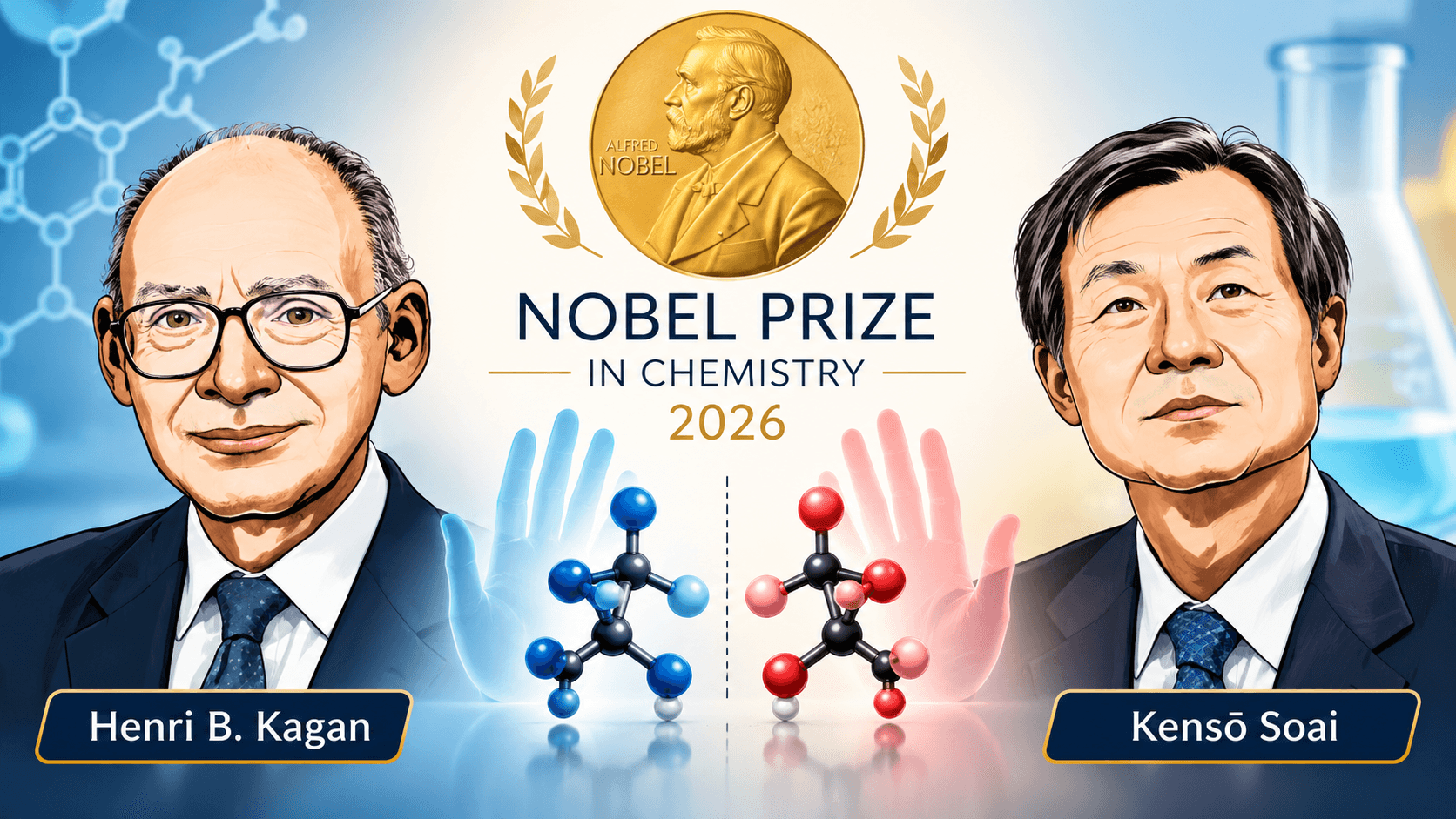
The 2026 Nobel Prize in Chemistry has been awarded to Henri B. Kagan of France and Kensō Soai of Japan.
They have been honored “for the discovery of non-linear effects and autocatalysis in asymmetric organic synthesis.”
Their work helped scientists understand how chemical reactions can produce one preferred form of a molecule rather than an equal mixture of two mirror-image forms.
This is important for medicines, pharmaceuticals, chemical manufacturing and understanding the origin of life.
In a nut shell, their work relates to Chirality, Asymmetric Synthesis, Non-linear Effects and Autocatalysis.
Important Terms related to the discovery:
- Chirality: The word chirality comes from the Greek word for hand. Our left and right hands are mirror images of each other. However, we cannot perfectly place one over the other.
Some molecules behave in the same way. They can exist in
two forms that are mirror images of each other. These are
called enantiomers.
It means that although the two molecules may look almost
identical, they can behave differently inside a living a living
organism.
This difference may look small, but it can have major biological impact. For example, one form of a molecule may work effectively as a medicine, while its mirror image may have a weaker effect or a completely different biological effect.
2. Asymmetric Synthesis: Normally, a chemical reaction that can produce two mirror-image molecules, may produce both forms. Scientists wanted to develop methods that could produce mainly one desired form.
This is known as asymmetric synthesis or asymmetric organic synthesis. It is particularly important for making pharmaceutical drugs and other biologically active compounds.
- Autocatalysis: A catalyst is a substance that helps a chemical reaction take place faster without being consumed in the reaction.
In autocatalysis, one of the products of a chemical reaction helps the same reaction to continue
- Non-linear Effects: It means that a small difference in the proportion of one molecular form can produce a much larger difference in the final reaction product. This concept is important for understanding how chemical asymmetry can be amplified.
- Homochirality: Predominance of one molecular form in biological systems
Significance
- Understanding the Origin of Life: The research provides clues about how one molecular form could become dominant in biological systems.
- Medical utility: It helps scientists produce molecules with greater precision, which is particularly important in drug development.
Who Are Henri Kagan and Kensō Soai?
Henri B. Kagan: French chemist associated with Paris-Sud University/Paris-Saclay.
He made major contributions to asymmetric synthesis, a field of chemistry that allows scientists to selectively produce one particular form of a molecule.
His work helped chemists develop better ways of controlling the 3D structure of molecules.
Kensō Soai: Japanese chemist associated with the Tokyo University of Science. He is famous for his research on autocatalysis and molecular chirality.
Kagan and Soai's research together helped address a long-standing question in chemistry: How can one form of a mirror-image molecule become dominant?
Conclusion
The 2026 Nobel Prize in Chemistry highlights a fascinating feature of molecules: sometimes, being a mirror image can make a major difference.
The research of Henri Kagan and Kensō Soai has helped scientists understand how chemical reactions can favour one molecular form and amplify that preference.