Can AI Revolutionize Indian Agriculture?
Why in News?
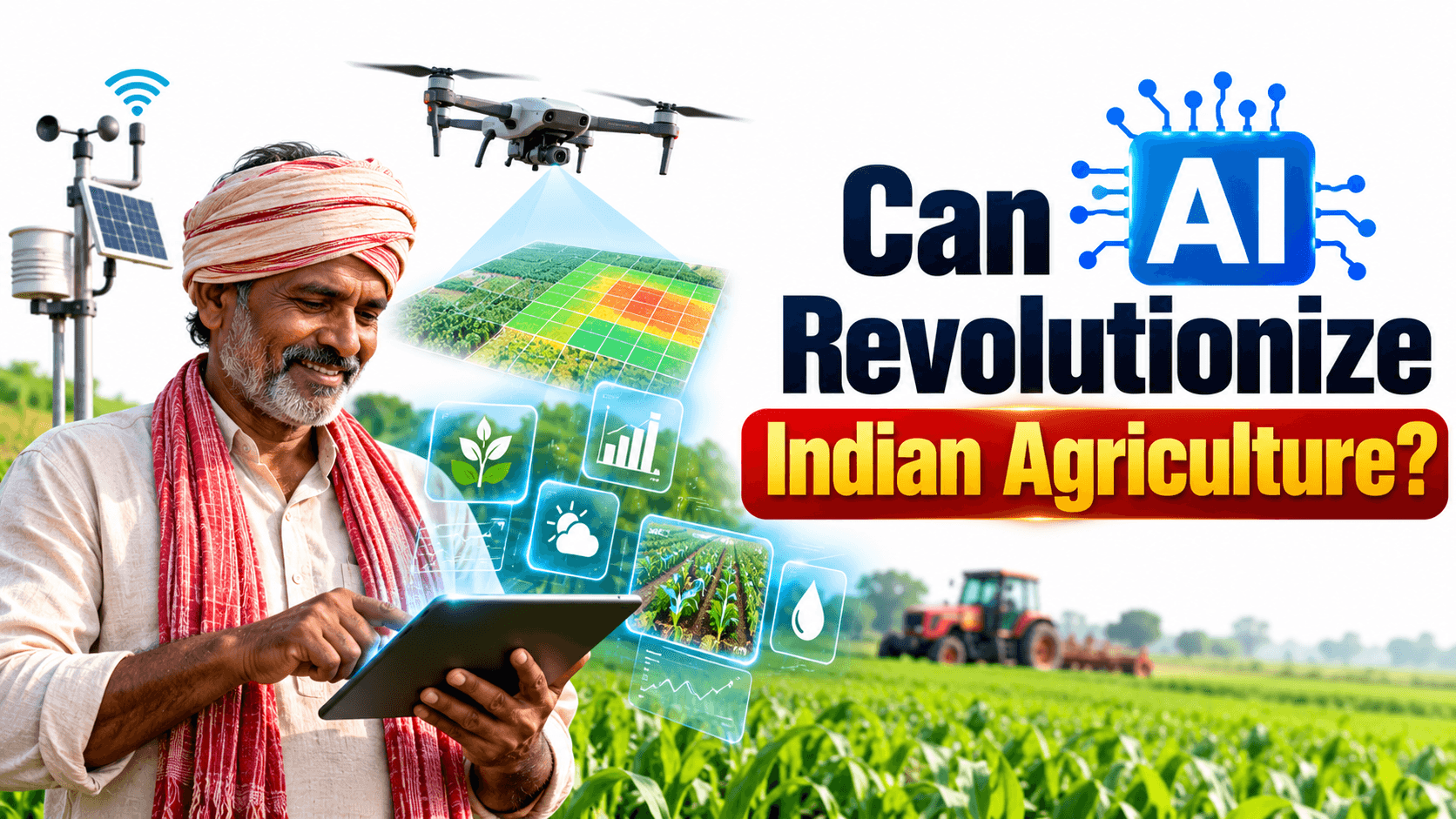
Recently, the second meeting of the Global Initiative on AI for Agri-Food Systems (GI-AI4FS) was held alongside the India Mobile Congress (IMC) in New Delhi. The meeting focused on the responsible use of Artificial Intelligence (AI) and the Internet of Things (IoT) to make agriculture smarter, more efficient, and more sustainable.
An agrifood system is the complete network that connects farmers, markets, and consumers, covering everything from farm to fork and beyond, including both food and non-food products.
The Internet of Things (IoT) is a network of physical objects, such as appliances, vehicles, and industrial machinery, embedded with sensors, software, and connectivity that allow them to collect, share, and act on data in real time. For example, your smartwatch, smart AC, Alexa, or car sensors. The basic idea is Sensors + Internet + Data Analysis = Smart Decision.
When the same IoT technology is used only for farming, it is called IoT in Agriculture. Here, sensors and devices are used in the field to help farmers. Example: General IoT: A soil moisture sensor in your garden pot that sends water-level alerts to your phone. Example: General IoT: A soil moisture sensor in your garden pot that sends water-level alerts to your phone.
The meeting was hosted by the Telecommunication Engineering Centre (TEC), Department of Telecommunications (DoT), in collaboration with the Indian Council of Agricultural Research (ICAR), under the Ministry of Agriculture and Farmers Welfare.
The initiative aims to strengthen international cooperation and promote farmer-centric digital solutions that can address real-world challenges in agriculture and food systems.
What Is GI-AI4FS? Understanding the Global Initiative
The Global Initiative on AI for Agri-Food Systems (GI-AI4FS) is a United Nations initiative that promotes the responsible and effective application of AI and digital technologies across agriculture and food systems.
It is coordinated by the International Telecommunication Union (ITU) in close collaboration with three major UN organizations:
- Food and Agriculture Organization (FAO): Works to improve food security and sustainable agriculture.
- International Fund for Agricultural Development (IFAD): Supports rural communities and small-scale farmers.
- World Food Programme (WFP): Addresses hunger and strengthens food security.
The initiative seeks to ensure that emerging technologies benefit farmers, improve agricultural productivity, and contribute to more resilient food systems.
How Can AI and IoT Transform Agriculture?
Agriculture is increasingly using digital technologies to improve productivity, conserve resources, and respond to changing weather conditions. AI and IoT can help farmers make better decisions by turning real-time data into practical insights.
| Precision Agriculture | AI-powered systems can analyze information about soil conditions, weather, crop health, and water availability. This helps farmers apply water, fertilizers, and pesticides more precisely, reducing waste and production costs. |
| Early Detection of Crop Diseases | AI can analyze images captured by smartphones, drones, and other devices to identify signs of crop diseases and pest attacks at an early stage. Timely detection can help farmers take preventive action and minimize crop losses. |
| Smart Irrigation and Resource Management | IoT-based sensors can monitor soil moisture, temperature, and other environmental conditions. When combined with AI, this information can help farmers determine when and how much to irrigate, improving water-use efficiency. |
| Weather Forecasting and Risk Management | AI-based analytics can process weather and environmental data to help farmers prepare for droughts, floods, heatwaves, and other extreme weather events. Better information can support timely decisions on sowing, irrigation, and harvesting. |
| Better Agricultural Supply Chains | Digital technologies can improve the tracking of agricultural produce from farms to markets. They can also help identify inefficiencies, improve traceability, and reduce post-harvest losses. |
International Hackathon on AI for Agri-Food Systems
Ahead of the meeting, TEC and ICAR jointly organized a two-day International Hackathon on AI for Agri-Food Systems on 8–9 October 2026 at the ICAR campus in New Delhi.
The hackathon brought together students, researchers, developers, and innovators to develop technology-based solutions to practical agricultural challenges.
Shortlisted teams presented their innovations during the GI-AI4FS meeting. The event also recognized outstanding solutions through an award ceremony, acknowledging the contributions of participating teams, mentors, and partners.
The hackathon highlighted how collaboration between researchers, technology developers, and agricultural institutions can help turn innovative ideas into practical solutions for farmers.
Key Discussions at the Second GI-AI4FS Meeting
The meeting brought together around 70 delegates in person and 25 participants online, representing international organizations, government departments, agricultural research institutions, academia, industry, and standards-development organizations.
Key areas of discussion included
- Governance structure: Developing a suitable framework for coordinating the initiative’s activities.
- Working groups: Nominating and confirming Working Group Chairs, co-chairs, and members.
- Terms of Reference: Defining the responsibilities and scope of the working groups.
- Priority areas: Identifying key issues and initial work streams for future collaboration.
- Global standards: Promoting interoperability and trustworthy AI solutions that can work across different agricultural systems.
- Farmer-centric innovation: Encouraging technologies that address farmers’ actual needs and can be applied in real-world conditions.
Why Is AI in Agriculture Important for India?
Agriculture remains a major source of livelihood in India, but farmers face several challenges, including unpredictable weather, rising input costs, water scarcity, crop diseases, and post-harvest losses.
The integration of AI and IoT offers an opportunity to address these challenges through better information, more efficient resource use, and timely decision-making.
However, the benefits of agricultural AI will depend on affordable access to technology, reliable rural connectivity, digital literacy, data quality, and solutions suited to small and marginal farmers. Responsible use of farmers’ data and the availability of local-language digital tools will also be important.
Therefore, the focus must extend beyond technological innovation to ensuring that these solutions are accessible, practical, and beneficial to farmers across different regions.
Challenges of Using AI and IoT in Agriculture
- Limited Digital Connectivity: Poor internet connectivity in rural areas can prevent farmers from accessing AI-based agricultural services.
- High Initial Costs: Sensors, drones, smart irrigation systems, and other digital tools may be unaffordable for small and marginal farmers.
- Lack of Digital Literacy: Many farmers may need training to understand and effectively use AI-powered applications.
- Data Privacy and Security: Collecting farmers’ personal, financial, and farm-related data raises concerns about privacy, ownership, and misuse.
- Unreliable Data: Inaccurate weather forecasts, incomplete soil information, or poor-quality crop images can lead to incorrect recommendations.
- Regional and Language Barriers: AI solutions may not work equally well across different agro-climatic regions or support all local languages.
- Limited Access to Technical Support: Farmers may struggle to maintain digital equipment or obtain timely assistance when systems fail.
- Risk of Unequal Benefits: Wealthier farmers and large agricultural enterprises may benefit more than small farmers if affordable access is not ensured.
- Interoperability Issues: Different digital platforms and devices may not communicate effectively because of incompatible systems and standards.
- Dependence on Technology: Excessive reliance on automated recommendations without local knowledge or human oversight can lead to poor agricultural decisions.
Way Forward: India needs affordable digital tools, stronger rural connectivity, farmer training, local-language AI applications, robust data protection, and common technical standards to ensure that AI-driven agriculture is inclusive, reliable, and farmer-centric.
Conclusion
The second GI-AI4FS meeting at IMC 2026 highlighted the growing role of AI, IoT, and digital connectivity in building smarter and more resilient agri-food systems. By bringing governments, international organizations, researchers, and technology developers together, the initiative aims to strengthen cooperation on agricultural innovation, governance, and standards.
The larger goal is to make technology work for farmers, helping them improve productivity, manage risks, conserve resources, and reduce losses. If implemented responsibly and inclusively, AI-driven agriculture can become an important tool for strengthening food security and promoting sustainable agricultural development.