Ayushman Bharat: 8 Years of Healthcare Access
Why in News?
The Government of India recently marked 8 years of Ayushman Bharat–Pradhan Mantri Jan Arogya Yojana (AB PM-JAY). Launched in 2018, the scheme has become an important part of India’s efforts to make healthcare more affordable and accessible, particularly for poor and vulnerable families.
The broader objective is not just to provide financial support during hospitalization but to move India closer to Universal Health Coverage (UHC)—where people can access essential healthcare without facing financial hardship.
What is Ayushman Bharat PM-JAY?
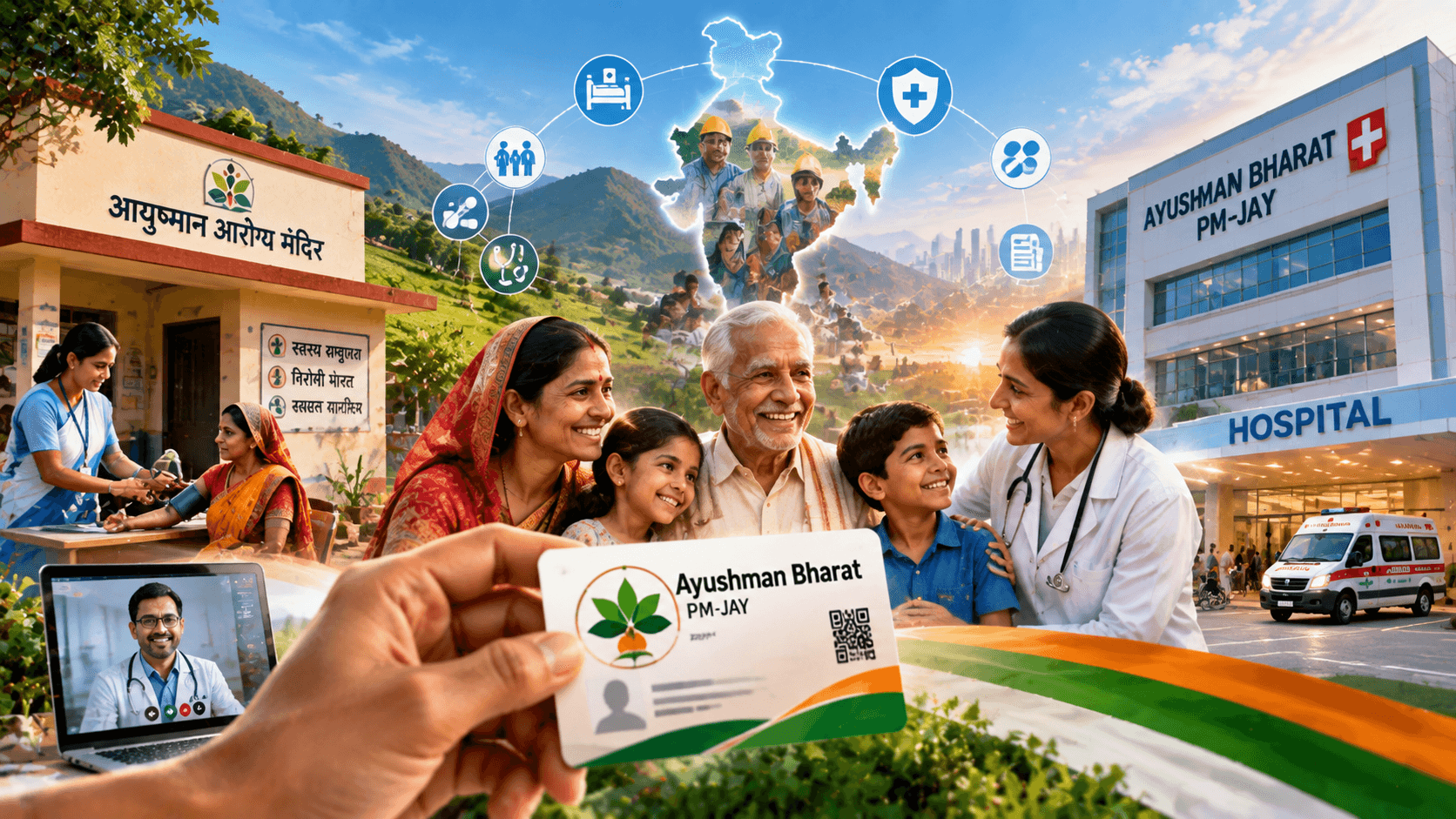
Ayushman Bharat–Pradhan Mantri Jan Arogya Yojana (AB PM-JAY) was launched on 23 September 2018. It provides health assurance for secondary and tertiary hospitalization to eligible beneficiaries through a network of empaneled public and private hospitals.
As of 21 September 2026, the scheme has achieved significant coverage:
- More than 48.51 crore Ayushman Cards have been issued.
- The scheme covers nearly 33% of India’s population.
- More than 38,000 public and private hospitals are empaneled.
- Till 31 August 2026, around 13.25 crore hospital admissions had been supported.
- Treatment worth approximately ₹2.03 lakh crore has been provided.
How Does PM-JAY Reduce Healthcare Costs?
For many poor households, a serious illness can quickly turn into a financial crisis. Hospitalization, surgery, and long-term treatment can force families to borrow money or use their savings.
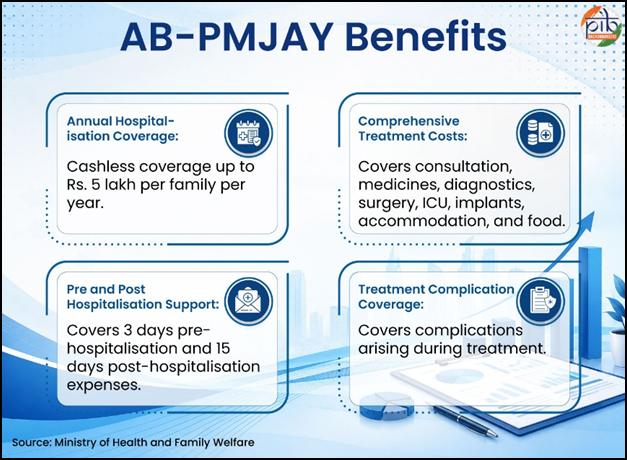
PM-JAY attempts to reduce this burden by providing cashless treatment at empaneled hospitals.
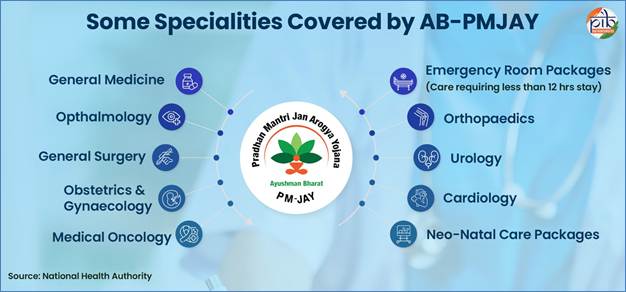
The scheme currently covers 1,961 procedures across 27 medical specialties. This helps beneficiaries access major medical services without having to bear the entire treatment cost themselves.
Therefore, one of the key contributions of PM-JAY is its effort to reduce Out-Of-Pocket Expenditure (OOPE) and the risk of catastrophic health spending.
Who is Covered Under Ayushman Bharat?
Over the years, the government has expanded the scheme to include several vulnerable and underserved groups.
These include:
- ASHA workers, Anganwadi workers, and Anganwadi helpers
- Senior citizens aged 70 years and above
- Building and Other Construction Workers and Their Families
- Sanitation workers and waste pickers
- Particularly Vulnerable Tribal Groups (PVTGs)
- Transgender persons
- Eligible children covered under PM CARES for Children
- Road accident victims under PM-RAHAT
Special Focus on Senior Citizens
In 2024, the government expanded AB PM-JAY to cover all citizens aged 70 years and above.
The move is expected to benefit nearly 6 crore senior citizens. By 21 September 2026, more than 1.36 crore Ayushman Vay Vandana Cards had been issued.
This expansion is particularly significant because older people are more likely to require hospitalization and long-term medical care.
Coverage for Frontline Workers
In March 2024, around 37 lakh families of ASHA workers, Anganwadi workers, and Anganwadi helpers were brought under the scheme. By 21 September 2026, more than 44.81 lakh Ayushman Cards had been issued to these beneficiaries.
Four Key Pillars of Ayushman Bharat
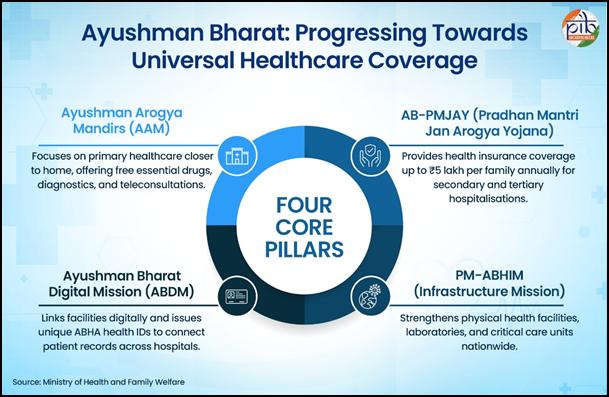
Ayushman Bharat is much broader than PM-JAY alone. It combines financial health protection with primary healthcare, digital health infrastructure, and stronger public health facilities.
1. Ayushman Arogya Mandirs: Strengthening Primary Healthcare
Ayushman Arogya Mandirs (AAMs) form the primary healthcare pillar of Ayushman Bharat. Their focus is to bring essential health services closer to people's homes and communities.
Earlier, many primary health centers focused mainly on maternal and child healthcare. AAMs have expanded this approach by providing a wider range of services.
Key services include:
- Screening and management of non-communicable diseases
- Mental healthcare
- Oral healthcare
- Eye and ENT services
- Essential medicines and diagnostics
- First-level emergency and trauma care
- Health awareness and community-level monitoring
Through e-Sanjeevani telemedicine, AAMs can also connect patients with doctors and specialists at higher-level health facilities.
Their reach has been substantial, with AAMs recording a cumulative footfall of more than 540 crore people.
2. Ayushman Bharat Digital Mission: Building Digital Healthcare
The Ayushman Bharat Digital Mission (ABDM) was launched in September 2021 to create a connected and citizen-friendly digital health ecosystem.
At the center of this system is the ABHA (Ayushman Bharat Health Account), which acts as a digital health identity. It can help individuals link and manage their health records and share relevant information with healthcare providers when required.
Major Components of ABDM
- ABHA: Digital health account for citizens.
- Healthcare Professionals Registry (HPR): Verified database of healthcare professionals.
- Health Facility Registry (HFR): Digital registry of hospitals, clinics, laboratories, and pharmacies.
- Unified Health Interface (UHI): Open digital network for accessing healthcare services.
- Arogya Setu 2.0: Platform supporting access to digital health services and personal health records.
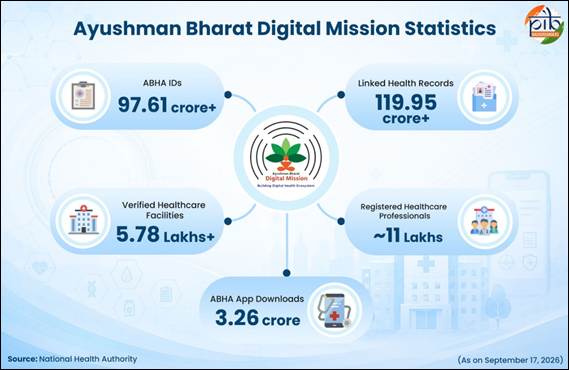
Together, these components aim to make healthcare more connected, accessible, and digitally enabled.
3. PM-ABHIM: Strengthening India's Health Infrastructure
The PM-Ayushman Bharat Health Infrastructure Mission (PM-ABHIM) was launched in October 2021 to improve health infrastructure, disease surveillance, and emergency preparedness.
With an outlay of around ₹64,180 crore for 2021–26, the mission focuses on building a stronger public health system.
Its major initiatives include:
- 23,224 rural health and wellness centers
- 13,736 urban health and wellness centers
- 3,389 Block Public Health Units
- 744 Integrated Public Health Laboratories
- 631 Critical Care Hospital Blocks
These initiatives are aimed at improving India's ability to prevent, detect, and respond to future health emergencies.
4. Financial Protection Through PM-JAY
The fourth major dimension is financial protection. PM-JAY helps eligible families access secondary and tertiary healthcare without having to bear the full cost of hospitalization.
This is particularly important for low-income households, for whom a major medical emergency can result in:
- Loss of savings
- Borrowing and debt
- Reduced household consumption
- Disruption of education or livelihoods
By providing cashless treatment, PM-JAY seeks to reduce these financial risks.
How is Ayushman Bharat funded?
AB PM-JAY is implemented as a centrally sponsored scheme, with cost-sharing arrangements depending on the state or union territory.
- Most States: Center-state ratio of 60:40
- North-Eastern States, Himachal Pradesh, Uttarakhand, and Jammu & Kashmir: 90:10
- Union Territories without legislatures: 100% central funding
- Union Territories with legislatures: 60:40
The Union Budget allocation for the scheme has also increased over time, with around ₹9,500 crore estimated for 2026–27.
Why is Ayushman Bharat important for India?
The significance of Ayushman Bharat goes beyond providing free or cashless treatment. It attempts to address different stages of the healthcare system.
At the primary level, Ayushman Arogya Mandirs bring preventive and basic healthcare closer to communities.
At the hospital level, PM-JAY provides financial protection for secondary and tertiary care.
At the digital level, ABDM is creating the infrastructure needed for connected healthcare services.
At the infrastructure level, PM-ABHIM focuses on strengthening hospitals, laboratories, and disease surveillance systems.
Together, these initiatives seek to create a healthcare system that is not only focused on treating illness but also on prevention, early detection, financial protection, and preparedness.
Conclusion
Eight years after its launch, Ayushman Bharat has evolved into a broader healthcare framework rather than remaining limited to hospital insurance. From Ayushman Arogya Mandirs at the grassroots level to PM-JAY for hospitalization, ABDM for digital healthcare, and PM-ABHIM for health infrastructure, the program covers multiple dimensions of India's healthcare system. With more than 48 crore Ayushman Cards issued and an expanding focus on senior citizens, frontline workers, and other vulnerable groups, Ayushman Bharat represents an important step towards India's goal of Universal Health Coverage—ensuring that access to healthcare does not become a source of financial hardship.