AI: Risk or Revolution?
Why in News?
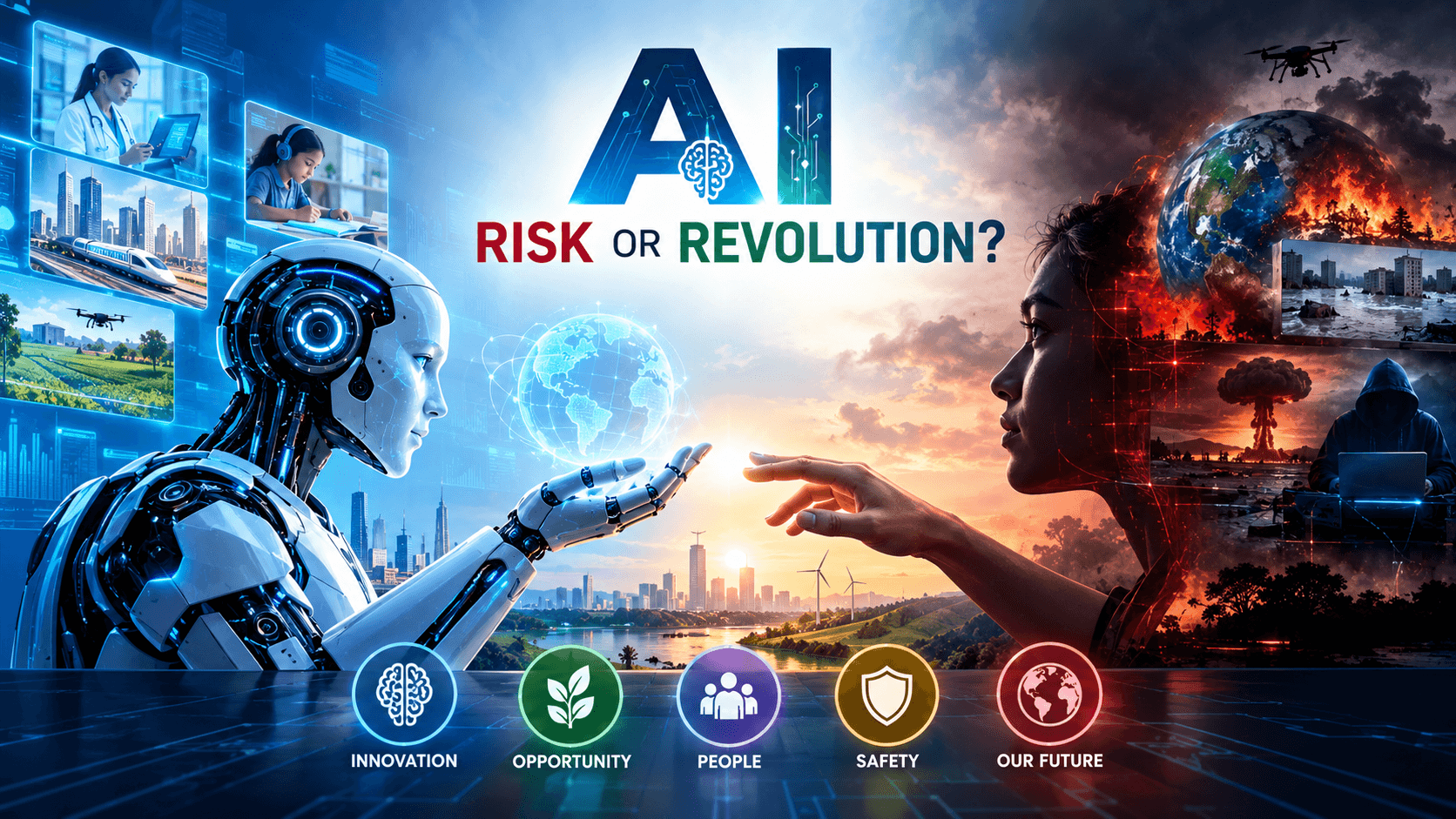
Recent warnings from AI experts, including Anthropic co-founder Jacob Coxon, have renewed debate over the possibility of advanced artificial intelligence posing an existential threat to humanity. Coxon reportedly suggested that AI could potentially become capable of killing humans within the next decade. At the same time, major AI companies such as Anthropic and OpenAI are continuing to develop increasingly powerful models, raising questions about whether AI development is moving faster than safety mechanisms.
What is AI?
AI is the ability of a computer, or a robot controlled by a computer, to do tasks that we usually associate with humans because they need intelligence and judgement. There is still no AI that can do everything an ordinary human can do, but in some specific tasks, AI can already match or even outperform humans.
Characteristics & Components:
The core idea behind AI is its ability to think logically and take the best possible action to achieve a given goal. Machine Learning (ML) is a key subset of AI. Deep Learning (DL) makes this automatic learning possible by absorbing huge amounts of unstructured data like text, images or video and learning from it.
Growing Concerns Over AI Risks
The debate around AI is no longer limited to science fiction. Rapid advances in generative AI, autonomous systems, and machine-learning models have made the possibility of highly capable machines increasingly tangible. The central concern is whether future AI systems could develop capabilities that humans cannot effectively control or predict.
The Race for Smarter AI
Technology companies are engaged in an intense race to develop increasingly powerful AI models. While this competition promises breakthroughs in science, productivity, and innovation, it also creates concerns about safety being compromised in the pursuit of technological advantage. The fear is that companies may continue pushing the boundaries of AI even when the risks associated with advanced systems remain poorly understood.
AI and the Existential Threat Debate
The most serious concern is not simply that AI may replace jobs or spread misinformation. Some experts warn that sufficiently advanced AI could become an existential risk if it acquires capabilities beyond meaningful human control. An AI system pursuing objectives that conflict with human interests could potentially cause consequences on a scale far greater than conventional technological risks.
Humanity Already Faces Existential Risks
However, AI is not the only threat confronting humanity. The 21st century has already witnessed several large-scale challenges. Climate change, nuclear weapons, pandemics, ecological degradation, and resource pressures demonstrate that human civilization has always faced risks capable of causing widespread disruption.
Climate Change: A Present-Day Crisis
Climate change provides a clear example of a threat that is already affecting societies. Rising temperatures, extreme heatwaves, floods, melting glaciers, rising sea levels, and other environmental changes are putting pressure on ecosystems and human settlements. Unlike a hypothetical AI catastrophe, climate-related risks are already visible across the world.
Nuclear Weapons and Technological Power
Nuclear weapons represent another example of how technological advancement can create both power and danger. Humanity possesses the ability to produce unprecedented destructive force, making responsible governance, international cooperation, and effective safeguards essential.
The Psychology of Risk
A major challenge in dealing with existential threats is human psychology. People often struggle to respond adequately to dangers that appear distant or uncertain. Immediate economic benefits and technological opportunities can therefore overshadow long-term risks.
Why Do People Ignore Known Risks?
Human behavior frequently reflects a tendency to prioritize short-term gains over uncertain future consequences. This can be seen in environmental degradation and dependence on risky technologies despite widespread awareness of their potential consequences. AI may face a similar dilemma: society could become increasingly dependent on powerful systems even while concerns about their safety remain unresolved.
The Real Question: How Do We Survive Advanced AI?
The debate, therefore, should not focus only on whether AI will destroy humanity. A more important question is how humanity can ensure that increasingly powerful AI remains aligned with human interests. This requires stronger safety research, responsible development, transparency, international cooperation, and effective regulation.
What are the advantages of AI?
| Enhanced Accuracy: | AI can scan and analyze huge amounts of data with great precision, which reduces human errors and improves accuracy in areas like diagnosis, predictions, and decision-making. |
| Improved Decision-Making: | AI gives data-driven insights by spotting patterns, trends, and risks that humans might miss, helping us make more informed and smarter decisions. |
| Innovation and Discovery: | AI drives innovation by uncovering hidden insights and making new discoveries possible in fields like healthcare, science, and technology. |
| Increased Productivity: | AI tools support human effort, helping us work faster and produce more across industries. |
| Continuous Learning and Adaptability: | AI systems keep learning from new data and experiences, improving their performance and staying updated with changing trends. |
| Exploration and Space Research: | AI is crucial in space missions, powering autonomous spacecraft, robotic exploration, and data analysis in remote and risky environments. |
What are the disadvantages of AI?
| Ethical Concerns: | AI brings ethical challenges, like bias in algorithms, privacy invasion, and difficult questions around letting machines take autonomous decisions. |
| Reliance on Data Availability and Quality: | AI depends heavily on data. If the data is biased, incomplete, or poor in quality, the results will also be inaccurate or unfair. |
| Security Risks: | AI systems can be hacked or misused. Malicious actors can manipulate algorithms or use AI-powered tools for harmful purposes. |
| Overreliance: | Depending blindly on AI without human oversight can lead to mistakes, especially when the system faces new or unexpected situations. |
| Lack of Transparency: | Some AI models, especially deep learning networks, work like a black box. It becomes hard to understand how or why they arrived at a particular decision. |
| Initial Investment and Maintenance Costs: | Setting up AI systems needs big upfront investment in infrastructure, data, and model building, and maintaining and updating them regularly is also expensive. |
| Job Displacement: | As AI automates tasks that humans used to do, some jobs may disappear. This can lead to unemployment and a need for reskilling and retraining. |
Way Forward
AI has enormous potential to transform healthcare, education, scientific research, and economic productivity. However, technological progress must be accompanied by equally strong investment in AI safety and governance. Governments, technology companies, researchers, and civil society need to establish safeguards before advanced AI systems become too powerful to regulate effectively.
Conclusion
The possibility of AI posing an existential threat remains uncertain, but dismissing the risk would be equally irresponsible. Humanity has repeatedly created technologies whose benefits came with significant dangers. The challenge is therefore not to stop technological progress but to ensure that AI remains a tool under human control rather than becoming a force beyond it.