
EDU TERIA Logo
CartSign InSign UpEnroll Now
Back Modern Indian History
BPSC Mains GS-1 Masterclass · Modern Indian History

Tenancy, Bakasht & AfterPeasant Movements in Bihar II

Once the Congress took office in 1937, the Kisan Sabha found itself fighting its old ally over a diluted tenancy law and over Bakasht lands that zamindars had taken in the Depression. The struggle at Barahiya Tal and Reora, the war years and the post-war fight carried the movement to zamindari abolition.

Rally19 Nov 1937Kisan Demands Day

lakhs rallied peacefully.

Protest25–31 Jul 1938Anti-agreement week

against the tenancy deal.

Barahiya~1000 bighasSettled at Monghyr

in the tenants' favour.

GayaFour-fifthsAwarded at Deora

of the disputed land.

Law< 6 acresHoldings restored

if sold during 1928-35.

Zamindari11 Sep 1950Land Reforms assent

President's assent.

Part 1 · The movement against the Tenancy Amendment Bill

A Diluted Tenancy Law and a Broken Alliance

The Congress ministry promised relief, then bowed to the landlords; the Kisan Sabha called it ‘worthless’ and took to the streets.

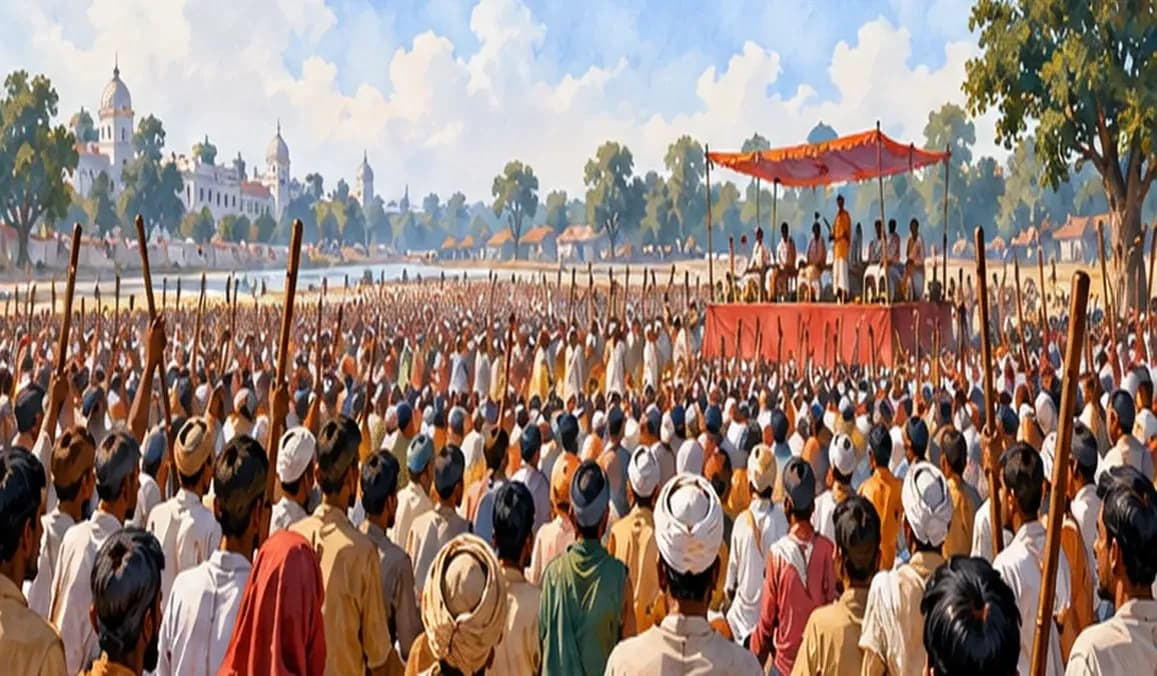
Illustration of a vast peaceful peasant rally on a large open maidan in Patna in 1937, lathis raised, seen from behind the crowd

From promise to diluted law

  1. Demand

    Debt committee

    After the formation of the Congress ministry, the Kisan Sabha urged the government to appoint a committee to examine the appalling burden of debts of peasants thoroughly to ‘devise ways and means of liquidating agricultural indebtedness’.

    Passes on: Congress promises
  2. Promise

    Two bills

    Indeed, Congress promised the waiving of debts, rent reduction, and the abolition of rents and arrears of all kinds. It introduced two bills in the Legislative Assembly, i.e. Tenancy Reforms (Amendment) Act and Agricultural Income Tax Bill.

    Passes on: landlords oppose
  3. Opposition

    Select Committee

    However, the Tenancy Reforms (Amendment) Act was sent to the Select Committee for reconsideration due to strong opposition by prominent landlords. The Bihar Landholders' Association even blamed the Kisan Sabha and socialist leaders for pressurising the Congress to bring radical changes in the tenancy bill.

    Passes on: Congress gives way
  4. Result

    Diluted bill

    In the view of the threat of financial support from landlords, the Congress modified its amendment in the Tenancy Act. Only the diluted version of the bill was passed. As per the amendment, if peasants failed in paying rent continuously for four years, landlords got the right to file a suit for such arrears.

Rajendra Prasad: pro-peasant

Rajendra Prasad described this amendment as pro-peasant and said that peasants ‘were able to reap the advantages of a new law almost immediately’.

Kisan Sabha: ‘worthless’

However, the Kisan Sabha, while describing it as ‘worthless’ and as an ‘example of an exhibition of Congress autocracy’, completely opposed the amendment.

The Kisan Sabha's protest

  • The Kisan Sabha celebrated an ‘anti-agreement week’ (July 25 to July 31, 1938). Sahajanand accused the Congress of entering into ‘an unholy alliance’ with landlords. It was the Kisan Sabha's attack on the zamindari system, which ‘started the process of alienation between the Sabha and the Congress’.
    • The Kisan Sabha warned the Congress leaders ‘against such nefarious provisions being included in the Tenancy Bill’.
  • The amendment was also criticised in the fifth and sixth Kisan Sabha conferences held at Bachwara of Monghyr district and Waini of Darbhanga district in 1937 and 1939 respectively.
  • Between 1937-1938, there broke out a wide range of peasant unrest led by the Kisan Sabha and CSP which challenged the orthodox leadership of the Congress.
  • A Kisan Demands Day was held on November 19, 1937, where lakhs of peasants participated in the rally without a single violent incident.
    • In 1938, another rally was organised in Bankipur Maidan (now Gandhi Maidan) in Patna. However, it was not successful as the government enforced IPC Section 144 to prevent the rally.

The Congress hits back

The Congress ministry blamed the Kisan Sabha for anti-Congress activities and attempted to break their movements by employing state machinery. Rajendra Prasad and Sardar Patel also criticised Sahajanand's stand against the Congress.

  • In 1937, the District Congress Committee (DCC) of Champaran and Saran districts issued resolutions not to let Kisan Sabha hold meetings and interrupted peasants who came to participate in the rallies.
  • To weaken the Kisan Sabha, the All India Khet-Mazdoor Sammelan was also to be organised under the leadership of Sardar Patel during the Haripura session of the AICC; however it could not be held.
  • The Congress leaders also criticised Sahajanand's danda which had become the symbol of resistance for peasants with the slogan lath hamara zindabad.
The Kisan Sabha explains itself

For clarifying the Kisan Sabha's stand vis-a-vis the Congress, Sahajanand, Jai Prakash Narayan, Gangasaran Singh, Rambriksha Benipuri, Ramnandan Mishra and Dhanraj Sharma signed a petition for informing the Congress that it did not intend to harm the Congress, but it only meant to ‘enable ministers to enforce the demands in the election manifesto’.

“It was the Kisan Sabha's attack on the zamindari system which ‘started the process of alienation between the Sabha and the Congress’.”
— BPSC Mains answer · Peasant movements in Bihar

Curated for BPSC, UPSC & State PCS Civil Services Aspirants | Modern Indian History Master Module