
EDU TERIA Logo
Sign InSign UpEnroll Now

Explain the pattern of monsoon rainfall distribution in India, describing the nature and type of Indian monsoon system. Discuss the importance of monsoon in the Indian economy and…

BPSC Mains answer writing · · 38 marks · model answer in Hindi & English

हिंदी माध्यम

प्रश्न

भारतीय मानसून प्रणाली के स्‍वभाव (प्रकृति) एवं प्रकार का वर्णन करते हुए भारत में मानसून वर्षा वितरण के पैटर्न को समझाएँ। भरतीय अर्थव्‍यवस्‍था में मानसून की महत्ता तथा इस पर जलवायु परिवर्त्तन के प्रभावों की विवेचना करें।


आदर्श उत्तर

मानसून शब्द की उत्पति अरबी भाषा के शब्द ‘मौसिम’ से हुई है जिसका तात्पर्य मौसम (ऋतु) से है। मानसून शब्द का सामान्य अर्थ किसी प्रदेश में प्रवाहित होने वाली हवाओं की दिशा में मौसमी परिवर्तन से है। भारतीय मानसून तंत्र एक जटिल एवं विशिष्ट मौसम प्रणाली है जो दक्षिण एशिया विशेष रूप से भारत की जलवायु पर गहरा प्रभाव डालती है। भारतीय अर्थव्यवस्था पर मानसून का प्रत्यक्ष प्रभाव पड़ता है। हाल के दिनों में जलवायु परिवर्त्तन का प्रभाव भी नकारात्‍मक रूप से मानसून प्रणाली पर पड़ा है।

भारत में मौसम के अनुसार हवाओं में परिवर्तन देखने को मिलता है अर्थात् मानसून की खासियत हवाओं में मौसमी परिवर्तन है। गर्मियों में यह हवा समुद्र से ज़मीन की ओर चलती है जबकि सर्दियों में ज़मीन से समुद्र की ओर चलती है। भारतीय मानसून की प्रकृति को हम निम्‍न रूप में देख सकते हैं-

  • मौसमी (Seasonal) प्रवृत्तिः भारतीय मानसून एक मौसमी घटना है, जो विशेष समय (जून से सितंबर) में सक्रिय होती है। इसका आगमन और वापसी निश्चित क्रम में होता है।

  • द्वैध प्रवाह प्रणाली (Dual Air Stream System): भारतीय मानसून दो भागों में बँटा होता है:

  • दक्षिण-पश्चिम मानसूनः जून से सितंबर तक, यह मुख्य मानसून होता है और लगभग 75% वार्षिक वर्षा इसी से होती है।

  • उत्तर-पूर्व मानसूनः अक्टूबर से दिसंबर के बीच, विशेषकर तमिलनाडु और आंध्र प्रदेश के कुछ हिस्सों में वर्षा कराता है।

  • अप्रत्याशितता (Unpredictability): मानसून की प्रकृति अनिश्चित होती है। कभी समय से पहले आ जाता है, कभी देरी से। वर्षा की मात्रा और स्थान भी हर वर्ष बदलते हैं।

  • क्षेत्रीय विविधता (Regional Variation): भारत के विभिन्न क्षेत्रों में मानसून की तीव्रता और समय विशेषकर तमिलनाडु और आंध्र प्रदेश के कुछ हिस्सों में वर्षा करता है।

  • अप्रत्याशितता (Unpredictability): मानसून की प्रकृति अनिश्चित होती है। कभी समय से पहले आ जाता है, कभी देरी से। वर्षा की मात्रा और स्थान भी हर वर्ष बदलते हैं।

  • क्षेत्रीय विविधता (Regional Variation): भारत के विभिन्न क्षेत्रों में मानसून की तीव्रता और समय अलग-अलग होता है। जैसे मेघालय के मासिनराम में अत्यधिक वर्षा होती है, जबकि राजस्थान में बहुत कम।

  • धीरे-धीरे फैलना और लौटना (Gradual Onset and Withdrawal): मानसून के आगमन और वापसी में समय लगता है। केरल से शुरू होकर धीरे-धीरे उत्तर की ओर बढ़ता है, और फिर धीरे-धीरे लौटता है।

  • जलवायु पर प्रभावः मानसून भारत की जलवायु को प्रभावित करता है जैसे तापमान में गिरावट, आर्द्रता में वृद्घि, कृषि का चक्र, जलाशयों का भराव आदि।

  • अंतरवर्षीय अंतर (Inter-annual Variation): हर साल मानसून का व्यवहार अलग होता है किसी साल सामान्य वर्षा होती है तो किसी साल सूखा (ड्रॉट) या अत्यधिक वर्षा (फ्लड) होती है।

भारतीय उपमहाद्वीप में दो प्रकार का मानसून तंत्र देखने को मिलता है-

1. दक्षिण-पश्चिम मानसून: दक्षिण-पश्चिम मानसून भूमध्‍य रेखा को पार करने के बाद दक्षिण-पश्चिम दिशा में प्रवाहित होता है। दक्षिण-पश्चिम मानसून का नाम इसी के आधार पर रखा गया है। यह भारतीय उपमहाद्वीप पर बनने वाली तीव्र निम्‍न दबाव प्रणाली के परिणामस्‍वरूप उत्‍पन्‍न होता है। दक्षिण-पश्चिम मानसून भारत के अधिकांश हिस्‍सों में भारी बारिश लाती है। प्री आगमन है, तो प्रचंड गड़गडाहट और बिजली के साथ नमी लाने वाली हवाएँ चलती हैं।

ध्यातव्य है कि केरल, कर्नाटक, गोवा और महाराष्ट्र के तटीय क्षेत्रों में मानसून का जून के पहले सप्ताह में आगमन हो जाता है, जबकि आन्तरिक क्षेत्रों में इसका प्रभाव जुलाई के पहले सप्ताह में देखने को मिलता है। मध्य जून से मध्य जुलाई तक दैनिक तापमान 5°C से 8°C तक गिर जाता है। यद्यपि भारतीय उपमहाद्वीपीय भूमि पर पहुँचते ही इन पवनों की दक्षिण-पश्चिमी दिशा उत्तर-पश्चिम भारत पर राहत और तापीय निम्न दबाव द्वारा संशोधित होती है। जैसे ये पवनें भारत के मुख्य भूमि के निकट आती है तो ये दो शाखाओं में विभाजित हो जाती हैं- अरब सागर शाखा और बंगाल की खाड़ी शाखा।

2. उत्तर-पूर्वी मानसून: उत्तर-पूर्वी मानसून भारत में उत्तर-पूर्व से प्रवेश करता है, इस प्रकार के मानसून में हवा समुद्र से जमीन की ओर चलती है। हिन्द महासागर से नमी मानसूनी पवनों द्वारा लाई जाती है। वस्तुतः पूर्वोत्तर मानसून दक्षिण भारत तक सीमित है, जो अक्टूबर से दिसम्बर तक तमिलनाडु, पुडुचेरी, कराईकल, आंध्र प्रदेश, केरल, माहे और दक्षिण आन्तरिक कर्नाटक में बारिश लाता है। इसे शीतकालीन मानसून भी कहा जाता है। यह तमिलनाडु की मुख्य वर्षा ऋतु है। इन तीन महीनों के दौरान तमिलनाडु में वार्षिक वर्षा का 48% प्राप्त होता है।

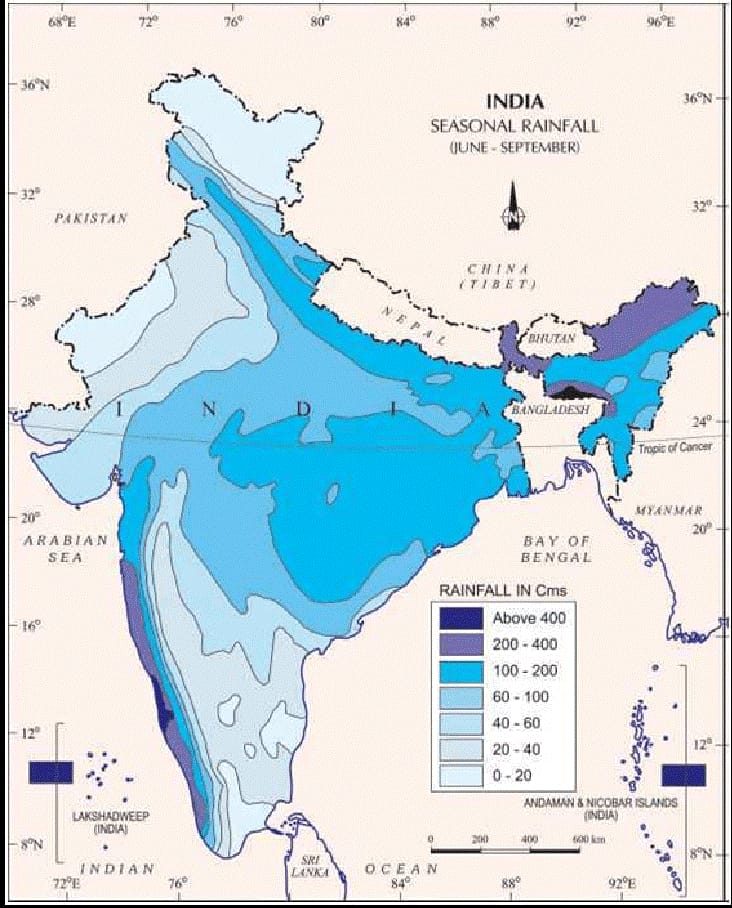
भारत में मानसून वर्षा का वितरण
A map of india showing rainfall

AI-generated content may be incorrect.
  • उच्च वर्षा वाले क्षेत्रः पश्चिमी घाट सहित पश्चिमी तट पर सबसे अधिक वर्षा होती है, जो 200 सेमी से अधिक होती है। पूर्वोत्तर में उप-हिमालयी क्षेत्र और मेघालय की पहाड़ियों में भारी वर्षा होती है, खासी और जयंतिया पहाड़ियों जैसे कुछ क्षेत्रों में 1,000 सेमी से अधिक वर्षा होती है। ब्रह्मपुत्र घाटी और आस-पास की पहाड़ियों में वर्षा 200 सेमी से कम होती है।

  • मध्यम वर्षा वाले क्षेत्रः गुजरात के दक्षिणी भाग, पूर्वी तमिलनाडु, उत्तर पूर्वी प्रायद्वीप (ओडिशा, झारखंड, बिहार, पूर्वी मध्य प्रदेश को शामिल करते हुए), उप-हिमालय के साथ उत्तरी गंगा का मैदान तथा कछार घाटी और मणिपुर में 100-200 सेमी के बीच वर्षा होती है।

  • कम वर्षा वाले क्षेत्रः पश्चिमी उत्तर प्रदेश, दिल्ली, हरियाणा, पंजाब, जम्मू और कश्मीर, पूर्वी राजस्थान, गुजरात और दक्कन के पठार में 50-100 सेमी के बीच वर्षा होती है।

  • अपर्याप्त वर्षा वाले क्षेत्रः प्रायद्वीप के कुछ हिस्सों, खासकर आंध्र प्रदेश, कर्नाटक, महाराष्ट्र, लद्दाख और पश्चिमी राजस्थान के अधिकांश हिस्सों में 50 सेमी से भी कम वर्षा होती है। मानसून की प्रकृति के कारण वार्षिक वर्षा में परिवर्तनशीलता बहुत अधिक है, खासकर कम वर्षा वाले क्षेत्रों में। यह परिवर्तनशीलता राजस्थान, गुजरात और पश्चिमी घाट के पवनाविमुखी ढाल जैसे क्षेत्रों में स्पष्ट है।

भारतीय मानसून की भारतीय अर्थव्‍यवस्‍था में महत्ता

  • कृषि जीविकाः कृषि क्षेत्र के लिए मानसून बहुत महत्वपूर्ण है, क्योंकि यह फसलों के लिए आवश्यक पानी उपलब्ध कराता है। इसकी व्यवहार्यता मानसून की विभिन्न फसलों को बनाए रखने की क्षमता में निहित है, जो भारत के खाद्य उत्पादन में महत्वपूर्ण योगदान देता है।

  • आर्थिक प्रभाव: मानसून कृषि, जल संसाधन और जल विद्युत उत्पादन को प्रभावित करके अर्थव्यवस्था में महत्वपूर्ण भूमिका निभाता है। एक अच्छी तरह से वितरित और समय पर मानसून से प्राप्त आर्थिक लाभों में व्यवहार्यता स्पष्ट है।

  • जल संसाधनों की पुन: पूर्ति: मानसून नदियों, झीलों और भूजल सहित जल संसाधनों का पुनःपूर्ति करता है, जिससे निरंतर जल आपूर्ति सुनिश्चित होती है। यह व्यवहार्यता पारिस्थितिकी तंत्र, मानव बस्तियों और पानी पर निर्भर विभिन्न उद्योगों को बनाए रखने के लिए महत्वपूर्ण है।

कुल मिलाकर जीवन और स्फूर्ति का पर्याय माने जाने वाले भारतीय मानसून तंत्र में जलवायु परिवर्तन के कारण बदलाव देखने को मिल रहे हैं। पूर्वी और पश्चिमी जेट धाराओं से प्रभावित इसके नाजुक संतुलन के लिए टिकाऊ प्रथाओं की आवश्यकता है। इस मौलिक शक्ति की विकसित होती गतिशीलता को समझने के लिए इसकी बहुमुखी प्रकृति की सराहना करना आवश्यक है।

जलवायु परिवर्तन का भारतीय मानसून पर प्रभाव

  • वर्षा पैटर्न में बदलाव : जलवायु परिवर्तन के कारण पारंपरिक मानसून वर्षा पैटर्न में बदलाव हो सकता है, जिससे विभिन्न क्षेत्रों में वर्षा के वितरण, तीव्रता और अवधि में बदलाव हो सकता है। यह अप्रत्याशित कृषि के लिए चुनौतियाँ पैदा करती है, जिससे फसल नियोजन और पैदावार पर असर पड़ता है।

  • चरम मौसम की घटनाओं में वृद्घि : ग्लोबल वार्मिंग के कारण भारी बारिश, तूफान और चक्रवात जैसी चरम मौसम की घटनाएँ लगातार और तीव्र होती जा रही हैं। ये घटनाएँ नियमित मानसून पैटर्न को बाधित कर सकती हैं, जिससे बाढ़, जलभराव और अन्य खतरे पैदा हो सकते हैं जो कृषि गतिविधियों को प्रभावित करते हैं।

  • अनिश्चित शुरुआत और वापसीः जलवायु परिवर्तन मानसून की शुरुआत और वापसी के समय को प्रभावित कर सकता है। पारंपरिक मौसमी पूर्वानुमान कम विश्वसनीय हो जाता है, जिससे किसानों के लिए बुवाई और कटाई के कार्यक्रम की योजना बनाना मुश्किल हो जाता है। मानसून के समय में परिवर्तनशीलता फसल चक्र और जल प्रबंधन को प्रभावित करती है।

  • कृषि और खाद्य सुरक्षा के लिए खतराः चूंकि भारत कृषि के लिए मानसून पर बहुत अधिक निर्भर करता है, इसलिए जलवायु परिवर्तन के कारण होने वाला कोई भी व्यवधान खाद्य सुरक्षा के लिए गंभीर खतरा पैदा करता है। अप्रत्याशित मानसून पैटर्न से फसल खराब हो सकती है, जिससे लाखों किसानों की आजीविका प्रभावित हो सकती है और क्षेत्र की समग्र स्थिरता प्रभावित हो सकती है।

भारतीय मानसून एक महत्वपूर्ण जलवायु घटना है जो न केवल मौसम बल्कि पूरे देश की आर्थिक और सामाजिक संरचना को प्रभावित करती है। अच्छी मानसून वर्षा भारतीय कृषि के लिए वरदान साबित होती है जबकि कमजोर मानसून सूखा एवं कृषि की विफलता का कारण बनती है। यह अपनी अनिश्चित प्रकृति के कारण वैज्ञानिक एवं नीतिगत अध्ययन का एक प्रमुख विषय बना हुआ है।
English Medium

Question

Explain the pattern of monsoon rainfall distribution in India, describing the nature and type of Indian monsoon system. Discuss the importance of monsoon in the Indian economy and the impact of climate change on it.


Model answer

The monsoon is the lifeline of Indian agriculture and the broader economy, shaping the socio-economic fabric of the country. Derived from the Arabic word “mausim”, meaning season, the Indian monsoon refers to the seasonal reversal of winds that bring heavy rainfall to the subcontinent. The Southwest Monsoon, which arrives is early June and withdraws by September, accounts for nearly 75% of India’s annual rainfall. It influences not just crop patterns and water availability, but also energy generation, transport, and rural livelihoods.

In India, changes in winds are seen according to the season, that is, the specialty of monsoon is seasonal change in winds. In summers, this wind blows from the sea towards the land while in winters it blows from the land towards the sea. We can see the nature of Indian monsoon in the following form-

  • Seasonal pattern: Indian monsoon is a seasonal phenomenon, which is active at a particular time (June to September). Its arrival and return happen in a fixed order.

  • Dual Air Stream System: Indian monsoon is divided into two parts:

  • Southwest Monsoon: From June to September, it is the main monsoon and brings about 75% of the annual rainfall.

  • Northeast Monsoon: From October to December, brings rain especially to Tamil Nadu and parts of Andhra Pradesh.

  • Unpredictability: The nature of monsoon is uncertain. Sometimes it comes before time, sometimes late. The amount and location of rainfall also changes every year.

  • Regional Variation: The intensity and timing of monsoon rains in different regions of India especially in Tamil Nadu and parts of Andhra Pradesh.

  • Unpredictability: The nature of monsoon is uncertain. Sometimes it comes before time, sometimes late. The amount and location of rainfall also changes every year.

  • Regional Variation: The intensity and timing of monsoon varies in different regions of India. For example, Mawsynram in Meghalaya receives heavy rainfall, while Rajasthan receives very little rainfall.

  • Gradual Onset and Withdrawal: The arrival and withdrawal of the monsoon takes time. Starting from Kerala, it slowly moves northwards, and then slowly returns.

  • Effect on Climate: Monsoon affects the climate of India like drop in temperature, increase in humidity, agricultural cycle, filling of reservoirs etc.

  • Inter-annual Variation: The behaviour of monsoon is different every year, some years there is normal rainfall, some years there is drought or excessive rainfall (flood).

Two types of monsoon systems are seen in the Indian subcontinent-

1. Southwest Monsoon: The southwest monsoon flows in the southwest direction after crossing the equator. The southwest monsoon is named after this barrier. It is produced as a result of an intense low-pressure system formed over the Indian subcontinent. The southwest monsoon brings heavy rains to most parts of India. Pre-arrival winds bring moisture along with severe thunder and lightning.

It is noteworthy that monsoon arrives in the coastal areas of Kerala, Karnataka, Goa and Maharashtra in the first week of June, while its effect is seen in the interior areas in the first week of July. From mid-June to mid-July, the daily temperature falls by 5°C to 8°C. However, as soon as they reach the Indian subcontinental land, the south-western direction of these winds is modified by relief and thermal low pressure over north-west India. As these winds approach the mainland of India, they get divided into two branches - Arabian Sea branch and Bay of Bengal branch.

2. North-East Monsoon- North-East monsoon enters India from the North-East, in this type of monsoon the air moves from the sea towards the land. Moisture from the Indian Ocean is brought by the monsoon winds. Actually, the North-East monsoon is limited to South India, which brings rain to Tamil Nadu, Puducherry, Karaikal, Andhra Pradesh, Kerala, Mahe and South Interior Karnataka from October to December. It is also called the winter monsoon. It is the main rainy season of Tamil Nadu. During these three months, Tamil Nadu receives 48% of its annual rainfall.

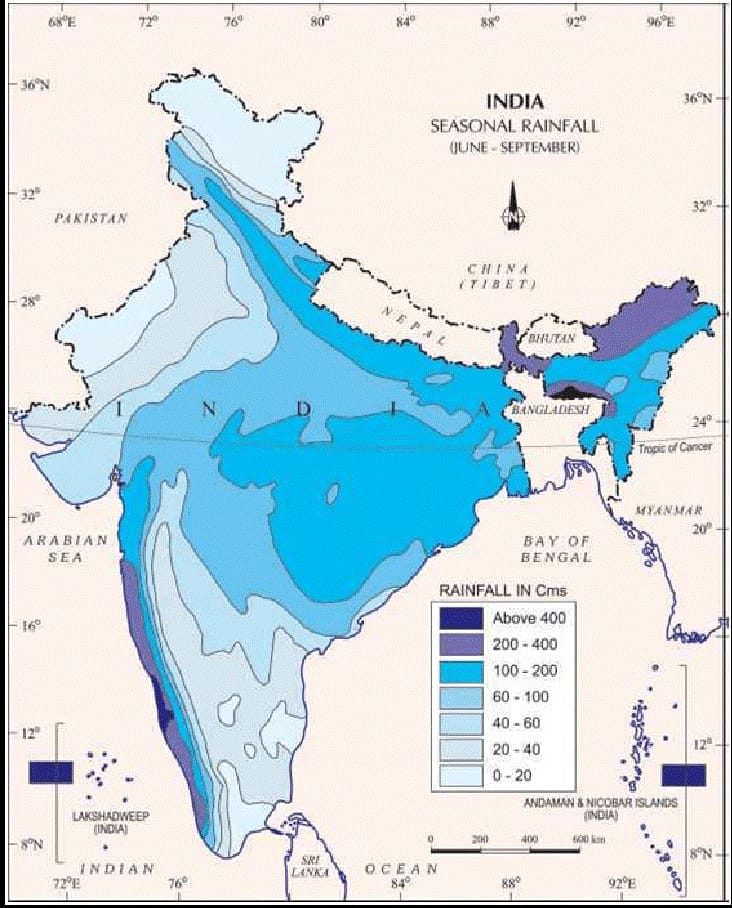
Distribution of Monsoon Rainfall in India

  • High rainfall areas: The western coast including the Western Ghats receives the highest rainfall, exceeding 200 cm. The sub-Himalayan region in the northeast and the Meghalaya hills receive heavy rainfall, with some areas like the Khasi and Jaintia Hills receiving over 1,000 cm of rainfall. The Brahmaputra Valley and adjoining hills receive rainfall less than 200 cm.

  • Moderate Rainfall Areas: Southern parts of Gujarat, Eastern Tamil Nadu, North Eastern Peninsula (including Odisha, Jharkhand, Bihar, Eastern Madhya Pradesh), Northern Gangetic Plain along with Sub-Himalayas and Cachar Valley and Manipur receive rainfall between 100-200 cm.

  • Low rainfall areas: Western Uttar Pradesh, Delhi, Haryana, Punjab, Jammu and Kashmir, Eastern Rajasthan, Gujarat and Deccan Plateau receive rainfall between 50-100 cm.

  • Areas with inadequate rainfall: Parts of the peninsula, especially Andhra Pradesh, Karnataka, Maharashtra, Ladakh and most parts of western Rajasthan receive less than 50 cm of rainfall. Due to the nature of the monsoon, the variability in annual rainfall is very high, especially in the deficient rainfall areas. This variability is most pronounced in areas like Rajasthan, Gujarat and the leeward slopes of the Western Ghats.

Importance of Indian monsoon to Indian economy

  • Agricultural Livelihood: The monsoon is very important for the agricultural sector, as it provides the water required for crops. Its viability lies in the monsoon's ability to sustain a variety of crops, which contribute significantly to India's food production.

  • Economic Impact: Monsoon plays a vital role in the economy by affecting agriculture, water resources and hydropower generation. The viability is evident in the economic benefits accruing from a well-delivered and timely monsoon.

  • Replenishment of water resources: The monsoon replenishes water resources, including rivers, lakes and groundwater, ensuring a continuous water supply. This viability is vital for sustaining ecosystems, human settlements and various industries that depend on water.

Overall, the Indian monsoon system, which is considered synonymous with life and vigour, is witnessing changes due to climate change. Its delicate balance, influenced by the eastern and western jet streams, requires sustainable practices. To understand the evolving dynamics of this fundamental force, it is necessary to appreciate its multifaceted nature.

Impact of climate change on Indian monsoon

  • Changes in rainfall patterns: Climate change may cause changes in traditional monsoon rainfall patterns, leading to changes in the distribution, intensity and duration of rainfall across different regions. This unpredictability poses challenges for agriculture, impacting crop planning and yields.

  • Increase in extreme weather events: Extreme weather events such as heavy rainfall, storms and cyclones are becoming more frequent and intense due to global warming. These events can disrupt the regular monsoon pattern, leading to floods, waterlogging and other hazards that affect agricultural activities.

  • Uncertain onset and withdrawal: Climate change may affect the timing of the onset and withdrawal of monsoons. Traditional seasonal forecasting becomes less reliable, making it difficult for farmers to plan sowing and harvesting schedules. Variability in the timing of monsoons affects crop cycles and water management.

  • Threat to agriculture and food security: Since India is heavily dependent on monsoon for agriculture, any disruption caused by climate change poses a serious threat to food security. Unpredictable monsoon patterns can lead to crop failure, affecting the livelihoods of millions of farmers and the overall stability of the sector.

The Indian monsoon is an important climatic phenomenon that affects not only the weather but also the economic and social structure of the entire country. Good monsoon rainfall proves to be a boon for Indian agriculture while weak monsoon leads to drought and agricultural failure. It remains a major subject of scientific and policy studies due to its uncertain nature.

Practise it yourself. Get your copy evaluated, free.

New question every day at 10:00 PM IST · हर रात 10 बजे नया प्रश्न

Join PARAKH free