
EDU TERIA Logo
CartSign InSign UpEnroll Now

"Indian federalism is fundamentally rooted in two simultaneous pursuits of nationhood: an embrace of state-based cultural diversities and a commitment to the larger Indian politic…

BPSC Mains answer writing · · 38marks · model answer in Hindi & English

हिंदी माध्यम

प्रश्न

"भारतीय संघवाद मूल रूप से राष्ट्रीयता के दो एक-साथ प्रयासों में निहित है: राज्य-आधारित सांस्कृतिक विविधताओं को अपनाना और बड़े भारतीय राजनीतिक समुदाय के प्रति प्रतिबद्घता।" उपरोक्त कथन के आलोक में संघवाद के भारतीय मॉडल की प्रकृति का आलोचनात्मक परीक्षण कीजिए।


आदर्श उत्तर

भारतीय संघवाद एक अनूठा 'एकजुटता बनाए रखने वाला' मॉडल है। यह केवल सत्ता का विभाजन ही नहीं करता, बल्कि दो परस्पर विरोधी आवश्यकताओं के बीच निरंतर संतुलन स्थापित करता है: भारत की गहरी सांस्कृतिक, भाषाई और क्षेत्रीय विविधता को समायोजित करना और साथ ही एक मजबूत, एकीकृत राजनीतिक राष्ट्र को बनाए रखना। यह संरचना सैद्घांतिक पूर्णता से अधिक व्यावहारिक अस्तित्व पर केंद्रित है, जिसे उप-राष्ट्रीय पहचानों को पोषित करते हुए विखंडन को रोकने के लिए डिज़ाइन किया गया है।
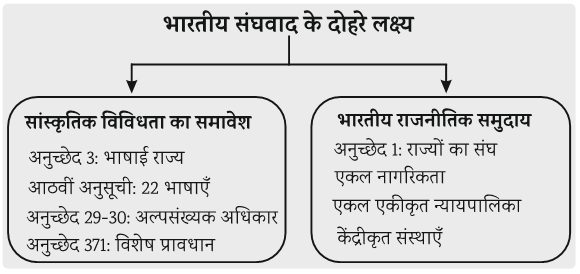
राज्य-आधारित सांस्कृतिक विविधताओं को अपनाना

भारतीय संविधान मानता है कि क्षेत्रीय और सांस्कृतिक पहचान राष्ट्रीय अखंडता के लिए खतरा नहीं हैं, बल्कि इसकी आधारभूत संरचना हैं।

  • भाषाई पुनर्गठन (अनुच्‍छेद 3): बहुसंख्यक समरूपता को रोकने के लिए, राज्य ने क्षेत्रीय उप-संस्कृतियों को संरक्षित करने हेतु भाषा के आधार पर आंतरिक सीमाओं का पुनर्गठन करते हुए, राज्य पुनर्गठन अधिनियम, 1956 पारित किया।

  • संवैधानिक भाषा संरक्षण (आठवीं अनुसूची): संविधान स्पष्ट रूप से 22 आधिकारिक भाषाओं को मान्यता देता है, जिससे उप-राष्ट्रीय पहचानों को कानूनी रूप से संस्थागत दर्जा प्राप्त होता है।

  • सांस्कृतिक और शैक्षिक अधिकार (अनुच्‍छेद 29 और 30): ये मौलिक अधिकार अल्पसंख्यक समुदायों को उनकी विशिष्ट भाषा, लिपि या संस्कृति को संरक्षित करने का पूर्ण अधिकार प्रदान करके उनकी रक्षा करते हैं।

  • असममित संघवाद (अनुच्‍छेद 371 से 371J): यह ढांचा नागालैंड (अनुच्‍छेद 371A) और मिजोरम (अनुच्‍छेद 371G) जैसे राज्यों के प्रथागत कानूनों, धार्मिक परंपराओं और जनजातीय प्रशासनिक प्रणालियों को संरक्षित करने के लिए विशिष्ट, असमान छूट प्रदान करता है।

  • छठी अनुसूची (पूर्वोत्तर स्वायत्तता): यह असम, मेघालय, त्रिपुरा और मिजोरम में जनजातीय आबादी के सामाजिक, सांस्कृतिक और प्रशासनिक अधिकारों की रक्षा के लिए स्वायत्त जिला परिषदों के गठन का प्रावधान करती है।

  • न्यायिक समर्थन: प्रदीप जैन बनाम भारत संघ (1984) मामले में, सर्वोच्च न्यायालय ने भारत को एक समृद्घ "रत्नों के संदूक" के रूप में खूबसूरती से वर्णित किया, जहां प्रत्येक राज्य एक अद्वितीय, विशिष्ट रत्न का प्रतिनिधित्व करता है।

  • विकेंद्रीकरण (73वां और 74वां संशोधन): इन संशोधनों ने स्थानीय स्वशासन को सशक्त बनाया, जिससे विशिष्ट सांस्कृतिक या क्षेत्रीय समुदायों को अपने स्थानीय मामलों का सीधे प्रबंधन करने की अनुमति मिली, जिससे जमीनी स्तर पर लोकतांत्रिक विविधता को बढ़ावा मिला।

व्यापक भारतीय राजनीतिक समुदाय के प्रति प्रतिबद्घता:

साथ ही, संविधान उपमहाद्वीप में विभाजन को रोकने और मानक लोकतांत्रिक मानदंडों को बढ़ावा देने के लिए एक अटूट संस्थागत ढांचा स्थापित करता है।

  • क्षेत्रीय अविनाशिता (अनुच्‍छेद 1 और 3): अनुच्‍छेद 1 भारत को "राज्यों का संघ" के रूप में स्थापित करता है। डॉ. बी.आर. अंबेडकर ने स्पष्ट किया कि संघ किसी अनुबंध का परिणाम नहीं है, जिसका अर्थ है कि किसी भी राज्य को अलग होने का अधिकार नहीं है। संसद अनुच्‍छेद 3 के तहत किसी भी राज्य को उसकी सहमति के बिना एकतरफा रूप से बदल सकती है, उसका नाम बदल सकती है या उसे भंग कर सकती है।

  • एकल संवैधानिक पहचान: भारत केंद्र और राज्यों दोनों के लिए एकल नागरिकता और एकल संविधान के माध्यम से एक एकीकृत राजनीतिक वास्तविकता को लागू करता है।

  • विधान निर्माण में संघीय प्रधानता (अनुच्‍छेद 246): सातवीं अनुसूची में केंद्र की ओर स्पष्ट झुकाव दिखता है। संघ सूची में प्रमुख राष्ट्रीय विषय शामिल हैं, और अनुच्‍छेद 246(2) यह सुनिश्चित करता है कि समवर्ती सूची में किसी विवाद की स्थिति में केंद्रीय कानून स्वतः ही राज्य कानून पर हावी हो जाएगा।

  • अवशिष्ट शक्तियां (अनुच्‍छेद 248): तीनों सूचियों में स्पष्ट रूप से निर्दिष्ट न किए गए किसी भी विधायी क्षेत्र (जैसे साइबर कानून) स्वतः ही संघ में निहित हो जाते हैं।

  • एकीकृत प्रशासनिक तंत्र: एकल एकीकृत न्यायपालिका (सर्वोच्च न्यायालय के साथ), अखिल भारतीय सेवाएं (आईएएस, आईपीएस), और भारत का एकल चुनाव आयोग (अनुच्‍छेद 324) स्थानीय प्रशासनों को राष्ट्रीय केंद्र से मजबूती से जोड़ते हैं।

आलोचनात्मक विश्लेषण: भारतीय मॉडल की प्रकृति:

क्योंकि संविधान की संरचना केंद्रीय राजनीतिक समुदाय की ओर अधिक झुकी हुई है, इसलिए संवैधानिक विद्वानों ने ऐतिहासिक रूप से भारतीय मॉडल को "अर्ध-संघीय" (के.सी. व्हेयर) या "स्पष्ट एकात्मक झुकाव" वाला संघ कहा है।

एकात्मक झुकाव के संरचनात्मक प्रमाण:

  • केंद्रीकृत नौकरशाही (अखिल भारतीय सेवाएँ): केंद्र सरकार द्वारा अखिल भारतीय सेवाओं (आईएएस, आईपीएस) की भर्ती और प्रशिक्षण से केंद्र को राज्य-स्तरीय कार्यान्वयन पर महत्वपूर्ण प्रशासनिक नियंत्रण प्राप्त होता है, जो प्रभावी रूप से केंद्रीय नीति कार्यान्वयन के विस्तार के रूप में कार्य करता है।

  • अवशिष्ट शक्तियाँ (अनुच्‍छेद 248): अमेरिका या स्विट्जरलैंड जैसे पारंपरिक संघों के विपरीत, जहाँ अवशिष्ट शक्तियाँ राज्यों के पास होती हैं, भारतीय संविधान इन्हें संघ में निहित करता है, जिससे केंद्र को किसी भी नए या अपरिभाषित विषय पर विधायी सर्वोच्चता प्राप्त होती है।

  • राज्य सीमाओं पर संसदीय नियंत्रण (अनुच्‍छेद 3): संघ संसद को राज्य सीमाओं के पुनर्गठन, नामकरण या यहां तक कि समाप्ति का एकतरफा अधिकार प्राप्त है, जो इस सिद्घांत को सुदृढ़ करता है कि संघ अविनाशी है जबकि राज्य नहीं।

  • एकीकृत न्यायपालिका और चुनाव तंत्र: एक एकल, एकीकृत न्यायिक प्रणाली और भारत का एक केंद्रीकृत चुनाव आयोग कानून प्रवर्तन और चुनावी प्रक्रियाओं में एकरूपता सुनिश्चित करते हैं, जिससे राज्य-विशिष्ट कानूनी या प्रक्रियात्मक भिन्नताओं की गुंजाइश सीमित हो जाती है।

  • वित्तीय केंद्रीकरण (अनुच्‍छेद 270 और 293): संघ प्रमुख कर स्रोतों (जीएसटी, आयकर) पर प्रभुत्व रखता है, जिससे ऊर्ध्वाधर राजकोषीय असंतुलन उत्पन्न होता है। राज्य वित्त आयोग के माध्यम से केंद्रीय हस्तांतरण और विवेकाधीन केंद्रीय अनुदानों पर वित्तीय रूप से निर्भर रहते हैं। इसके अलावा, अनुच्‍छेद 293 राज्य कार्यपालिकाओं पर कठोर, प्रतिबंधात्मक उधार सीमाएं लगाता है।

  • राज्यपाल कार्यालय (अनुच्‍छेद 155 और 200): राज्यपालों की केंद्रीय नियुक्ति ने अक्सर इस कार्यालय को संघीय संपर्क सूत्र से राजनीतिक टकराव का केंद्र बना दिया है, विशेष रूप से तब जब राज्यपाल राज्य के कानूनों को अनिश्चित काल के लिए अस्वीकार कर देते हैं या राष्ट्रपति शासन की सिफारिश करते हैं।

  • आपातकालीन परिवर्तन (अनुच्‍छेद 352, 356, 360): आपातकाल की घोषणा अस्थायी रूप से संघीय व्यवस्था को निलंबित कर देती है, जिससे औपचारिक संवैधानिक संशोधन के बिना ही पूरी व्यवस्था स्वतः ही एकात्मक मॉडल में परिवर्तित हो जाती है।

बदलती परिस्थितियाँ: सहयोग और प्रतिस्पर्धा की ओर बदलाव:

वित्तीय सहयोग के साधन:

  • केंद्र प्रायोजित योजनाएँ (सीएसएस): केंद्र और राज्यों द्वारा संयुक्त रूप से वित्तपोषित (उदाहरण- स्‍वच्‍छ भारत मिशन, प्रधानमंत्री आवास योजना)। ये योजनाएँ संयुक्त कार्यान्वयन को प्रोत्साहित करती हैं, लेकिन इनमें राज्यों को समान अनुदान प्रदान करना आवश्यक होता है, जिससे कभी-कभी राज्य के बजट पर दबाव पड़ सकता है।

  • केंद्रीय क्षेत्र योजनाएँ: केंद्र सरकार द्वारा पूर्णतः वित्तपोषित और कार्यान्वित (उदाहरण- पीएम-किसान, भारत नेट)। ये प्रत्यक्ष सेवा वितरण और राष्ट्रीय एकरूपता सुनिश्चित करती हैं, जिससे राज्य स्तर की वित्तीय बाधाओं को प्रभावी ढंग से दरकिनार किया जा सकता है।

  • न्यायिक संरक्षण: ऐतिहासिक एस.आर. बोम्मई बनाम भारत संघ (1994) मामले में, सर्वोच्च न्यायालय ने औपचारिक रूप से संघवाद को संविधान की मूल संरचना का हिस्सा घोषित किया। इससे राज्य सरकारों के विरुद्घ अनुच्‍छेद 356 (राष्ट्रपति शासन) के मनमाने दुरुपयोग पर प्रभावी रूप से रोक लगी।

  • संस्थागत संरचनात्मक सौदेबाजी: जीएसटी परिषद (अनुच्‍छेद 279ए) की स्थापना सच्चे सहकारी संघवाद को दर्शाती है, जिससे यह सुनिश्चित होता है कि कर नीतियां एकतरफा केंद्रीय आदेशों के बजाय संयुक्त केंद्र-राज्य मतदान के माध्यम से तय की जाती हैं।

  • प्रतिस्पर्धी संघवाद: नीति आयोग के हस्तक्षेप (जैसे सतत विकास लक्ष्य सूचकांक) राज्यों को शासन में सुधार के लिए एक स्वस्थ, प्रतिस्पर्धी दौड़ में शामिल करते हैं, जिससे संघर्ष से प्रदर्शन की ओर ध्यान केंद्रित होता है।

  • अंतर-राज्य परिषद (अनुच्‍छेद 263): यद्यपि संविधान केंद्र-राज्य परामर्श के लिए यह मंच प्रदान करता है, फिर भी इसका कम उपयोग होता है, जिससे संघर्ष समाधान के प्राथमिक तंत्र के रूप में इसकी क्षमता का दोहन नहीं हो पाता है।

दो लक्ष्यों के बीच संतुलन बनाने में सीमाएं और चुनौतियां:

इस दोहरी राष्ट्रवाद मॉडल के व्यावहारिक कार्यान्वयन में कई गंभीर बाधाएँ हैं:

  • उप-राष्ट्रवाद बनाम राष्ट्रीय एकता: सांस्कृतिक पहचान के वैध दावे कभी-कभी अति-क्षेत्रवाद या अलगाववादी प्रवृत्तियों में परिवर्तित हो सकते हैं, जिससे गंभीर आंतरिक सुरक्षा संकट उत्पन्न हो सकते हैं।

  • समरूपता का दबाव: भाषाई एकरूपता की दिशा में संरचनात्मक प्रयास (जैसे हिंदी के प्रचार को लेकर बहुभाषी टकराव की आशंका) को दक्षिणी और पूर्वोत्तर राज्यों से अक्सर तीव्र प्रतिरोध का सामना करना पड़ता है, जिससे "विविधता को अपनाने" की क्षमता की परीक्षा होती है।

  • विकासशील राज्यों का राजकोषीय संकट की स्थिति (बिहार का उदाहरण): बिहार जैसे आर्थिक रूप से कमजोर और उच्च जनसंख्या घनत्व वाले राज्य अत्यधिक राजकोषीय केंद्रीकरण से जूझ रहे हैं। बिहार का कम औद्योगिक कर आधार इसे वित्त आयोग के क्षैतिज हस्तांतरण पर संरचनात्मक रूप से निर्भर बनाता है। विशेष श्रेणी का दर्जा प्राप्त करने की इसकी दीर्घकालिक मांग केंद्र-राज्य वार्ता में अटकी हुई है, जो दर्शाती है कि सीमित स्थानीय राजकोषीय क्षमता किसी राज्य की अपनी अनूठी सांस्कृतिक और विकासात्मक आवश्यकताओं को पूरा करने की क्षमता को कैसे सीमित करती है।

  • राजनीतिक विश्वास की कमी: केंद्र और विपक्षी दलों द्वारा शासित राज्यों के बीच बार-बार होने वाले संचार अवरोध 'विश्वास की कमी' पैदा करते हैं, जिससे अक्सर संयुक्त राष्ट्रीय परियोजनाओं के कार्यान्वयन में बाधा उत्पन्न होती है।

आगे का रास्ता और संस्थागत सुधार:

  • सरकारिया आयोग: इसने एक स्थायी अंतर-राज्य परिषद की स्थापना, अनुच्‍छेद 356 (राष्ट्रपति शासन) के प्रयोग पर सख्त सीमाएं लगाने और समवर्ती सूची से संबंधित मामलों पर राज्यों के साथ अनिवार्य परामर्श पर जोर दिया।

  • पुंछी आयोग: इसने अनुच्‍छेद 355/356 के तहत केंद्र के हस्तक्षेप को विशिष्ट अशांत क्षेत्रों तक सीमित करने, राज्यपाल की नियुक्तियों में मुख्यमंत्रियों की राय सुनिश्चित करने, वित्त आयोग को एक स्थायी निकाय बनाने और राज्यपाल की विवेकाधीन शक्तियों को सीमित करने की सिफारिश की।

  • राजमन्नार समिति: इसने राज्यों को वित्तीय और विधायी शक्तियों के अधिक हस्तांतरण की वकालत की, जिसमें कुछ संघ सूची के विषयों (जैसे खनिज संसाधन) को राज्य सूची में स्थानांतरित करना शामिल है।

  • प्रथम प्रशासनिक सुधार आयोग (एआरसी): इसने राज्यों को प्रशासनिक और वित्तीय शक्तियों के अधिकतम प्रत्यायोजन और संघर्ष समाधान के प्राथमिक मंच के रूप में अंतर-राज्य परिषद को सुदृढ़ करने की आवश्यकता पर बल दिया।

  • राजकोषीय संघवाद सुधार: वित्त आयोग के भार मानदंड का पुनर्मूल्यांकन करके संसाधनों के अधिक न्यायसंगत वितरण की दिशा में आगे बढ़ने से राजकोषीय रूप से संकटग्रस्त राज्यों की शिकायतों का समाधान हो सकता है और क्षेत्रीय असमानताओं को कम किया जा सकता है।

  • सहयोगात्मक शासन: 'ऊपर से नीचे' के आदेशों से हटकर 'नीचे से ऊपर' की नीति निर्माण पर ध्यान केंद्रित करने से, जहां राज्य राष्ट्रीय नीतियों के निर्माण में समान भागीदार हों, विशेष रूप से समवर्ती सूची में शामिल विषयों के लिए, बेहतर कार्यान्वयन परिणाम प्राप्त हो सकते हैं।

भारतीय संघवाद एक कठोर सिद्घांत नहीं, बल्कि एक व्यावहारिक अनुकूलन है। जैसा कि डॉ. बी.आर. अंबेडकर ने कहा था, यह समय की आवश्यकता के अनुसार 'एकात्मक और संघीय' दोनों है। इस प्रणाली की असली परीक्षा इसके संवैधानिक पाठ में नहीं, बल्कि इसके दैनिक अभ्यास में है। आगे बढ़ते हुए, ध्यान राजनीतिक प्रतिस्पर्धा से हटकर सहयोगात्मक शासन पर केंद्रित होना चाहिए, जिससे यह सुनिश्चित हो सके कि संघ की शक्ति और राज्यों की विविधता आपस में टकराएं नहीं, बल्कि मिलकर एक अधिक मजबूत लोकतंत्र का निर्माण करें।
English Medium

Question

"Indian federalism is fundamentally rooted in two simultaneous pursuits of nationhood: an embrace of state-based cultural diversities and a commitment to the larger Indian political community." Examine critically the nature of Indian model of federalism in the light of the above statement.


Model answer

Indian federalism is a unique 'holding together' model. It doesn't just divide power; it constantly balances two competing needs: accommodating India’s deep cultural, linguistic, and regional diversity while maintaining a strong, unified political nation. This structure is less about theoretical perfection and more about practical survival, designed to prevent fragmentation while nurturing sub-national identities.

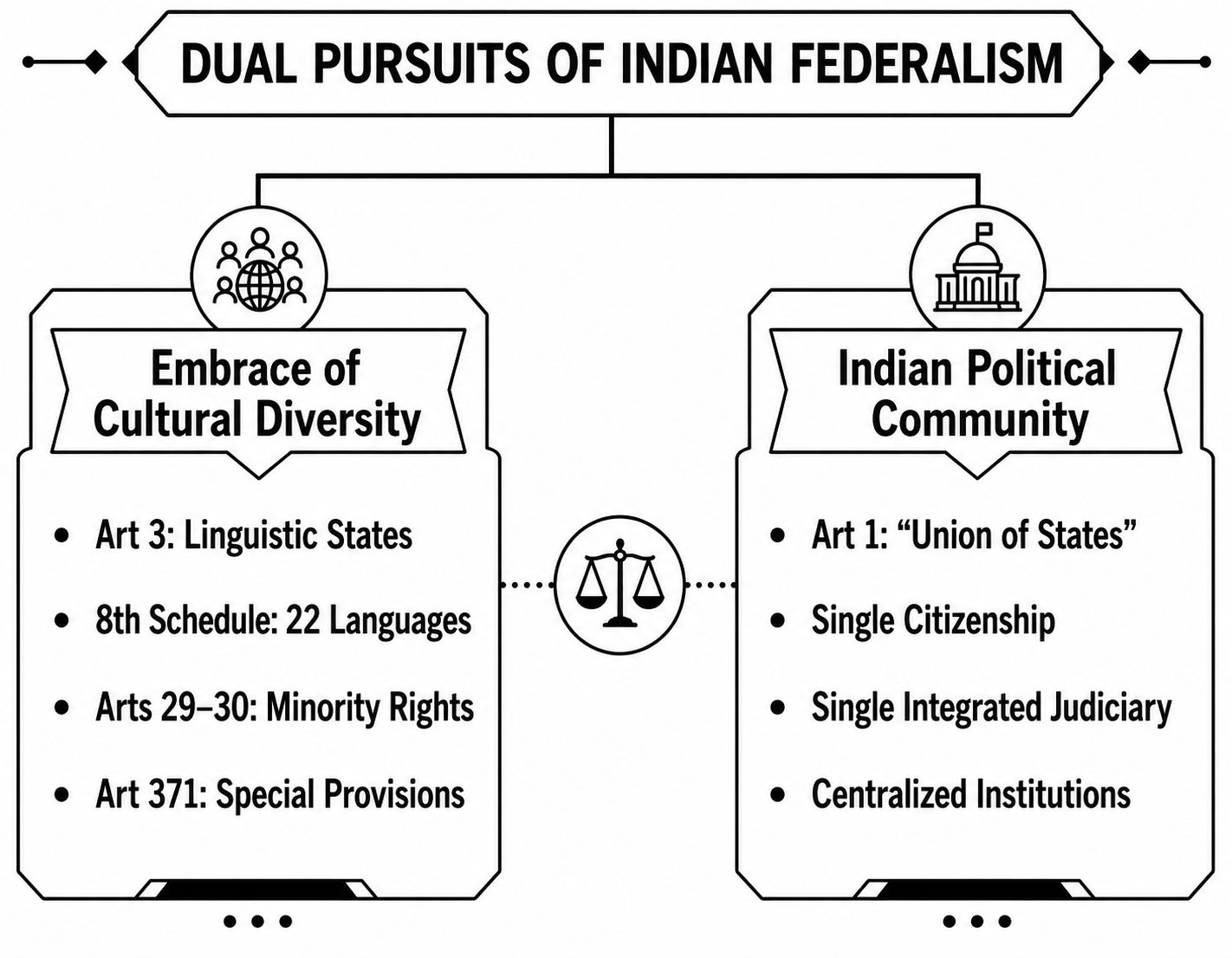
Embrace Of State-Based Cultural Diversities

The Indian Constitution recognizes that regional and cultural identities are not threats to national integrity, but rather its foundational building blocks:

  • Linguistic Reorganization (Article 3): To prevent majoritarian homogenization, the State passed the States Reorganisation Act, 1956, restructuring internal boundaries based on language to preserve regional sub-cultures.

  • Constitutional Language Safeguards (8th Schedule): The Constitution explicitly recognizes 22 official languages, legally institutionalizing sub-national identities.

  • Cultural and Educational Rights (Articles 29 & 30): These Fundamental Rights shield minority communities by granting them the absolute right to conserve their distinct language, script, or culture.

  • Asymmetrical Federalism (Articles 371 to 371J): The framework tailors specific, unequal exemptions to preserve the customary laws, religious traditions, and tribal administrative systems of states like Nagaland (Art 371A) and Mizoram (Art 371G).

  • Sixth Schedule (Northeast Autonomy): Provides for the creation of Autonomous District Councils in Assam, Meghalaya, Tripura, and Mizoram to protect the social, cultural, and administrative rights of tribal populations.

  • Judicial Endorsement: In Pradeep Jain v. Union of India (1984), the Supreme Court beautifully described India as an organic "casket of gems," where each state represents a unique, distinct jewel.

  • Decentralization (73rd & 74th Amendments): These amendments empowered local self-governments, allowing specific cultural or regional communities to manage their own local affairs directly, deepening democratic diversity at the grassroots.

Commitment to the Larger Indian Political Community

Simultaneously, the Constitution establishes an unbreakable institutional canopy to prevent balkanization and foster standard democratic norms across the subcontinent:

  • Territorial Indestructibility (Article 1 & 3): Article 1 establishes India as a "Union of States." Dr. B.R. Ambedkar clarified that the federation is not a result of a contract, meaning no state has the right to secede. The Parliament can unilaterally alter, rename, or dismantle any state under Article 3 without its consent.

  • Single Constitutional Identity: India enforces a unified political reality through Single Citizenship and a Single Constitution for both the Centre and the states.

  • Federal Primacy in Legislation (Article 246): The Seventh Schedule displays a sharp central tilt. The Union List handles dominant national subjects, and Article 246(2) ensures that central law automatically overrides state law in the case of a conflict on the Concurrent List.

  • Residuary Powers (Article 248): Any legislative domain not explicitly specified in the three lists (e.g., cyber law) automatically vests in the Union.

  • Unified Administrative Machinery: The Single Integrated Judiciary (with the Supreme Court at the apex), the All-India Services (IAS, IPS), and a singular Election Commission of India (Article 324) securely anchor local administrations to the national core.

Critical Examination: The Nature of the Indian Model

Because the architecture leans heavily toward the central political community, constitutional scholars historically classified the Indian model as "Quasi-Federal" (K.C. Wheare) or a federation with a "pronounced unitary bias."

Structural Evidence of the Unitary Bias

  • Centralized Bureaucracy (All-India Services): The recruitment and training of All-India Services (IAS, IPS) by the Union government allow the Centre to exert significant administrative control over state-level implementation, effectively acting as an extension of central policy execution.

  • Residuary Powers (Article 248): Unlike classical federations like the USA or Switzerland where residuary powers lie with states, the Indian Constitution vests these in the Union, ensuring the Centre has legislative supremacy over any new or undefined subjects.

  • Parliamentary Control over State Boundaries (Article 3): The Union Parliament holds the unilateral authority to reorganize, rename, or even extinguish state boundaries, reinforcing the principle that the Union is indestructible while states are not.

  • Integrated Judiciary and Election Machinery: A single, integrated judicial system and a centralized Election Commission of India ensure uniformity in law enforcement and electoral processes, limiting the scope for state-specific legal or procedural variations.

  • Financial Centralization (Articles 270 & 293): The Union dominates major tax pools (GST, Income Tax), generating a vertical fiscal imbalance. States remain financially dependent on central transfers via the Finance Commission and discretionary central grants. Furthermore, Article 293 places rigid, restrictive borrowing limits on state executives.

  • The Governor’s Office (Articles 155 & 200): The central appointment of Governors has frequently transformed the office from a federal bridge into a political friction point, specifically when Governors withhold assent to state legislation indefinitely or recommend President's Rule.

  • Emergency Conversion (Articles 352, 356, 360): The proclamation of emergencies temporarily suspends the federal matrix, automatically transforming the entire system into a completely unitary model without a formal constitutional amendment.

Evolving Dynamics: Shift Towards Cooperation and Competition

Fiscal Instruments of Cooperation:

  • Centrally Sponsored Schemes (CSS): Jointly funded by the Centre and States (e.g., Swachh Bharat Mission, Pradhan Mantri Awas Yojana). While they encourage joint implementation, they require states to provide matching grants, which can sometimes strain state budgets.

  • Central Sector Schemes: Fully funded and executed by the Union government (e.g., PM-KISAN, BharatNet). These ensure direct service delivery and national uniformity, effectively bypassing state-level fiscal constraints.

  • Judicial Shielding: In the landmark S.R. Bommai v. Union of India (1994) case, the Supreme Court formally declared federalism a part of the Basic Structure of the Constitution. This effectively checked the arbitrary misuse of Article 356 (President's Rule) against state governments.

  • Institutional Structural Bargaining: The introduction of the GST Council (Article 279A) reflects true cooperative federalism, ensuring that tax policies are decided through combined center-state voting rather than unilateral central commands.

  • Competitive Federalism: Interventions by NITI Aayog (like the Sustainable Development Goals Index) push states into a healthy, competitive race to improve governance, shifting the paradigm from conflict to performance.

  • Inter-State Council (Art 263): While the Constitution provides this forum for center-state consultation, it remains underutilized, missing its potential as a primary conflict resolution mechanism.

Limitations and Challenges in Balancing the Two Pursuits

The practical execution of this dual nationhood model faces critical friction points:

  • Sub-Nationalism vs. National Integration: Legitimate assertions of cultural identity can occasionally warp into hyper-regionalism or secessionist tendencies, creating severe internal security crises.

  • The Push for Homogeneity: Structural moves toward linguistic uniformity (such as perceived multilingual friction over the promotion of Hindi) regularly encounter intense resistance from southern and northeastern states, testing the "embrace of diversity".

  • Fiscal Suffocation of Developing States (The Case of Bihar): Financially stressed, high-density states like Bihar struggle under extreme fiscal centralization. Bihar’s low industrial tax base makes it structurally dependent on the Finance Commission's horizontal devolution. Its long-standing demand for Special Category Status remains caught in central-state negotiations, illustrating how limited local fiscal capacity restricts a state's ability to cater to its unique cultural and developmental needs.

  • Political Trust Deficit: Frequent communication breakdowns between the Union and opposition-ruled states create a 'trust deficit,' often stalling the implementation of joint national projects.

Way Forward and Institutional Reforms

  • Sarkaria Commission: Emphasized the establishment of a permanent Inter-State Council, strict limits on the use of Article 356 (President's Rule), and mandatory consultation with states on matters involving the Concurrent List.

  • Punchhi Commission: Recommended limiting the Centre's intervention under Articles 355/356 to specific troubled areas, ensuring Chief Ministers have a say in Governor appointments, making the Finance Commission a permanent body, and limiting the Governor's discretionary powers.

  • Rajamannar Committee: Advocated for greater devolution of financial and legislative powers to states, including transferring certain Union List subjects (like mineral resources) to the State List.

  • First Administrative Reforms Commission (ARC): Stressed the need for maximizing the delegation of administrative and financial powers to states and reinforcing the Inter-State Council as the primary forum for conflict resolution.

  • Fiscal Federalism Reforms: Moving towards a more equitable distribution of resources by re-evaluating the Finance Commission’s weightage criteria can address the grievances of fiscally stressed states and reduce regional disparities.

  • Collaborative Governance: Shifting the focus from 'top-down' mandates to 'bottom-up' policy design where states are equal partners in drafting national policies, particularly for subjects in the Concurrent List, can foster better implementation outcomes.

In essence, Indian federalism is a pragmatic adaptation, not a rigid doctrine. As Dr. B.R. Ambedkar noted, it is 'both unitary and federal' depending on the need of the hour. The real test of this system isn't in its constitutional text, but in its daily practice. Moving forward, the focus must shift from political competition to collaborative governance ensuring that the Union's strength and the States' diversity don't clash, but combine to build a more resilient democracy.

Practise it yourself. Get your copy evaluated, free.

New question every day at 10:00 PM IST · हर रात 10 बजे नया प्रश्न

Join PARAKH free