
EDU TERIA Logo
CartSign InSign UpEnroll Now

Discuss the evolution of the 'Basic Structure Doctrine' through the landmark judgments of the Supreme Court. Explain its significance in limiting Parliament's amending power and i…

BPSC Mains answer writing · · 38marks · model answer in Hindi & English

हिंदी माध्यम

प्रश्न

सर्वोच्च न्यायालय के ऐतिहासिक निर्णयों के माध्यम से मूल संरचना सिद्घांत के विकास की चर्चा कीजिए। संसद की संशोधन शक्ति को सीमित करने तथा संसदीय संप्रभुता और संवैधानिक सर्वोच्चता के बीच संतुलन बनाए रखने में इसके महत्त्व की व्याख्या कीजिए।


आदर्श उत्तर

STEP-I : भूमिका

       भारतीय संविधान एक जीवंत एवं परिवर्तनशील दस्‍तावेज है, जिसकी गतिशीलता को बनाए रखने के लिए अनुच्‍छेद 368 के तहत संसद को संशोधन की शक्ति तो दी गई है, परंतु न्‍यायपालिका ‘मूल संरचना के सिद्घांत’ द्वारा इसकी सीमाओं का निर्धारण करता है। यह सिद्घांत न्‍यायिक व्‍याख्‍या के माध्‍यम से विकसित एक ‘संवैधानिक नवाचार’ है, जो संसद को संविधान के मूल भावना को प्रभावित किए बिना संशोधन की अनुमति देता है। यह ‘संसदीय संप्रभूता’ और ‘संवैधानिक सर्वोच्‍चता’ के बीच एक ऐसा संतुलनकारी बिंदु है, जो लोकतंत्र की आत्‍मा को अधिनायकवाद से सुरक्षित रखता है।

   STEP-II : ऐतिहासिक निर्णयों के माध्यम से मूल संरचना सिद्घांत का क्रमिक विकास

       मूल संरचना सिद्घांत के उद्भव की पृष्‍ठभूमि अनुच्‍छेद 13 और अनुच्‍छेद 368 के वैचारिक संघर्ष में निहित है। विवाद इस बात पर था कि क्या अनुच्छेद 368 के तहत किया गया 'संवैधानिक संशोधन' अनुच्छेद 13(2) के अंतर्गत आने वाले 'विधि' शब्द के दायरे में आता है या नहीं? यदि आता है, तो संसद मौलिक अधिकारों में संशोधन नहीं कर सकती। यदि नहीं आता, तो संसद मौलिक अधिकारों सहित पूरे संविधान को बदल सकती है। इसी कानूनी रस्साकशी से इस ऐतिहासिक सिद्घांत का जन्म हुआ, जिसे हम निम्‍नलिखित वादों के माध्‍यम से देख सकते हैं-

  • शंकरी प्रसाद बनाम भारत संघ (1951) : इस वाद में सर्वोच्च न्यायालय ने निर्णय दिया कि अनुच्छेद 368 के तहत संसद की संशोधन शक्ति में मौलिक अधिकारों में संशोधन करने की शक्ति भी शामिल है। न्यायालय के अनुसार, अनुच्छेद 13 में प्रयुक्त 'विधि' शब्द का अर्थ केवल 'सामान्य विधियों' से है, 'संवैधानिक संशोधन विधियों' से नहीं।

  • सज्जन सिंह बनाम राजस्थान राज्य (1965) : न्यायालय ने पुनः 5 जजों की पीठ के माध्यम से शंकरी प्रसाद मामले के निर्णय को दोहराया कि संसद मौलिक अधिकारों सहित संविधान के किसी भी हिस्से को बदल सकती है। हालांकि बहुमत का निर्णय संसद के पक्ष में था, लेकिन जस्टिस जे.आर. मुधोलकर ने अपने विमत में पहली बार यह संकेत दिया कि क्या संविधान की कुछ ऐसी "बुनियादी विशेषताएं" नहीं हैं जिन्हें बदला नहीं जा सकता? यही विचार आगे चलकर मूल संरचना की नींव बना।

  • गोलकनाथ बनाम पंजाब राज्य (1967) : पंजाब सरकार के एक भूमि सुरक्षा कानून को चुनौती दी गई, जिसने संपत्ति के अधिकार को प्रभावित किया था। इस मामले की गंभीरता को देखते हुए 11 न्यायाधीशों की विशाल पीठ का गठन किया गया। न्यायालय ने 6:5 के बहुमत से अपने पिछले दोनों निर्णयों (शंकरी प्रसाद और सज्जन सिंह) को उलट दिया। मुख्य न्यायाधीश के. सुब्बा राव ने निर्णय दिया कि:

  1. मौलिक अधिकार मानवीय अस्तित्व के लिए 'पारलौकिक और अपरिवर्तनीय' हैं।

  2. अनुच्छेद 368 केवल संशोधन की 'प्रक्रिया' बताता है, वह संसद को संशोधन की 'संप्रभु शक्ति' नहीं देता।

  3. संवैधानिक संशोधन भी अनुच्छेद 13 के तहत एक 'विधि' ही है, इसलिए संसद ऐसा कोई संशोधन नहीं कर सकती जो मौलिक अधिकारों का हनन करता हो।

     इस निर्णय ने संसद के हाथ पूरी तरह बांध दिए। सामाजिक-आर्थिक सुधारों के क्रियान्वयन में सरकार के सामने बड़ी बाधा खड़ी हो गई। तदुपरांत गोलकनाथ मामले के प्रभाव को बेअसर करने और अपनी सर्वोच्चता को पुनः स्थापित करने के लिए इंदिरा गांधी सरकार ने 24वॉं संविधान संशोधन (1971) तथा 25वाँ संविधान संशोधन (1971) के द्वारा अनुच्‍छेद 13 और अनुच्‍छेद 368 में संशोधन करके संसद को संशोधन की असीमित शक्ति दे दी।

  • केशवानंद भारती बनाम केरल राज्य (1973) : केरल सरकार द्वारा एडनीर मठ के प्रमुख स्वामी केशवानंद भारती की भूमि का अधिग्रहण किया गया था। इस मामले में 24वें, 25वें और 29वें संविधान संशोधनों की वैधता को चुनौती दी गई। इस मामले की सुनवाई के लिए भारतीय न्यायिक इतिहास की अब तक की सबसे बड़ी 13 न्यायाधीशों की पीठ बैठी, जिसने 68 दिनों तक दलीलें सुनीं। न्यायालय ने ऐतिहासिक निर्णय (7:6 के बहुमत से) दिया, जो इस प्रकार है-

  1. न्यायालय ने कहा कि अनुच्छेद 368 के तहत संसद को प्राप्त शक्ति 'संशोधन' करने की है, 'नष्ट' करने की नहीं। संसद संविधान के "मूल ढांचे" को नहीं छू सकती।

  2. न्यायालय ने 25वें संशोधन के उस हिस्से को असंवैधानिक घोषित कर दिया जिसने 'न्यायिक समीक्षा' को प्रतिबंधित किया था, और कहा कि न्यायिक समीक्षा स्वयं मूल संरचना का एक हिस्सा है।

  3. न्यायालय ने 24वें संविधान संशोधन की वैधता को स्वीकार कर लिया और गोलकनाथ मामले के फैसले को उलट दिया। न्यायालय ने माना कि संसद मौलिक अधिकारों सहित संविधान के किसी भी हिस्से में संशोधन कर सकती है। परंतु, न्यायालय ने संसद की इस शक्ति पर एक तार्किक और ऐतिहासिक सीमा लगा दी।

       आगे चलकर सर्वोच्‍च न्‍यायालय ने विभिन्‍न वादों (राजनरायण वाद 1975, मिनर्वा मिल्‍स वाद 1980, आई. आर. कोएल्‍हो वाद 2007 आदि) के माध्‍यम से इस सिद्घांत को और स्‍पष्‍ट और सुदृढ़ किया। साथ ही, सर्वोच्च न्यायालय ने मूल संरचना की कोई निश्चित सूची नहीं दी और कहा है कि समय और मुकदमों के तथ्यों के आधार पर इसके तत्वों को परिभाषित किया जाता रहेगा। अब तक विभिन्न निर्णयों के माध्यम से निम्नलिखित तत्वों को 'मूल संरचना' का हिस्सा माना गया है:
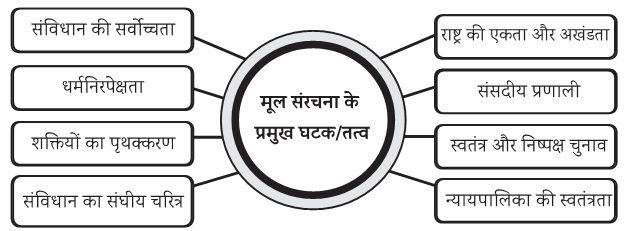
   STEP–III : संसद की संशोधन शक्ति को सीमित करने में इसका महत्व

   मूल संरचना सिद्घांत ने भारतीय संवैधानिक व्यवस्था में संसद की निरंकुश और असीमित शक्तियों पर एक अत्यंत प्रभावी 'नियंत्रण और संतुलन' के रूप में कार्य किया है। इसका महत्व निम्नलिखित बिंदुओं से स्पष्ट होता है:

  • संशोधन और पुनर्लेखन में अंतर स्पष्ट करना: यह सिद्घांत यह स्पष्ट करता है कि अनुच्छेद 368 संसद को केवल 'संशोधन' यानी सुधार या आंशिक परिवर्तन करने की शक्ति देता है। यह संसद को 'नया संविधान लिखने' या वर्तमान संविधान को 'ध्वस्त' करने की संप्रभु शक्ति नहीं देता।

  • बहुसंख्यकवाद और दलीय तानाशाही पर रोक: संसदीय लोकतंत्र में कभी-कभी किसी एक राजनीतिक दल को प्रचंड बहुमत मिल जाता है। यह सिद्घांत यह सुनिश्चित करता है कि कोई भी अस्थायी बहुमत वाली सरकार देश के स्थायी लोकतांत्रिक ताने-बाने (जैसे- धर्मनिरपेक्षता, संघवाद, गणतंत्र) को अपनी राजनीतिक विचारधारा के अनुसार समूल नष्ट न कर सके।

  • नागरिक अधिकारों की स्थायी ढाल: गोलकनाथ मामले में न्यायपालिका ने संसद की शक्ति को पूरी तरह रोक दिया था, जो व्यावहारिक नहीं था। मूल संरचना सिद्घांत ने संसद को जनहित में सामाजिक-आर्थिक सुधारों के लिए संशोधन करने की छूट दी, लेकिन साथ ही नागरिकों के 'जीवन के अधिकार' और 'समानता के अधिकार' जैसी मौलिक पहचान को हमेशा के लिए सुरक्षित कर दिया।

  • लिखित संविधान के दर्शन की रक्षा: एक लिखित संविधान का उद्देश्य ही यह होता है कि शासन की शक्तियाँ सीमित हों। यदि संसद को असीमित संशोधन शक्ति मिल जाए, तो लिखित संविधान का औचित्य ही समाप्त हो जाएगा। यह सिद्घांत लिखित संविधान की सर्वोच्चता को बनाए रखता है।

STEP-IV : संसदीय संप्रभुता और संवैधानिक सर्वोच्चता के बीच संतुलन

       भारत ने इन दोनों के बीच एक अद्भुत और संतुलित मध्यमार्ग अपनाया है। भारत में न तो ब्रिटिश संसद की तरह 'संसदीय संप्रभुता' है और न ही अमेरिका की तरह पूर्ण 'न्यायिक सर्वोच्चता' है; बल्कि भारत में "संवैधानिक सर्वोच्चता" है। मूल संरचना का सिद्घांत इसी संतुलन को बनाए रखने का सबसे मुख्य उपकरण है:

  • संसदीय संप्रभुता का सम्मान: न्यायपालिका संसद के कानून बनाने और संविधान में संशोधन करने के अधिकार को पूरी तरह मान्यता देती है। न्यायालय खुद आगे बढ़कर कानून नहीं बनाता और न ही नीतिगत मामलों में तब तक हस्तक्षेप करता है जब तक कि वे असंवैधानिक न हों। संसद जन-आकांक्षाओं के अनुरूप बड़े बदलाव (जैसे- GST लागू करना, ईडब्ल्यूएस आरक्षण देना) करने के लिए स्वतंत्र है।

  • न्यायिक सर्वोच्चता के माध्यम से संविधान की रक्षा: जब संसद अपनी शक्ति की सीमा लांघकर संविधान के बुनियादी ढांचे पर चोट करती है (जैसे- 99वें संशोधन द्वारा न्यायपालिका की स्वतंत्रता को प्रभावित करने वाले 'राष्ट्रीय न्यायिक नियुक्ति आयोग - NJAC' का गठन करना), तब न्यायालय 'मूल संरचना' का उपयोग करके उस संशोधन को अमान्य कर देता है।

  • शक्तियों का पृथक्करण : संविधान ने सरकार के तीनों अंगों (विधायिका, कार्यपालिका, न्यायपालिका) के कार्यक्षेत्र तय कर दिए हैं। मूल संरचना का सिद्घांत कार्यपालिका को न्यायपालिका के कार्यों में (और इसके विपरीत) हस्तक्षेप करने से रोकता है, जिससे अंगों के बीच टकराव न्यूनतम होता है और संतुलन बना रहता है।

       यह सिद्घांत संसद को पंगु नहीं बनाता, बल्कि उसे उत्तरदायी और मर्यादित बनाता है। यह "परिवर्तन के साथ निरंतरता" का मार्ग प्रशस्त करता है, जो किसी भी प्रगतिशील राष्ट्र के संविधान के लिए आवश्यक है। भारत जैसे बहुसांस्कृतिक, बहुधार्मिक और विशाल विविधता वाले देश में, जहाँ क्षेत्रीय और सामाजिक संतुलन बेहद संवेदनशील है, वहाँ यह सिद्घांत यह गारंटी देता है कि देश हमेशा विधि के शासन और संवैधानिक सिद्घांतों के अनुसार ही संचालित होगा।

   STEP-V : निष्कर्ष

       अतः यह निष्कर्ष निकाला जा सकता है कि मूल संरचना का सिद्घांत भारतीय न्यायपालिका द्वारा दुनिया के संवैधानिक कानून को दिया गया एक अमूल्य उपहार है, जिसने संसदीय संप्रभुता और संवैधानिक सर्वोच्चता के बीच एक ऐसा आदर्श संतुलन स्थापित किया है जो भारतीय लोकतंत्र को दीर्घायु और स्थायित्व प्रदान करता है।
English Medium

Question

Discuss the evolution of the 'Basic Structure Doctrine' through the landmark judgments of the Supreme Court. Explain its significance in limiting Parliament's amending power and in maintaining a balance between parliamentary sovereignty and constitutional supremacy.


Model answer

STEP-I : Introduction

       The Indian Constitution is a living and dynamic document; while Parliament has been granted the power to amend it under Article 368 to maintain this dynamism, the judiciary defines the limits of this power through the ‘Basic Structure Doctrine.’ This doctrine is a ‘constitutional innovation’ evolved through judicial interpretation, allowing Parliament to amend the Constitution without compromising its core spirit. It serves as a balancing point between ‘Parliamentary sovereignty’ and ‘constitutional supremacy,’ safeguarding the soul of democracy against authoritarianism.

   STEP-II : The gradual evolution of the basic structure doctrine through landmark judgments.

     The backdrop to the emergence of the 'Basic Structure' doctrine lies in the conceptual conflict between Article 13 and Article 368. The dispute centered on whether a 'constitutional amendment' enacted under Article 368 falls within the ambit of the term 'law' as defined in Article 13(2). If it does, Parliament cannot amend Fundamental Rights; if it does not, Parliament can alter the entire Constitution, including Fundamental Rights. This legal tug-of-war gave birth to this historic doctrine, which can be traced through the following cases—

  • Shankari Prasad v. Union of India (1951): In this case, the Supreme Court ruled that Parliament's amending power under Article 368 includes the power to amend Fundamental Rights. According to the Court, the term 'law' used in Article 13 refers only to 'ordinary laws' and not to 'constitutional amendment laws'.

  • Sajjan Singh v. State of Rajasthan (1965): A five-judge bench of the Court reiterated the ruling from the Shankari Prasad case, affirming that Parliament could alter any part of the Constitution, including Fundamental Rights. Although the majority decision favored Parliament, Justice J.R. Mudholkar, in his dissenting opinion, hinted for the first time at the existence of certain "basic features" of the Constitution that could not be altered. This idea later laid the foundation for the 'Basic Structure' doctrine.

  • Golaknath v. State of Punjab (1967): A Punjab government land security law that affected the right to property was challenged. Given the gravity of the matter, a large bench comprising 11 judges was constituted. By a 6:5 majority, the Court overruled its two previous judgments (Shankari Prasad and Sajjan Singh). Chief Justice K. Subba Rao held that:

  1. Fundamental rights are 'transcendental and inalienable' to human existence.

  2. Article 368 merely prescribes the 'procedure' for amendment; it does not confer upon Parliament the 'sovereign power' to amend.

  3. A constitutional amendment also constitutes 'law' under Article 13; therefore, Parliament cannot enact any amendment that violates fundamental rights.

     This decision completely tied the hands of Parliament, creating a major obstacle for the government in implementing socio-economic reforms. Subsequently, to nullify the impact of the Golaknath case and re-establish its supremacy, the Indira Gandhi government amended Articles 13 and 368 through the 24th and 25th Constitutional Amendment Acts (1971), thereby granting Parliament unlimited amending power.

  • Kesavananda Bharati v. State of Kerala (1973): The Kerala government had acquired land belonging to Swami Kesavananda Bharati, the head of the Edneer Mutt. In this case, the validity of the 24th, 25th, and 29th Constitutional Amendments was challenged. A 13-judge bench the largest in the history of the Indian judiciary was constituted to hear the matter and listened to arguments over a period of 68 days. The Court delivered a historic verdict (by a 7:6 majority), which is as follows—

  1. The Court held that the power vested in Parliament under Article 368 is one of 'amendment,' not 'destruction.' Parliament cannot alter the "basic structure" of the Constitution.

  2. The Court declared the part of the 25th Amendment that restricted 'judicial review' to be unconstitutional, stating that judicial review itself is a part of the basic structure.

  3. The Court upheld the validity of the 24th Constitutional Amendment and overruled the judgment in the Golaknath case. It held that Parliament could amend any part of the Constitution, including Fundamental Rights; however, the Court imposed a logical and historical limitation on this power of Parliament.

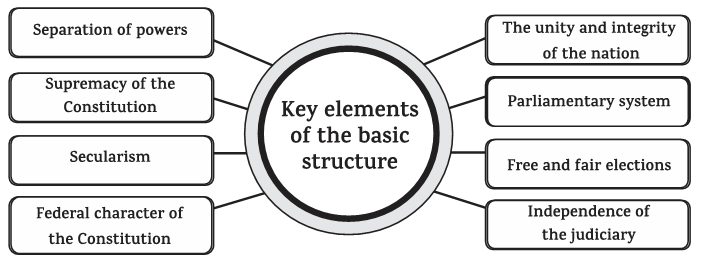
       Subsequently, the Supreme Court further clarified and strengthened this doctrine through various cases (such as the Raj Narain case of 1975, the Minerva Mills case of 1980, and the I.R. Coelho case of 2007). At the same time, the Supreme Court did not provide a definitive list of the 'basic structure,' stating instead that its elements would continue to be defined based on the passage of time and the facts of specific cases. To date, the following elements have been recognized as part of the 'basic structure' through various judgments:

   STEP–III : Its significance in limiting Parliament's amending power

   The 'Basic Structure' doctrine has served as a highly effective 'check and balance' on the absolute and unlimited powers of Parliament within the Indian constitutional framework. Its significance is evident from the following points:

  • Clarifying the distinction between amendment and rewriting: This doctrine clarifies that Article 368 empowers Parliament only to 'amend' that is, to make improvements or partial changes. It does not grant Parliament the sovereign power to 'write a new Constitution' or to 'destroy' the existing one.

  • Check on majoritarianism and party dictatorship: In a parliamentary democracy, a single political party sometimes secures an overwhelming majority. This doctrine ensures that a government holding a temporary majority cannot completely dismantle the nation's enduring democratic fabric (such as secularism, federalism, and the republican character) to suit its own political ideology.

  • A permanent shield for citizens' rights: In the Golaknath case, the judiciary had completely curtailed Parliament's power, which was not practical. The Basic Structure doctrine allowed Parliament to enact amendments for socio-economic reforms in the public interest while simultaneously safeguarding fundamental attributes such as the 'right to life' and the 'right to equality' for citizens in perpetuity.

  • Preserving the philosophy of a written constitution: The very purpose of a written constitution is to limit the powers of governance. If Parliament were to possess unlimited amending power, the rationale behind having a written constitution would be nullified. This doctrine upholds the supremacy of the written constitution.

STEP-IV : Balance between parliamentary sovereignty and constitutional supremacy

       India has adopted a remarkable and balanced middle path between the two. India possesses neither 'Parliamentary sovereignty' like the British Parliament nor absolute 'judicial supremacy' like the United States; instead, India has "Constitutional supremacy." The doctrine of basic structure is the primary instrument for maintaining this balance:

  • Respect for Parliamentary Sovereignty: The judiciary fully recognizes Parliament's authority to enact laws and amend the Constitution. Courts do not proactively create laws, nor do they interfere in policy matters unless they are unconstitutional. Parliament is free to implement major changes (such as the introduction of GST or the provision of EWS reservation) in alignment with public aspirations.

  • Protection of the Constitution through Judicial Supremacy: When Parliament oversteps its authority and infringes upon the 'basic structure' of the Constitution (for instance, by establishing the 'National Judicial Appointments Commission' (NJAC) via the 99th Amendment a move that compromised judicial independence), the Court invokes the 'basic structure' doctrine to strike down such an amendment.

  • Separation of Powers: The Constitution defines the respective spheres of operation for the three organs of government (Legislature, Executive, and Judiciary). The basic structure doctrine prevents the Executive from interfering in the functions of the Judiciary (and vice versa), thereby minimizing conflict between the organs and maintaining a balance.

       This principle does not render Parliament ineffective; rather, it makes it accountable and ensures it operates within proper bounds. It paves the way for "continuity with change," which is essential for the constitution of any progressive nation. In a country like India characterized by vast diversity and a multicultural, multi-religious fabric, where regional and social balances are extremely delicate this principle guarantees that the nation will always be governed in accordance with the rule of law and constitutional principles.

   STEP-V : Conclusion

       Thus, it can be concluded that the doctrine of basic structure is an invaluable gift from the Indian judiciary to global constitutional law, having established an ideal balance between parliamentary sovereignty and constitutional supremacy that imparts longevity and stability to Indian democracy.

Practise it yourself. Get your copy evaluated, free.

New question every day at 10:00 PM IST · हर रात 10 बजे नया प्रश्न

Join PARAKH free