
EDU TERIA Logo
CartSign InSign UpEnroll Now

Indian Constitution has conferred the amending power on the ordinary legislative institutions with a few procedural hurdles. In view of this statement, examine the procedural and…

BPSC Mains answer writing · · 8marks · model answer in Hindi & English

हिंदी माध्यम

प्रश्न

भारतीय संविधान ने संसद को कुछ प्रक्रियात्मक बाधाओं के साथ संविधान संशोधन की शक्ति प्रदान की है। इस कथन के संदर्भ में, संविधान में परिवर्तन करने की संसद की संशोधन शक्ति पर लागू प्रक्रियात्मक एवं सारभूत सीमाओं का परीक्षण कीजिए।


आदर्श उत्तर

भारतीय संविधान, अनुच्छेद 368 के तहत संसद को इसके प्रावधानों में संशोधन करने का अधिकार देकर लचीलेपन और कठोरता के बीच संतुलन बनाता है। हालाँकि, यह अधिकार असीमित नहीं है; यह प्रक्रियात्मक ज़रूरतों और 'मूल ढाँचे के सिद्घांत' द्वारा लगाई गई सीमाओं के अधीन है, ताकि यह सुनिश्चित किया जा सके कि संवैधानिक संशोधन संविधान के मूल सिद्घांतों को कमज़ोर न करें।
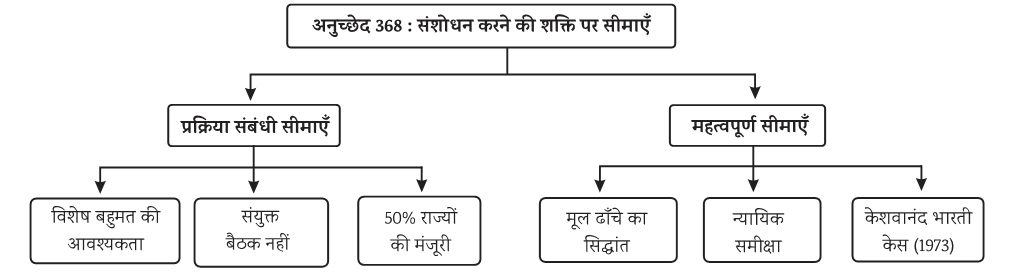
संशोधन करने की शक्ति पर प्रक्रियात्मक सीमाएँ

·      विशेष बहुमत : इसे पास करने के लिए मौजूद और वोट करने वाले सदस्यों के दो-तिहाई बहुमत की ज़रूरत होती है, जिससे अस्थायी बहुमत आसानी से संविधान के टेक्स्ट में बदलाव नहीं कर पाते। उदाहरण स्‍वरूप संविधान (131वां संशोधन) बिल, 2026 लोकसभा में दो-तिहाई बहुमत हासिल नहीं कर पाया।

·      राज्यों की मंज़ूरी : संघवाद में बदलाव के लिए 50 प्रतिशत राज्य विधानसभाओं की मंज़ूरी ज़रूरी है। जैसे- 106वां संशोधन अधिनियम, 2023 (महिलाओं के लिए आरक्षण) ने इसे सफलतापूर्वक पूरा किया।

·      संयुक्त बैठक नहीं : गतिरोध को संयुक्त बैठकों के ज़रिए हल नहीं किया जा सकता, इसलिए राज्यसभा में अलग से आम सहमति बनानी पड़ती है।

·      सिर्फ़ केंद्र की पहल : राज्य विधानसभाएं संशोधन बिल पेश नहीं कर सकतीं, जिससे प्रक्रिया के तौर पर संवैधानिक शक्ति संसद के पास केंद्रित हो जाती है।

·      अनिवार्य सहमति : 24वें संशोधन (1971) के तहत राष्ट्रपति की सहमति ज़रूरी कर दी गई; इससे कार्यकारी वीटो तो खत्म हो गया, लेकिन विधायी प्रक्रिया की बाधा बनी रही।

·      राज्यों से सलाह-मशविरा : राज्यों की सीमाएँ बदलने (अनुच्छेद 3) के लिए संबंधित राज्य की विधानसभाओं से पहले सलाह-मशविरा करना ज़रूरी है।

संशोधन करने की शक्ति पर ठोस सीमाएँ

·      मूल ढांचा की बाधा : यह प्रावधान संसद को संविधान के मूल ढांचे में बदलाव करने से रोकता है। इस सिद्घांत को सर्वोच्‍च न्‍यायालय द्वारा केशवानंद भारती वाद 1973 में प्रतिपादित किया गया था।  

·      चुनावी सत्‍यनिष्‍ठा : इलेक्टोरल बॉन्ड मामले (2024) में, सुप्रीम कोर्ट ने फैसला सुनाया कि विधायी संशोधनों से स्वतंत्र और निष्पक्ष चुनावों के मूल ढांचे को कमजोर नहीं किया जा सकता।

·      मूल संघवाद : दिल्ली बनाम भारत संघ (2023) के फैसले ने पुष्टि की कि केंद्र सरकार विधायी शक्तियों का इस्तेमाल करके मनमाने ढंग से राज्य के अधिकार क्षेत्र को अपने अधीन नहीं कर सकती।

·      न्यायिक स्वतंत्रता : 99वें संशोधन (NJAC) को रद्द करने से यह साबित हुआ कि शक्तियों का बंटवारा एक ऐसी अहम सीमा है जिस पर कोई समझौता नहीं किया जा सकता।

·      न्‍यायिक समीक्षा का विस्‍तृत दायरा : I.R. कोएल्हो (2007) के फैसले ने 1973 के बाद नौवीं अनुसूची में जोड़े गए कानूनों को न्यायिक समीक्षा के दायरे में ला दिया।

·      अधिकारों और नीति-निर्देशों में तालमेल : मिनर्वा मिल्स (1980) मामले में कहा गया कि वे संशोधन जो संविधान के भाग III और IV के बीच संतुलन को खत्म करते हैं, वे मूल रूप से अमान्य हैं।

·      वैश्विक स्तर पर अपनाना: इस अहम जांच प्रक्रिया को सही ठहराते हुए, भारत के 'बेसिक स्ट्रक्चर' (मूल ढांचे) के सिद्घांत को हाल ही में युगांडा और बांग्लादेश की अदालतों ने भी अपनाया है।

       हाल की विधायी कार्यवाही में अनुच्छेद 368 के तहत संशोधन प्रावधानों के व्यावहारिक उपयोग और विकास गर लगातार चर्चा हो रही है। अप्रैल 2026 में. केंद्र सरकार ने संविधान (131वां संशोधन) विधेयक, 2026 पेश किया, जिसका उद्देश्य महिलाओं के लिए आरक्षण की जल्द लागू करने के लिए 2011 की जनगणना के आंकड़ों के आधार पर लोकसभा सीटों की अधिकतम संख्या को 550 से बढ़ाकर 850 करना था। हालाँकि, आवश्यक विशेष बहुमत न मिल पाने के कारण यह विधेयक लोकसभा में पारित नहीं हो सका। कुल मिलाकर, ये विशेषताएँ भारतीय संविधान को एक ऐसा स्थायी ढाँचा बनाती है जो संस्थागत अधिकार और व्यक्तिगत स्वतंत्रता तथा सामाजिक-आर्थिक बदलाव के बीच संतुलन बनाए रखता है।
English Medium

Question

Indian Constitution has conferred the amending power on the ordinary legislative institutions with a few procedural hurdles. In view of this statement, examine the procedural and substantive limitations on the amending power of the Parliament to change the Constitution.


Model answer

The Indian Constitution strikes a balance between flexibility and rigidity by empowering Parliament to amend its provisions under Article 368. However, this power is not absolute; it is subject to procedural requirements and the substantive limitation imposed by the Basic Structure Doctrine, ensuring that constitutional amendments do not undermine the fundamental principles of the Constitution.

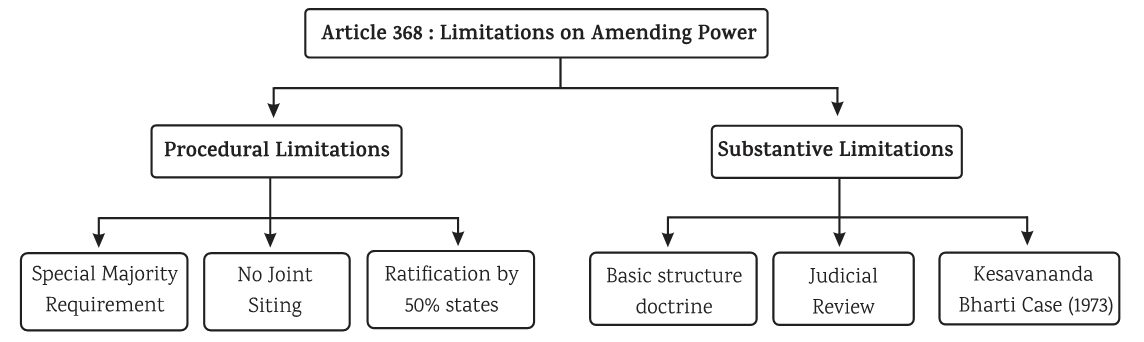
Procedural Limitations on Amending Power

·      Special Majority : Passing it requires the presence and a two-thirds majority vote of the members, ensuring that the text of the Constitution cannot be easily altered. For instance, the Constitution (131st Amendment) Bill, 2026, failed to secure a two-thirds majority in the Lok Sabha.

·      State Ratification : Changes to federalism require the approval of 50 percent of the state legislatures. For instance, the 106th Amendment Act, 2023 (reservation for women) successfully met this requirement.

·      No Joint Sitting : Deadlocks cannot be resolved via joint sittings, forcing independent consensus building in the Rajya Sabha.

·      Exclusive Union Initiation: State assemblies cannot initiate amendment bills, procedurally centralising constitutional power within Parliament.

·      Mandatory Assent: The 24th Amendment (1971) obligates Presidential assent, removing executive vetoes but finalising the legislative hurdle.

·      Implicit State Checks: Altering state boundaries (Article 3) mandates prior consultation with affected state legislative assemblies.

Substantive Limitations on Amending Power

·      Basic Structure Barrier: This provision prevents Parliament from altering the basic structure of the Constitution. This doctrine was propounded by the Supreme Court in the Kesavananda Bharati case of 1973.

·      Electoral Integrity: In the Electoral Bonds Case (2024), the Supreme Court ruled that legislative amendments cannot undermine the basic structure of free and fair elections.

·      Core Federalism: The Delhi v. Union of India (2023) judgment affirmed the Union cannot use legislative power to arbitrarily subsume state authority.

·      Judicial Independence: Invalidation of the 99th Amendment (NJAC) proved that the separation of powers is a non-negotiable substantive boundary.

·      Wide scope of judicial review: The I.R. Coelho (2007) judgment brought laws added to the Ninth Schedule after 1973 within the ambit of judicial review.

·      Rights-Directives Harmony: Minerva Mills (1980) held that amendments destroying the balance between Parts III and IV are substantively void.

·      Global Migration: Validating this substantive check, India's Basic Structure concept has recently been adopted by courts in Uganda and Bangladesh.

       Recent legislative proceedings have seen ongoing discussions regarding the practical application and evolution of the amendment provisions under Article 368. In April 2026, the Central Government introduced the Constitution (131st Amendment) Bill, 2026, which aimed to increase the maximum number of Lok Sabha seats from 550 to 850 based on 2011 census data to facilitate the early implementation of reservation for women. However, the Bill could not be passed in the Lok Sabha due to the failure to secure the requisite special majority. Overall, these features establish the Indian Constitution as an enduring framework that maintains a balance between institutional authority, individual liberty, and socio-economic transformation.

Practise it yourself. Get your copy evaluated, free.

New question every day at 10:00 PM IST · हर रात 10 बजे नया प्रश्न

Join PARAKH free