Why UAPA demands urgent reform
This article is significant in view of Internal Security in GS Paper 3 (UPSC). Through this article, you will understand the concept of UAPA, its importance and related dimensions.
Why in News?
There are growing demands to reform the UAPA, 1967. Critics point out that trials under the law take very long, and accused often stay in jail for years before trial, as bail is very difficult to get. This has raised concerns that the legal process itself becomes a punishment, even before guilt is proven.
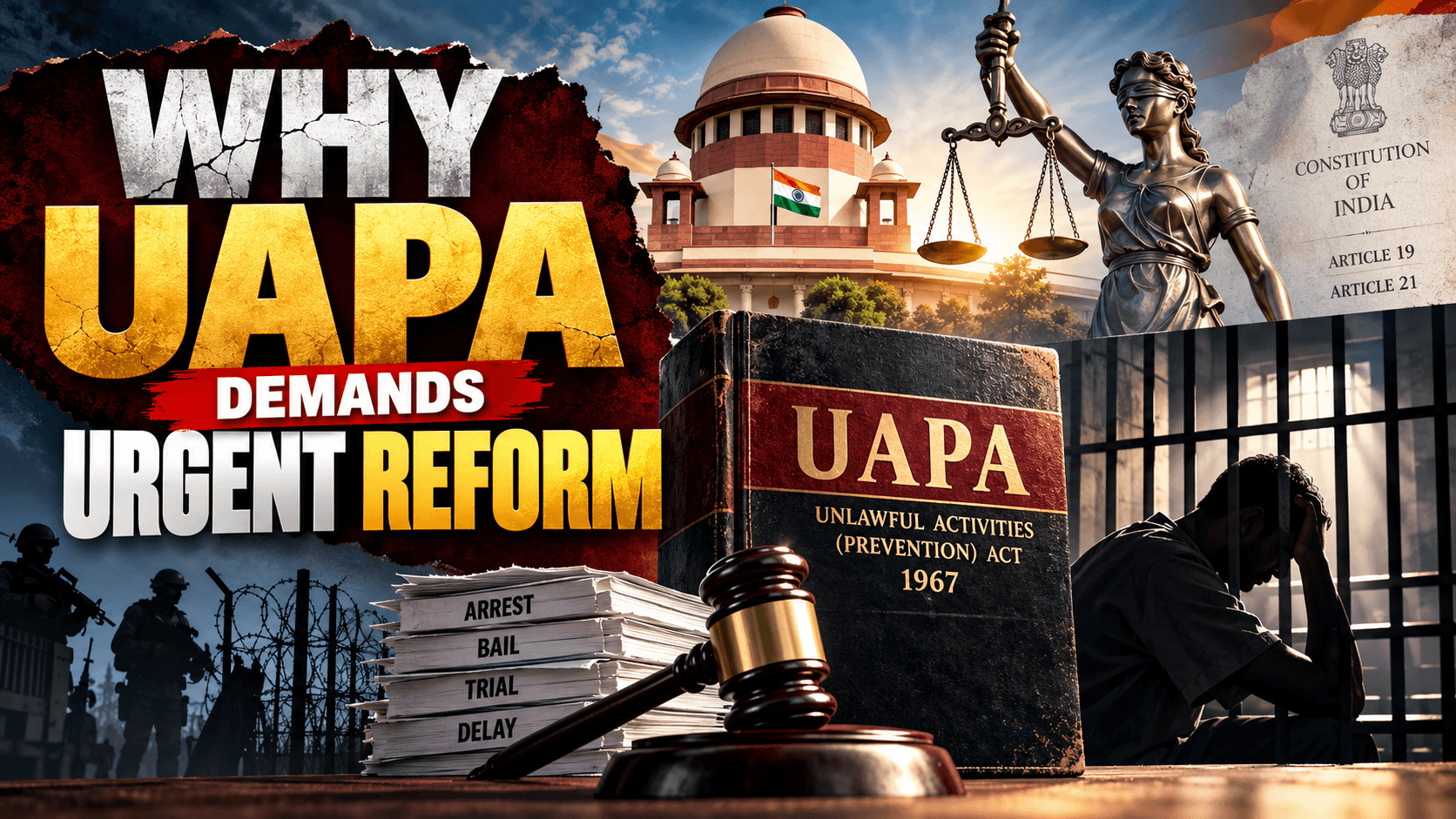
The UAPA, 1967 is India's main anti-terror law, but its strict bail rules and long pre-trial jail time raise concerns about Fundamental Rights under Articles 19 and 21, presumption of innocence, and the right to a speedy trial.
So, reforms are needed to balance national security with civil liberties through clearer definition of terrorism, more judicial discretion in bail, independent review of cases, time-bound trials, and compensation for wrongful detention.
What is UAPA, 1967?
UAPA stands for the Unlawful Activities (Prevention) Act. It is India's primary anti-terror law. It was enacted to protect sovereignty and integrity and, over time, expanded to cover terrorism and economic security threats.
Origin: Based on National Integration Council recommendations under PM Nehru. Enacted to give effect to the 16th Amendment Act, 1963, which allowed reasonable restrictions on freedom of speech and assembly for sovereignty and integrity.
Initial Scope (1967): Dealt only with unlawful activities threatening territorial integrity. Terrorism was not part of it originally.
2004 Amendment (POTA Legacy): After POTA was repealed, its key provisions were added to UAPA. Chapter IV added that terrorist acts are defined and unlawful activity is expanded to include disaffection against India.
2008 Amendment (Post-26/11): The definition of terrorist act was widened by adding "by any other means."
2012 Amendment: Terrorism expanded to economic security, counterfeit currency, livelihood, energy, and food security. Liability extended to trusts and societies.
2019 Amendment: The Centre can now designate individuals as terrorists, not just organizations. NIA is empowered to attach properties without state police consent.
Concerns Regarding UAPA
Vague Definitions: Terms like "membership," "terrorist act," and "likely to threaten" are broad and ambiguous. Allows arrest without direct link to violence, violates nullum crimen sine lege. UN Rapporteurs (2020) flagged it as incompatible with ICCPR and the UDHR due to no clear definition of terrorism.
Presumption of Innocence Reversed: Under Sec 43D(5), bail is denied if the chargesheet appears prima facie true. The accused must prove innocence at the pre-trial stage.
Process as Punishment: NCRB shows conviction below 3% despite thousands arrested. In the Bhima Koregaon case, where Father Stan Swamy died in custody awaiting trial, it shows long pre-trial detention itself becomes punishment.
Chilling Effect on Rights: Use against dissenters and journalists impacts Art 19(1)(a) and Art 21, speedy trial. Creates fear and discourages free speech and activism.
Disproportionate Impact: Poor and marginalized suffer more due to lack of legal resources.
Key Judgments:
Watali (2019): No mini-trial at bail stage, accept police case as is—makes bail very hard.
Arup Bhuyan (2011 vs. 2023): 2011 - mere membership is not a crime without an overt act. 2023 - overruled; mere continued membership enough.
K.A. Najeeb (2021): Meltdown Doctrine, Sec 43D(5) bail bar melts if trial delayed inordinately, violating Art 21.
Thwaha Fasal (2021): Mere association or radical literature is not UAPA unless criminal intent is proved.
Reforms Needed to Balance UAPA
Precise Definition of Terrorism: Align with UN Special Rapporteur guidelines. A terrorist act should require intent to cause death/serious injury + political/ideological motive. Vague terms like "likely to threaten" should be removed.
Amend Sec 43D(5), Restore Judicial Discretion: Adopt the UK Terrorism Act 2000 model—burden on the state to justify continued detention. Judges should be empowered to scrutinize police evidence at the bail stage, not just accept the charge sheet.
Independent Review Committees: Like safeguards in repealed POTA, 2002, committees of retired judges to examine the merit of charges before sanctioning prosecution to filter politically motivated cases.
Compensation for Wrongful Incarceration: Codify financial compensation and rehabilitation for those acquitted after long UAPA detention. Based on the constitutional tort principle recognized in Rudul Sah v. State of Bihar (1983), the state is liable to pay damages for violating fundamental rights.
Strict Timelines & Default Bail: Fast-track special courts to complete UAPA trials within fixed time (e.g., 2 years). Failure should give the automatic right to default bail.
Conclusion:
UAPA is essential for national security, but its implementation must balance security with constitutional liberties, due process, and human rights. Reforms are needed to prevent prolonged pre-trial detention and ensure national security does not undermine democratic values and fundamental rights.
Reference: