Starlink in India: Connecting the Unconnected
The Starlink issue is highly relevant for the UPSC Civil Services Mains Exam, primarily falling under General Studies Paper II (GS-2) and General Studies Paper III (GS-3). For the BPSC (CCE) Mains, this topic fits perfectly into the analytical and applied science sections.
Why in News?
The public disagreement over Starlink's plan to enter India's satellite internet market has sparked concerns about fair competition, regulatory clearances, national security, and affordability for consumers, bringing out the challenges involved in expanding satellite-based internet services in the country.
What are the key facts about Starlink?
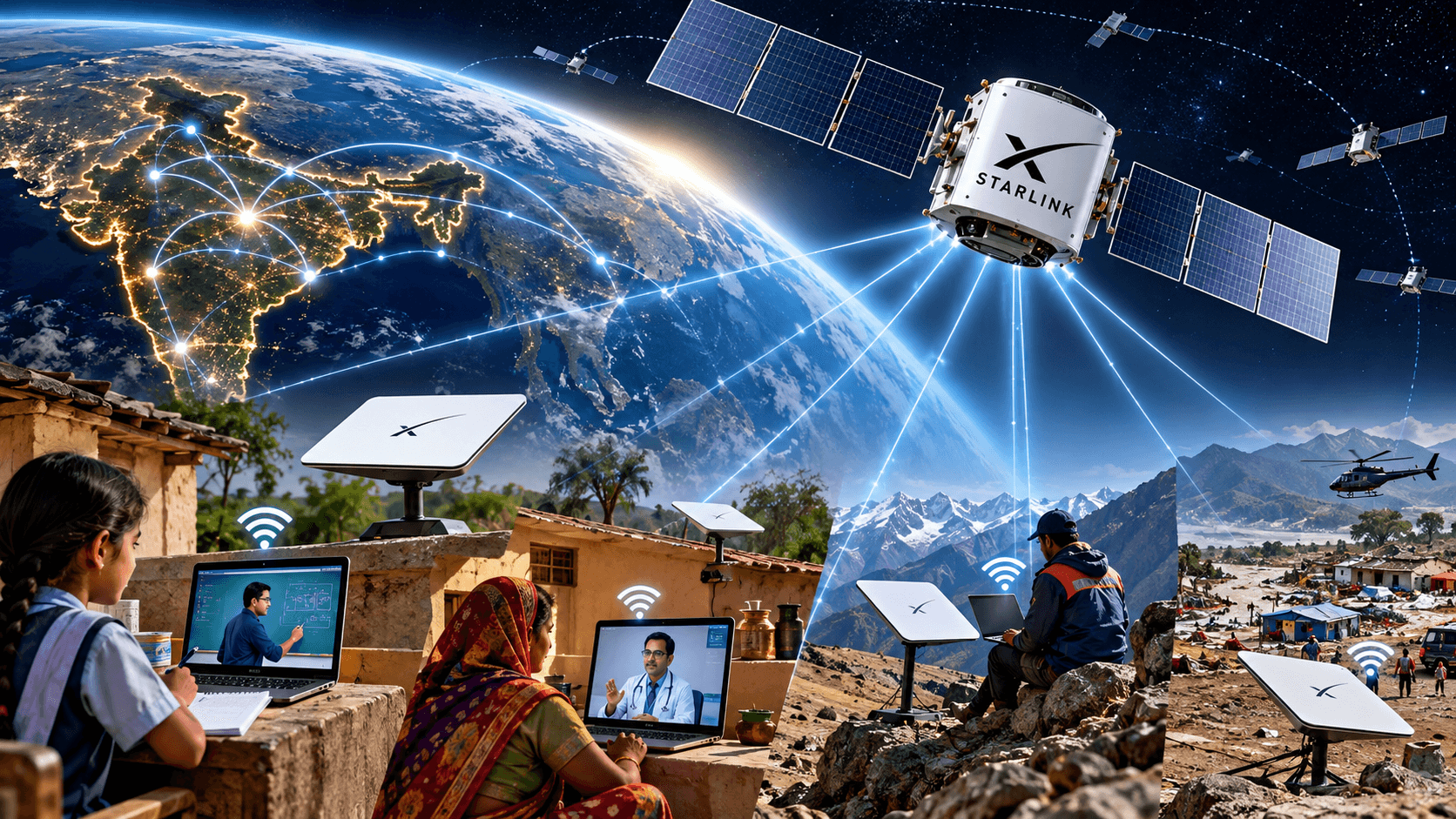
About Starlink: Starlink is a satellite-based broadband internet service developed by SpaceX. It uses a constellation of Low Earth Orbit (LEO) satellites to provide high-speed, low-latency internet, especially in remote and underserved areas.
Satellite Constellation: Starlink runs the world's largest commercial satellite constellation, with around 11,000 satellites in orbit as of October 2026. These operate at an altitude of about 550 km, much lower than 35,786 km for geostationary satellites.
Advanced Technology: Its satellites use optical inter-satellite links (space lasers), phased-array antennas, and argon-powered ion thrusters for high-speed data transfer, satellite-to-satellite communication, and orbital maneuvering.
Low-Latency Connectivity: Starlink offers latency of around 25 milliseconds in favorable conditions, compared to 600 milliseconds or more for traditional geostationary satellite internet. This makes it suitable for video calls, online gaming, and streaming.
SpaceX Integration: SpaceX manufactures and operates Starlink satellites and uses its Falcon 9 rockets to regularly launch and upgrade the constellation, helping continuous network expansion.
Strategic and Humanitarian Applications: Starlink provides connectivity in remote areas, disaster-hit regions, and conflict zones where ground-based networks are unavailable, damaged, or disrupted.
Military Applications: SpaceX has also developed Star Shield, a separate military-focused satellite communications program for US government and national security use.
How Does Satellite Internet Work?
Satellite internet is a communication technology that uses orbiting satellites to provide broadband connectivity, especially in remote, sparsely populated, and disaster-prone areas where laying ground networks is costly or not possible.
Working Mechanism: Satellite internet works through two main segments:
- Space Segment: Consists of satellites with communication payloads that receive, process, or relay data signals between user terminals and ground stations.
- Ground Segment: Includes user terminals (antennas and modems) and ground stations that talk to satellites and connect users to the internet backbone.
Orbital Deployment: Communication satellites are placed in three main orbits:
Geostationary Earth Orbit (GEO): Located at about 35,786 km above the equator, GEO satellites stay fixed relative to Earth and give wide coverage but have high latency, which affects time-sensitive uses. Example: Inmarsat Global Xpress (GX).
Medium Earth Orbit (MEO): Located between about 2,000 km and 35,786 km, MEO satellites have lower latency than GEO but need constellations for wider coverage. Example: O3b constellation.
Low Earth Orbit (LEO): Located below 2,000 km, LEO satellites offer low-latency connectivity but cover smaller areas individually, so they need large constellations for continuous coverage. Example: Starlink.
Mega-Constellation Technology: Advanced LEO constellations use onboard signal processing, phased-array antennas, and optical inter-satellite links (space lasers) to enable direct satellite-to-satellite communication, efficient data routing, and seamless connectivity even as satellites keep moving.
Applications: Satellite internet helps in remote connectivity, disaster management, telemedicine, precision agriculture, maritime and aviation communication, military operations, and emergency response.
Challenges: Despite benefits, satellite internet faces issues like high equipment and subscription costs, orbital congestion, space debris, cybersecurity risks, and national security concerns linked to its dual civilian-military use.
What is the status of Starlink's license in India?
| GMPCS License: | Starlink received a Unified License with Global Mobile Personal Communication by Satellite (GMPCS) authorization from the Department of Telecommunications (DoT) in June 2025, allowing satellite communication services subject to regulatory conditions. |
| IN-SPACE Authorization: | In July 2025, Starlink also got authorization from the Indian National Space Promotion and Authorisation Centre (IN-SPACe) for its satellite constellation. |
| Pending Clearances: | Despite these approvals, Starlink has not started commercial services in India, as final security clearances, spectrum assignment, and other regulatory requirements are still pending. |
| Commercial Partnerships: | In March 2025, SpaceX signed separate agreements with Jio Platforms and Bharti Airtel to explore distributing Starlink services in India, subject to necessary regulatory approvals. |
| Current Status: | Starlink has got key telecom and space-sector approvals but cannot launch commercial satellite internet services in India until remaining security and spectrum-related requirements are completed. |
Conclusion
Starlink's entry into India highlights the growing importance of satellite internet for bridging the digital divide, especially in remote and underserved areas. While it offers low-latency, high-speed connectivity with potential benefits for disaster management, education, healthcare, and strategic communications, its rollout also raises valid concerns around market competition, spectrum pricing, national security, data protection, and affordability.
Reference: