NADCP: Disease-Free Livestock Mission
Why in News?
The Press Information Bureau (PIB) has recently released a detailed fact sheet on NADCP. It highlights the program as one of the world's largest livestock vaccination drives and shows how sustained vaccination has led to a sharp decline in Foot and Mouth Disease (FMD) and Brucellosis outbreaks and a rise in bovine productivity.
What is NADCP, and why was it needed?
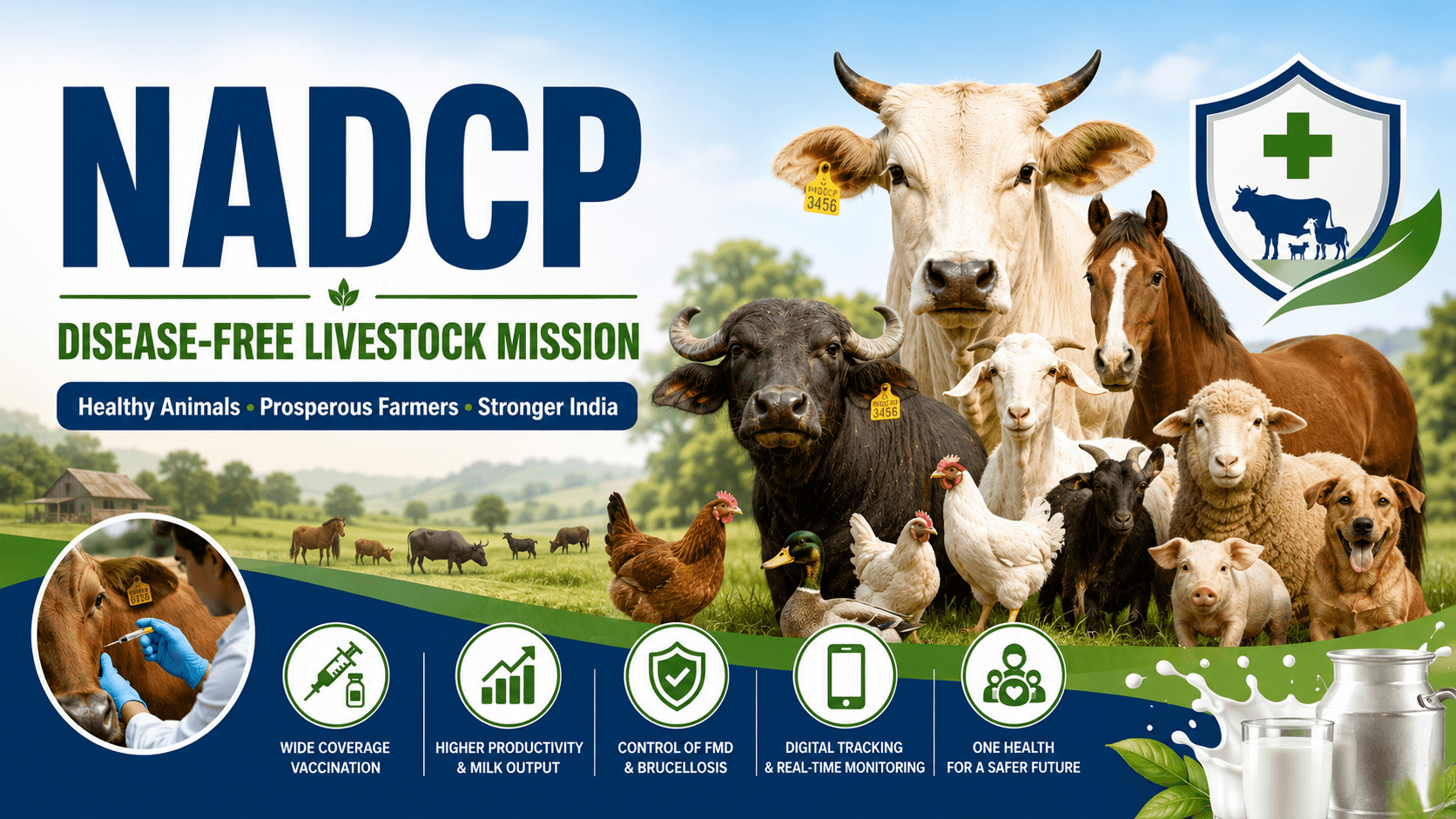
Launched in September 2019, NADCP aims to control and ultimately eradicate Foot and Mouth Disease (FMD) and Brucellosis through nationwide vaccination.
Actually, India has 535.78 million livestock as per the 20th Livestock Census 2019, including 302.79 million bovines. Two diseases have historically caused huge economic loss.
FMD: Highly contagious viral disease of cloven-hoofed animals like cattle, buffalo, sheep, goat, pig. It reduces milk yield, growth, reproductive capacity and blocks international trade.
Brucellosis: Bacterial disease caused by Brucella abortus. It attacks reproductive organs and causes infertility, abortion, and loss of milk. There is no curative treatment in bovines; only vaccination works.’
To address this, Government launched NADCP with the aim to control FMD by 100% biannual vaccination of all susceptible livestock and to control Brucellosis by one-time lifetime vaccination of female bovine calves aged 4-8 months.
Major Achievements
The program has shown measurable outcomes: • A total of 147.16 crore FMD vaccine doses were administered, benefiting 8.04 crore farmers. • FMD outbreaks reduced from 132 in 2019 to 40 in 2025. • Brucellosis outbreaks reduced from 22 to 15 in NSP antibody prevalence, which shows virus circulation, declined from 20.8% to 8.1%.No outbreak of FMD serotype Asia-1 for the last three years. • Post-vaccination protective immunity is now 78.1% for Serotype O, 71.7% for A, and 77.6% for Asia1. • For brucellosis, the seroconversion rate in 2025 is 75.63% in cattle calves and 67.17% in buffalo calves. • Since 2024, migratory sheep and goats in Haryana, Himachal Pradesh, Uttarakhand, J&K, and Ladakh are also covered to stop their spread along migratory routes.
Linkage with Productivity and Milk Production
1. Disease-free animals directly mean more income:
2. Indigenous and non-descript cattle productivity increased from 927 kg/animal/year in 2014-15 to 1343.2 kg in 2024-25 (44.89% rise).
3. Buffalo productivity increased from 1880 kg to 2365.2 kg (25.80% rise).
4. Average bovine productivity increased from 1640 kg to 2250 kg (36.63% rise), the highest gain recorded globally.
5. National milk production increased from 146.31 MT to 247.87 MT (69.4% rise).The government target is 3000 kg per animal per year by 2030.
Pillars of Implementation—Integrated Action
| 1. | Vaccination & Surveillance: | Biannual mass vaccination, ear-tagging with 12-digit ID, sero-surveillance and sero-monitoring (pre- & post-vaccination antibody check), outbreak investigation, and virus typing. |
| 2. | Digital Backbone - Bharat Pashudhan Portal: | Over 39 crore livestock registered by July 2026. Enables real-time tracking, traceability, and AI-enabled disease intelligence. |
| 3 | Last-Mile Delivery: | 4,019 Mobile Veterinary Units (MVUs) operational via toll-free 1962, benefiting 136 lakh farmers and treating 276 lakh animals. 39,810 MAITRIs trained for doorstep services. Vaccinators get a minimum of Rs 3 per dose. |
| Institutional & Financial Support: | Now subsumed under the Livestock Health and Disease Control Programme (LHDCP) with a budget of Rs 2,010 crore for 2026-27. ICAR institutions supported research. The private sector is supported through the Animal Husbandry Infrastructure Development Fund (AHIDF) for vaccine manufacturing. | |
| One Health & Pandemic Preparedness: | FMD and Brucellosis are economic diseases, but Brucellosis is zoonotic. NADCP feeds into the National One Health Mission approved by PM-STIAC in July 2022. In 2024, India launched a $25 million Pandemic Fund Project with ADB, FAO, and the World Bank for genomic surveillance, lab strengthening, and cross-border collaboration. The government released Standard Veterinary Treatment Guidelines (SVTG) for rational drug use and Crisis Management Plan (CMP) for outbreaks. |
Conclusion
In short, NADCP has proved to be a game-changer—from 147.16 crore vaccinations to bringing FMD outbreaks down from 132 to 40 and raising milk output to 247.87 MT. By linking vaccination, digital tracking through Bharat Pashudhan Portal with 39 crore animals, and doorstep services via 4,019 MVUs, it has connected animal health directly with farmers' income and food security. As part of One Health and with Rs 2,010 crore under LHDCP, it is laying the foundation for a disease-free, more productive, and globally competitive livestock sector for Viksit Bharat 2047.
The National Animal Disease Control Programme (NADCP) falls under the General Studies (GS Paper II - Indian Economy and Geography/Science & Technology segments) of the BPSC Syllabus as part of government policies/schemes on agriculture, animal rearing, and rural economy. For optional papers, it maps directly to animal husbandry and veterinary science or agriculture.