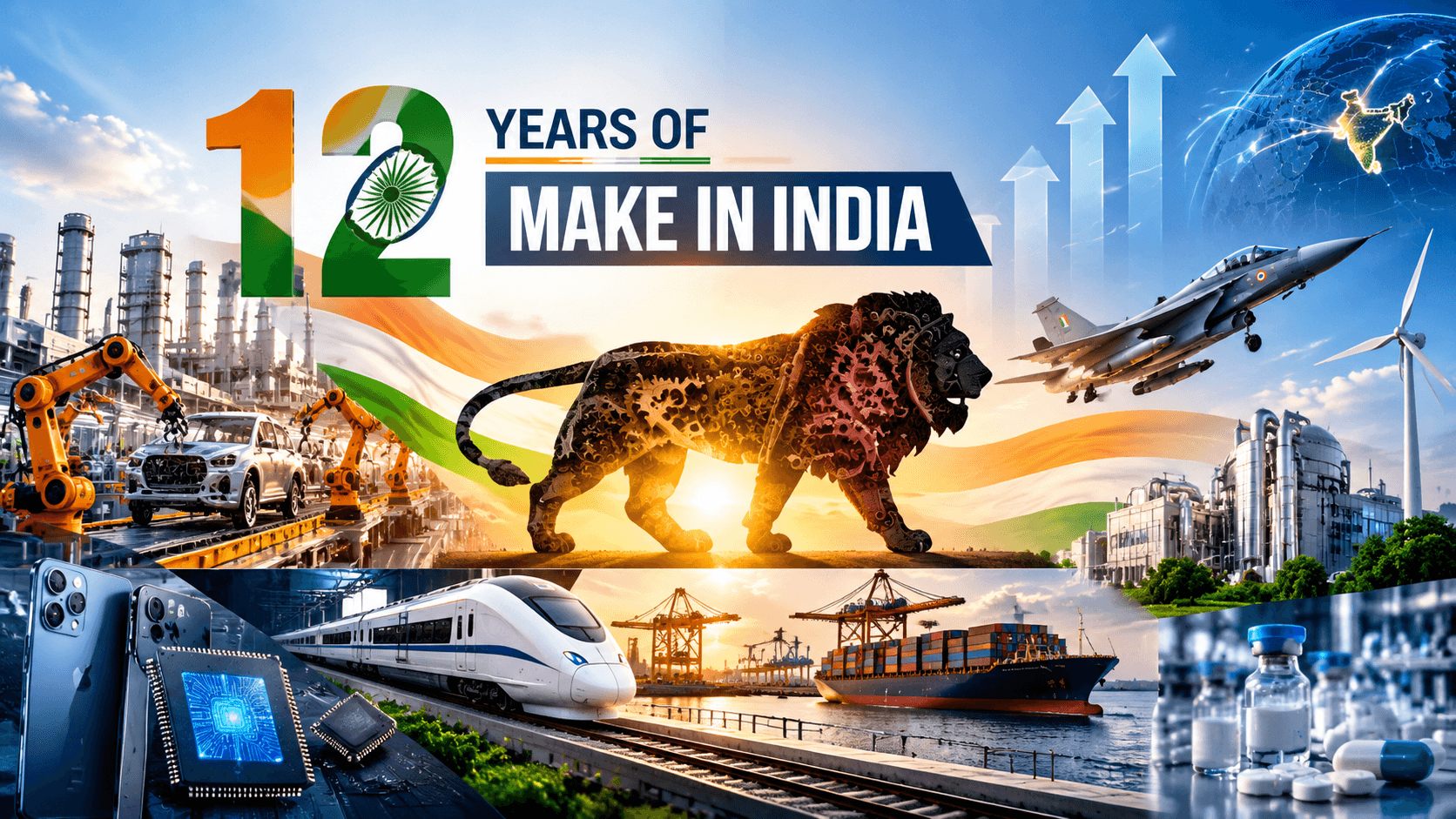
12 Years of Make in India
Why in News?
The Government of India's flagship 'Make in India' initiative completed 12 years since its launch. While official data shows big growth in sectors like electronics and defense, experts and recent reports say the overall performance has been patchy, especially in terms of manufacturing share in GDP, private investment, and job creation.
Key facts pertaining to Make in India
While making in India has greatly expanded India's manufacturing base, and especially in electronics, mobile phones, defense, automobiles, steel, and pharma, and boosted exports and global value-chain integration, challenges remain.
Issues persist in manufacturing's share in GVA, private investment, job creation, domestic value addition, and R&D. To ensure long-term growth, India needs to focus more on component localization, better logistics, innovation, and strengthening MSMEs.
What is Make in India?
| Launch: | Started on 25th September 2014 with the aim of making India a global hub for manufacturing, design, and innovation. |
| Core Philosophy: | Based on 'Minimum Government, Maximum Governance,' to make it easier to invest, encourage innovation, and build world-class infrastructure. |
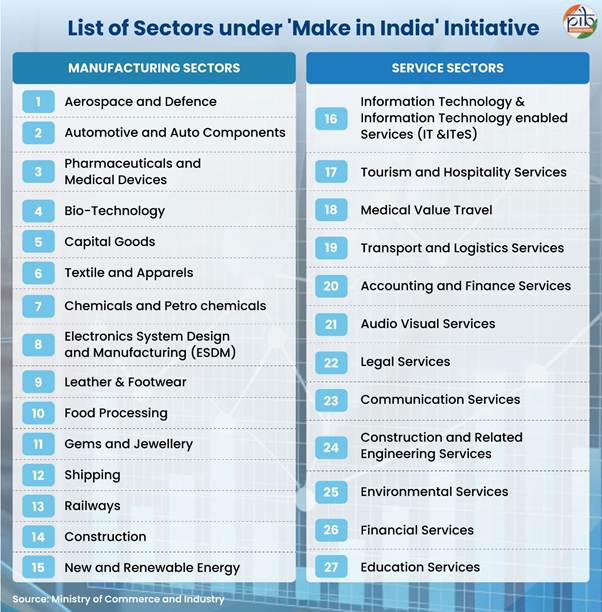
| Make in India 2.0: | Launched in Feb 2021, it now covers 27 priority sectors, 15 in manufacturing and 12 in services. |
Major Achievements:
| Electronics & Mobile: | Electronics production jumped nearly 7 times, from Rs 1.9 lakh crore in 2014-15 to Rs 13.11 lakh crore in 2025-26. India is now the world's 2nd largest mobile manufacturer, with 99.2% of phones used in India made locally. In 2025, smartphones became India's top exported product. |
| Automobiles: | Total vehicle production reached 31.03 million units in 2024-25, up 33% from 2014-15. Passenger and commercial vehicles grew by 65% each since 2020-21. |
| Defense: | Indigenous defense production grew by about 283% from 2014 to 2026. |
| Steel: | Crude steel production more than doubled, from 81.7 MT in 2014-15 to 170 MT in 2025-26. |
| Pharma & Medical Devices: | India ranks 3rd in pharma volume globally with a turnover of Rs 5.08 lakh crore in 2025-26. Medical device manufacturing grew 48.2% (2019-25). Major breakthroughs include the world's first biosimilar for breast cancer (Trastuzumab Emtansine), the world's first antibody cocktail for rabies, and India's first new antibiotic in 30 years (Miqnaf). |
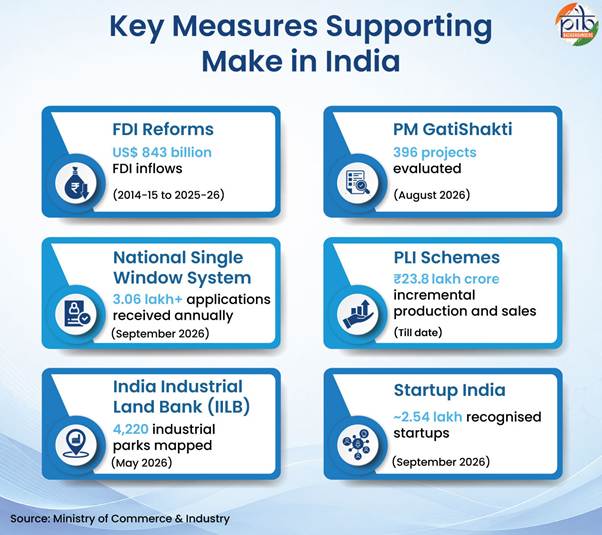
| PLI Scheme: | A key pillar across 14 sectors, it has attracted Rs 2.6 lakh crore in investment, Rs 23.8 lakh crore in production/sales, and created 14.6 lakh jobs till June 2026. |
| High-Tech Push: | |
| Semiconductors: | ISRO and SCL developed VIKRAM3201 and KALPANA3201, India's first space-grade microprocessors. |
| Critical Materials: | A pilot plant for rare-earth magnets (Nd-Fe-B) is commissioned in Hyderabad in March 2026 for EV and wind turbine supply chains. |
| Aerospace: | HAL started its 3rd Tejas Mk1A assembly line in Oct 2025, raising capacity to 24 jets per year. |
| Nuclear & Rail: | NFC delivered steam-generator tubes for 700 MW reactors, and the Rail Wheel Factory produced over 2.10 lakh wheels in 2025-26. |
What are the concerns regarding making in India?
- Stagnant Share in GDP: The original target was to take manufacturing to 25% of GDP, but its share in GVA has only moved slightly from 14.6% in 2022-23 to 15.6% in 2025-26.
- Stagnant Global Export Share: Non-petroleum goods exports grew from USD 253.5 billion in 2014-15 to USD 388.3 billion in 2025-26, but India's share in global merchandise exports is still stuck at around 1.7%, the same as in 2013.
- Sluggish Private Investment: The expected private investment boom didn't happen. Private-sector Gross Fixed Capital Formation (GFCF) as a share of GDP has fallen in recent years.
- FDI Disparities: Manufacturing FDI has grown slower than overall FDI in 7 out of the last 12 years.
- Weak Job Creation: Broad-based job growth in manufacturing is still missing, and the sector has failed to absorb the large workforce moving out of agriculture.
What Measures are Needed to Strengthen Make in India?
- Move from Assembly to Component Making: India should not just import parts and assemble them here. We need to expand Design-Linked Incentives (DLI) for critical components like semiconductor wafers, pharma APIs, and rare-earth magnets. This will build our own intellectual property and create real value addition.
- Plug-and-Play Frontier Tech Parks: Under the National Manufacturing Mission (NMM), India plans 20 Plug-and-Play Frontier Tech Parks. These parks will solve land acquisition issues and provide shared Industry 4.0 facilities like IoT, AI testbeds, and digital twins, so MSMEs can modernize without huge costs.
- Boost Private R&D: India's R&D spend is stuck at just 0.64% of GDP. Government should give deep tax benefits and Viability Gap Funding (VGF) to private companies working on advanced materials, robotics, and clean tech.
- Link Logistics with Manufacturing: High logistics costs hurt exports. Using PM Gati Shakti, manufacturing zones should be directly connected with ports and dedicated freight corridors to reduce transit time and freight cost.
Conclusion
Making in India has clearly boosted production and built capabilities in key sectors like electronics, mobile, defense, steel, and pharma, and improved India's presence in global value chains. However, the original goals of raising manufacturing share to 25% of GDP, boosting private investment, and creating large-scale jobs are still unmet. The next phase must shift from mere assembly to deep component localization, stronger R&D, better logistics integration, and support for MSMEs. Only then can India move from being a manufacturing assembler to a true global manufacturing hub.