Interlinking of Rivers: Boon or Ecological Blunder?
Why in News?
At the Southern Zonal Council meeting in Mamallapuram, the union home minister stressed the need to resolve water disputes in South India and proposed interlinking rivers from the Brahmaputra to Godavari and Cauvery as a long-term water security solution.
The issue is in focus due to ongoing disputes like Pennaiyar and Mekedatu, which highlight challenges in interstate water management and the debate between big infrastructure projects vs. demand-side conservation.
Key facts about
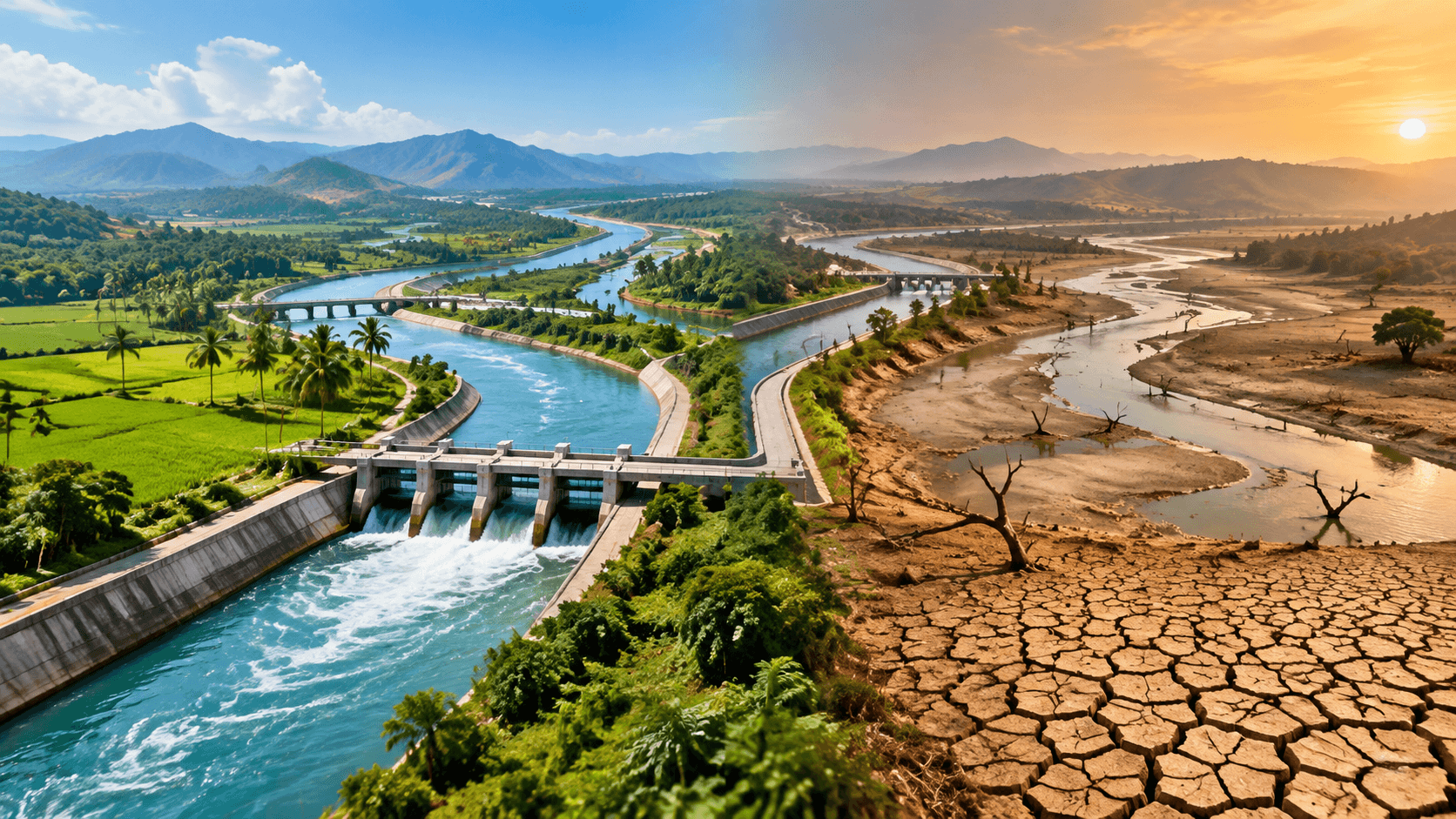
River interlinking aims to transfer water from surplus basins to deficit regions through canals, reservoirs, and diversion structures.
While projects like Mullaperiyar Dam, the Parambikulam-Aliyar Project, the Krishna Water Supply Project, and the Indira Gandhi Canal show the benefits of inter-basin transfers, large-scale river linking also brings complex environmental, social, and federal challenges.
Experts argue that India's water crisis cannot be solved by increasing supply alone. More focus is needed on water conservation, demand-side management, groundwater regulation, and efficient farming practices.
What are the key facts about interlinking of rivers (ILR)?
Interlinking of rivers is a large-scale water management initiative. It aims to transfer water from surplus basins to deficit areas through a network of reservoirs, canals, and diversion structures.
Objectives: To ensure water security and expand irrigation
To reduce flood and drought risks
To generate hydropower
To promote balanced regional development
Historical Background:
The idea is not new. It goes back to the 19th century when Sir Arthur Cotton proposed linking rivers for irrigation and navigation. After independence, the concept gained momentum because of uneven rainfall and recurring floods and droughts across the country.
National Perspective Plan (NPP):
In 1980, the Ministry of Water Resources formulated the NPP. It identified 30 major links in total, 14 under the Himalayan component and 16 under the Peninsular component.
Executing Agency:
The National Water Development Agency (NWDA) was established in 1982 to conduct feasibility studies and technical assessments of these river-linking projects.
| Project | States Involved | Key Features |
|---|---|---|
| Mullaperiyar Dam Project | Kerala and Tamil Nadu | Diverts water from the Periyar Basin in Kerala to the Vaigai Basin in Tamil Nadu for irrigation and drinking water; supports agriculture in drought-prone areas of Tamil Nadu. |
| Parambikulam-Aliyar Project (PAP) | Kerala and Tamil Nadu | A multi-reservoir interstate project that diverts river waters from the Western Ghats for irrigation in Tamil Nadu; demonstrates interstate water-sharing arrangements. |
| Krishna Water Supply Project | Maharashtra, Karnataka, Telangana, and Andhra Pradesh | Transfers Krishna River water to meet the drinking-water requirements of Hyderabad, helping address urban water shortages. |
| Indira Gandhi Canal Project | Punjab, Haryana, and Rajasthan | Transfers water from the Sutlej-Beas river system to arid Rajasthan; significantly expanded irrigation, agriculture, and settlement in the Thar Desert region. |
What are the key arguments in favor of and against river interlinking?
Arguments in Favor
| Enhancing Water Security | ILR transfers water from surplus to deficit regions, reducing regional disparity. Ex: The Ken-Betwa Link Project will provide irrigation and drinking water to drought-prone Bundelkhand in MP and UP. |
| Improving Agricultural Productivity | More irrigation means higher output, crop diversification, and better farm incomes. Ex: The Indira Gandhi Canal transformed arid parts of Rajasthan. |
| Mitigating Flood and Drought Risks | Excess flood water can be diverted to scarce regions, reducing both flood and drought intensity and improving long-term water resilience. |
| Meeting Drinking Water and Industrial Needs | It can ensure supply for cities, industries, and rural areas. Ex: The Krishna Water Supply Project meets Hyderabad's drinking water needs. |
| Generating Economic Benefits | Large projects create jobs, improve rural infrastructure, and boost regional economies through irrigation, navigation, and allied activities. |
| Promoting Integrated Basin Management | It encourages coordinated planning across states and a more integrated approach to managing river systems. |
Arguments Against
| Ecological Concerns | Rivers are interconnected ecosystems. Changing natural flow affects biodiversity, wetlands, sediment flow, and groundwater recharge. It can disturb fish migration and ecological balance. Ex: Kerala opposed the Pamba-Achankovil-Vaippar link, fearing damage to the Vembanad wetlands. |
| Inter-State Water Conflicts | River water is a shared resource, and allocation is sensitive. Ex: The Pennaiyar dispute, where Tamil Nadu sought a tribunal alleging violation of the 1892 agreement by Karnataka, and the Mekedatu dam, where Karnataka's proposal is opposed by Tamil Nadu over downstream availability. |
| Federal and Governance Challenges | Water needs Centre-State cooperation. While the Inter-State River Water Disputes Act, 1956, provides for tribunals, delays in their formation and in implementing awards are common. Lack of consensus delays projects. |
| Social and Rehabilitation Issues | Large projects need huge land acquisition, leading to displacement, especially of tribals. Fair rehabilitation and livelihood protection remain major challenges. Ex: The Ken-Betwa project faced resistance from tribal communities. |
| Economic and Technical Challenges | These projects involve very high costs, complex engineering, and long gestation periods. Huge investment is needed for dams, canals, and their maintenance. Climate change also makes the idea of "surplus" water uncertain. |
| Climate Change and Sustainability Concerns | Changing rainfall patterns and glacier behavior make surplus-deficit assumptions unreliable. Over-reliance on large engineering projects can divert focus from sustainable solutions like conservation, watershed management, and demand-side measures. |
Way Forward
1. Strengthen Institutional Mechanisms
NRLP and ILR should be implemented in a scientific, transparent, and participatory manner. NWDA must conduct detailed basin-level studies to ensure water transfers are ecologically and socially sustainable.
2. Ensure Effective Dispute Resolution and Cooperative Federalism
Centers and states should strengthen mechanisms under the Inter-State River Water Disputes Act, 1956, for timely resolution of disputes. Article 262 should be effectively used to promote equitable and cooperative management of interstate rivers.
3. Adopt a Balanced Approach
Projects like the Ken-Betwa Link must integrate environmental impact assessment, climate risk analysis, and proper rehabilitation measures to balance development with ecological sustainability.
4. Prioritise Demand-Side Management
India needs to move beyond large supply-side projects and focus on efficient use—micro-irrigation, groundwater conservation, rainwater harvesting, watershed management, and revival of traditional water bodies.
5. Promote Community Participation and Integrated Basin Management
Involve local communities, farmers, and civil society in conservation. A basin-based approach with states, experts, and stakeholders will ensure sustainable river management and reduce conflicts over water sharing.
Conclusion
River interlinking can improve water security, but it is not a silver bullet. Its success depends on ecological sustainability, federal consensus, and social justice. A balanced strategy that combines selective, scientifically vetted linking with a strong focus on conservation, demand management, and cooperative federalism is the way forward for India’s long-term water security.