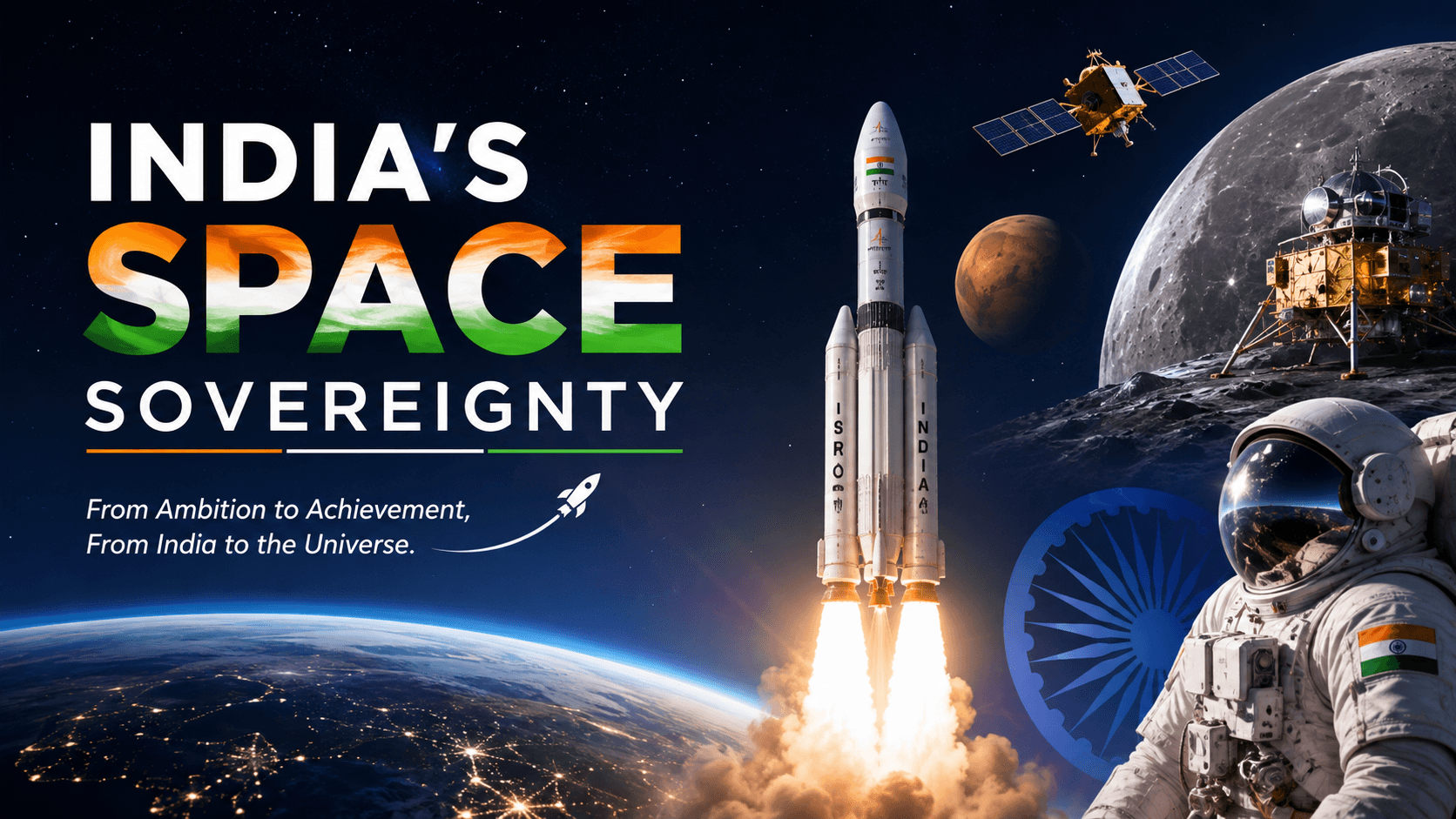
India’s Space Sovereignty
Why in the news?
Recently, India has commemorated National Space Day, 2026. India observes National Space Day annually on August 23, marking its third edition in 2026 to celebrate the historic soft landing of Chandrayaan-3. In a pertaining to India’s revolution in the field of space, Press Information Bureau (PIB) has released two separate articles regarding space technology and India’s success stories. We will discuss 360-degree views related to world of space.
The New Space Economy
India’s space sector has undergone a remarkable transformation from a government-led program to an increasingly private-led and globally competitive ecosystem.
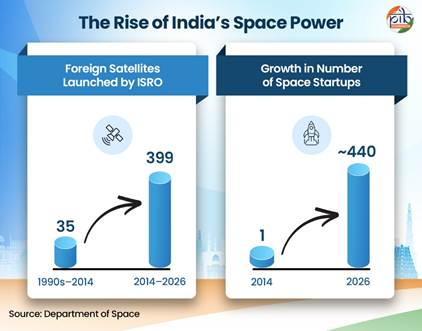
The number of space startups has grown from just 1 in 2014 to more than 400 by 2026. The Indian space economy, currently valued at around $8–9 billion, is projected to reach $40–45 billion over the next decade, with India targeting an 8% share of the global space economy.
Private investment has risen sharply, crossing $500 million and reaching $618.5 million by March 2026. With 113 authorizations granted to 52 private entities and 399 foreign satellites launched since 2014, India is emerging as a major global launch hub.
The EO-PPP initiative of IN-SPACe, backed by about ₹1,200 crore in private investment, is expected to create India’s first privately developed Earth Observation constellation.
1. Rise of a Global Space Power
India’s transformation rests on three interconnected pillars: space capability beyond Earth, national capacity for development, and global partnerships.
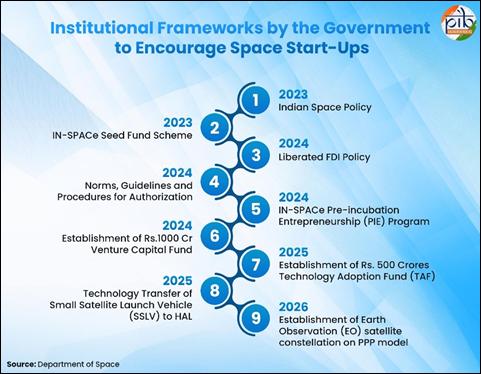
The opening of the sector to private players in 2020 marked a major turning point. The Space Policy 2023 further clarified institutional responsibilities, while the February 2024 FDI reforms opened the sector to greater domestic and international investment—up to 74% through the automatic route for satellites, 49% for launch vehicles and spaceports, and 100% for space components.
The commercial ecosystem has expanded rapidly. NSIL, ISRO’s commercial arm, increased its revenue from ₹321 crore in FY 2021–22 to ₹3,246 crore in FY 2024–25 and has signed 118 technology-transfer agreements. IN-SPACE functions as a single-window facilitator and has enabled 71 technology transfers by January 2026.
Government support is being reinforced through the ₹1,000 crore Venture Capital Fund, ₹500 crore Technology Adoption Fund, Seed Fund, and other programs. Together, these reforms have created a stronger environment for companies such as Skyroot, Agnikul, Pixxel, and Dhruva Space.
2. India’s Capability Beyond Earth
India’s space program has evolved from launching satellites to undertaking complex lunar, solar, planetary, and human-spaceflight missions.
Lunar Exploration
Chandrayaan-1, launched in 2008, provided important evidence of water on the Moon. Chandrayaan-2, launched in 2019, demonstrated advanced lunar-orbiting capabilities and high-resolution imaging.
Chandrayaan-3 achieved a historic soft landing in 2023 near the lunar south polar region, making India the fourth country to achieve a soft landing on the Moon and the first to land in the region. Its rover also confirmed the presence of sulfur on the lunar surface.
The next major step is Chandrayaan-4, planned for 2027, which aims to undertake lunar sample return. India is also collaborating with Japan on LUPEX/Chandrayaan-5 to study water and volatiles in permanently shadowed lunar regions.
Mars and the Sun
Mangalyaan, launched in 2013, made India the first Asian nation to successfully reach Mars orbit and achieved success on its maiden attempt. Designed for six months, it ultimately operated for about eight years.
Aditya-L1, launched in 2023, is India’s first dedicated solar observatory. Positioned around the Sun–Earth L1 point, approximately 1.5 million km from Earth, it is generating valuable data on the Sun and space weather.
Astronomy and Space Docking
AstroSat completed a decade of operation in 2025, while XPoSat, launched in 2024, expanded India’s capabilities in X-ray and polarization astronomy.
The SpaDeX mission achieved autonomous docking and undocking in January 2025, making India the fourth country to demonstrate this capability. The indigenous docking system and power-transfer demonstration are important technological foundations for future space stations, satellite servicing, and human spaceflight.
India is also preparing for its Venus Orbiter Mission, approved for March 2028, which will investigate Venus’s geology and atmosphere using advanced aerobraking and thermal technologies.
3. Gaganyaan and the Bharatiya Antariksh Station
Human spaceflight has now become a central focus of India’s space program. The Gaganyaan program aims to send a three-member Indian crew to a 400-km orbit for approximately three days. The revised program outlay is ₹20,193 crore, covering eight missions.
India’s human-spaceflight experience received a major boost through Group Captain Shubhanshu Shukla’s Axiom-4 mission in 2025. He travelled to the International Space Station aboard SpaceX’s Dragon spacecraft, conducted seven Indian microgravity experiments, and returned to Earth in July 2025.
This experience will complement the technology and operational preparations for Gaganyaan, including the planned uncrewed missions and the subsequent crewed mission.
The long-term objective is the Bharatiya Antariksh Station (BAS)—a planned five-module space station in low Earth orbit by 2035, with BAS-01 targeted for 2028.
The station is intended to provide a platform for long-duration scientific research and human spaceflight. International cooperation is already being developed, including an ESA–India joint intent covering cooperation on BAS and lunar exploration.
4. Private Sector Powering Transformation
The private sector is becoming a critical pillar of India’s space ambitions. Policy reforms have created clearer institutional roles, simplified approvals, and expanded opportunities for private companies across launch services, satellites, applications, and space-based manufacturing.
The government is also encouraging private participation through public-private partnership models. The EO-PPP initiative aims to establish a private Earth observation constellation, while the transfer of SSLV technology to HAL represents an important step towards greater private and industrial participation in launch systems.
Startups are increasingly moving beyond prototypes towards commercially viable products and services. Companies such as Skyroot, Agnikul, Pixel, and Dhruva Space demonstrate the breadth of this emerging ecosystem—from launch vehicles and satellite platforms to Earth observation and space infrastructure.
5. Building Self-Reliant Space Transportation
India is strengthening its ability to independently transport payloads into space. The PSLV, GSLV, and LVM3 provide launch capabilities ranging from Earth observation and communication satellites to heavier missions.
The next generation of launch technology is focused on higher capacity, reusability, and lower costs. The proposed Next Generation Launch Vehicle (NGLV) is designed for significantly greater payload capacity, while work on semi-cryogenic propulsion, the Vikas engine throttling, CE20 restart capability, and reusable launch technology is expanding India’s technological base.
The Reusable Launch Vehicle–Technology Demonstrator (RLV-TD) has already demonstrated successful autonomous landing tests. Indigenous semiconductor development, including the VIKRAM3201 and KALPANA32 chips, is further strengthening technological self-reliance.
Launch infrastructure is expanding as well. The second spaceport at Kulasekarapattinam in Tamil Nadu is being developed primarily for SSLV missions, with an expected capacity of around 20–25 launches annually. A third launchpadat Sriharikota was also approved in 2025 to support future human spaceflight and lunar missions.
6. Space for Citizens and Global Partnerships
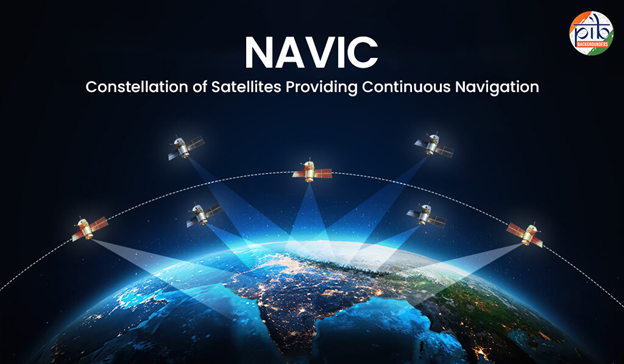
India’s space program increasingly serves everyday development needs. NavIC, India’s indigenous satellite navigation system, provides positioning services across India and beyond. The second-generation NavIC satellites are expanding its capabilities, with applications in transportation, power-grid synchronization, agriculture, and other public services.
Space technology is also being integrated into programs covering rural employment, roads, irrigation, urban development, crop mapping, water resources, and disaster management.
Fishermen receive potential fishing zone advisories, while satellite-based systems support search and rescue. Telemedicine and satellite-enabled education are expanding access to healthcare and learning, including through hundreds of PM e-VIDYA channels.
India’s space diplomacy has grown alongside its technological capabilities. The country now has more than 300 space-related agreements with around 61 countries. Major international collaborations include NISAR with NASA, launched in 2025 for Earth and climate monitoring; TRISHNA with France’s CNES for thermal Earth observation; and LUPEX with Japan’s JAXA for lunar exploration.
Long-standing cooperation with Russia, including its historic role in Aryabhata and Rakesh Sharma’s mission, has evolved towards cooperation in human-spaceflight training. India is also deepening space ties with Germany, Italy, Saudi Arabia, Mauritius, Bhutan, and BIMSTEC partners.
The Journey Ahead
India’s next phase will be defined by human spaceflight, reusable launch technology, planetary exploration, private enterprise, and international cooperation.
The immediate priorities include Gaganyaan missions, Chandrayaan-4’s lunar sample-return mission, LUPEX, the Venus Orbiter Mission, and the development of the Bharatiya Antariksh Station. At the same time, NGLV, semi-cryogenic propulsion, LOX-methane technologies, and reusable launch vehicles are being developed to make access to space more economical and sustainable.
The larger transformation is therefore not limited to rockets and satellites. India’s space ecosystem now combines technology, entrepreneurship, manufacturing, governance, national development, strategic capability, and global partnerships.
Conclusion
In little more than a decade, India has moved from building space capability to establishing itself as an emerging global space power. The expansion of private enterprise, major scientific missions, indigenous technologies, human-spaceflight ambitions, and international partnerships has fundamentally changed the character of the Indian space sector.
The new space economy represents more than commercial opportunity. It is becoming an instrument of Vishwas, Vikas, and Jan Kalyan, supporting the broader vision of Viksit Bharat 2047 through technological self-reliance, economic growth, national capability, and development for citizens.