India’s first human Space mission "Gaganyaan"
Recently, Union Minister of State for Prime Minister’s office and Personnel, Public Grievances and Pensions, Atomic Energy and Space, Dr. Jitendra Singh informed about GAGANYAAN PROGRAMME, in a written reply in the Lok Sabha.
Gaganyaan missions will be launched from Second Launch Pad (SLP) of SDSC SHAR. Accordingly, to meet the integration, testing and launch requirements, various elements/ facilities/ systems were planned, configured and realized.
Orbital Module Preparation Facility (OMPF) is realized to carry out the preparation of Crew Module (CM), Service Module (SM) and Crew Escape System (CES) including the CES solid motors.
What is the Gaganyaan Mission?
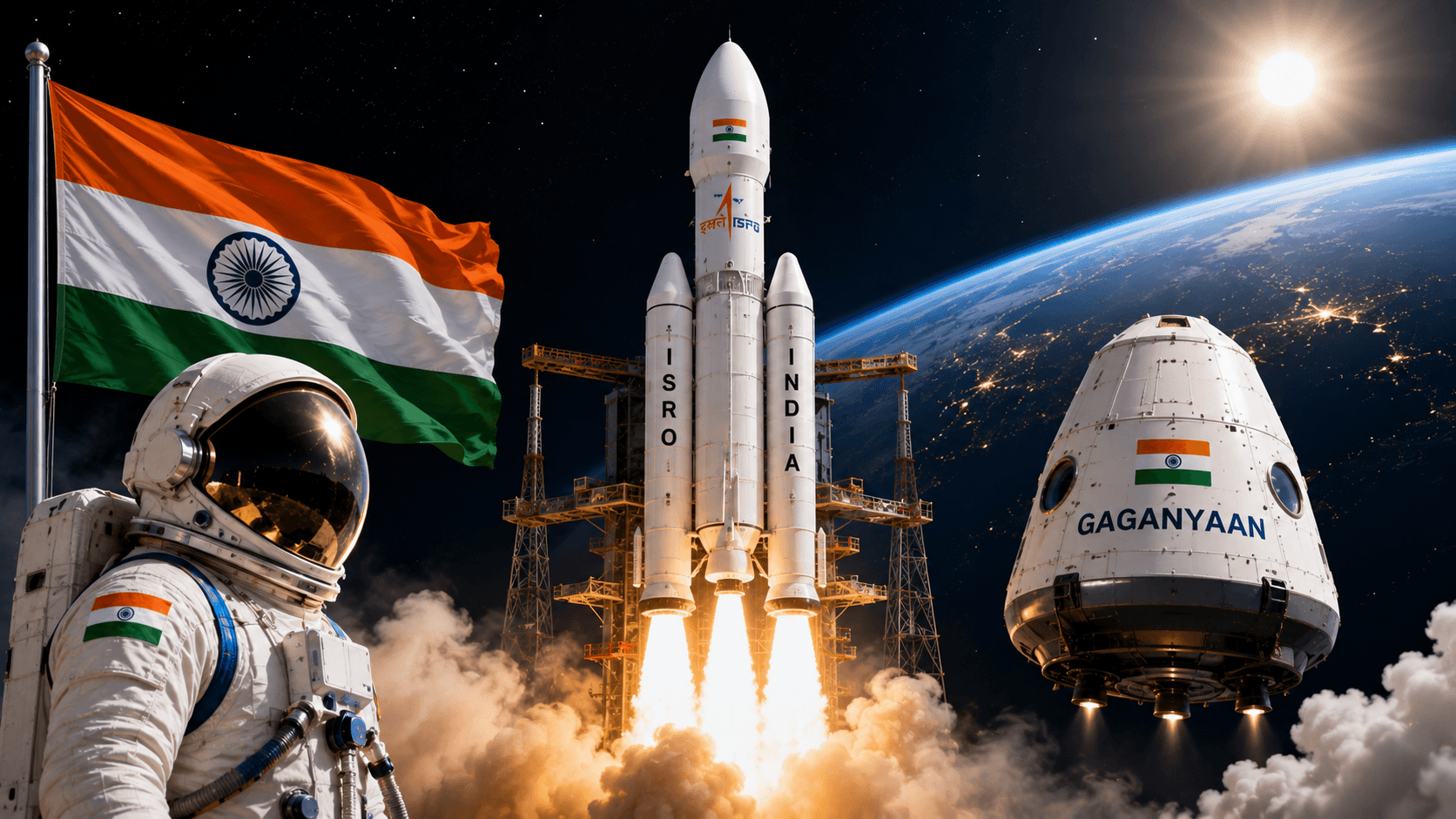
Gaganyaan is India’s flagship indigenous human spaceflight programme, formally announced in 2018.
It marks India’s entry into an elite group of nations with independent crewed spaceflight capability.
Key Objectives:
Demonstrate Human Spaceflight Capability :-The mission aims to send a crew of three Indian astronauts to a 400 km Low Earth Orbit (LEO) for a three-day mission and bring them back safely via a splashdown in Indian sea waters.
Establish India Among Spacefaring Nations:-With Gaganyaan, India will become the fourth country in the world, after the United States, Russia, and China, to independently design, develop, and execute a human spaceflight mission.
Indigenous Launch System:- The Human-rated Launch Vehicle Mark-3 (HLVM3) will place the Orbital Module (OM) carrying the crew into the intended orbit. HLVM3 is a modified, more reliable version of ISRO’s proven LVM3.
Safety-First Approach Through Test Flights:- Prior to the crewed mission, ISRO is conducting a series of uncrewed test flights to validate the safety, reliability, and performance of critical systems. These include the Crew Module, the Crew Escape System, and the HLVM3 itself.
As a matter of fact, Gaganyaan is not just a mission — it is a statement of India’s scientific self-reliance and ambition in space exploration.
The development activities carried out for Gaganyaan mission include the following:
- Human Rated Launch Vehicle (HLVM3): Development and ground testing of all propulsion stages and structures completed.
- Orbital Module: Propulsion systems for Crew Module and Service Module developed, tested and qualified. Engineering model for Environmental Control & Life Support Systm (ECLSS) has been realized. Deceleration system, Crew Module Up-righting System, Thermal Protection System and end to end avionics have been developed and tested.
- Crew Escape System (CES): 5 types of motors developed and static tested. All the CES structures are realised and qualified.
- Infrastructure established: Orbital Module Preparation Facility, Gaganyaan Control Centre, Gaganyaan Control facility, Crew training facility, Second Launch pad modifications have been realised.
- Test Missions: First Test Vehicle mission (TV-D1) for inflight validation of Crew Escape System (CES) has been successfully completed. Integrated Air Drop Test- 01 (IADT-01) and Integrated Air Drop Test- 02 (IADT-02) with simulated Crew Module for validation of deceleration system have been completed successfully. Accomplishment of TV-D2 mission is in advanced stage.
- Flight Operations and Communication Network: Ground network configuration finalized. IDRSS-1 feeder stations and terrestrial links established. MoUs have been signed with other space agencies for cross supports.
- Crew Recovery Operations: Recovery assets finalized. Recovery Plan worked out.
Mission specific training
Parallelly, various ground qualification tests towards demonstrating new systems realized for Gaganyaan are being carried out.
Gaganyatris have completed generic training at Glavkosmos, Russia. Gaganyaan mission specific training is in progress at Astronaut Training facility, Bengaluru.
Activities are in progress towards accomplishment of first uncrewed mission, G1. All stages of HLVM3 viz. HS200, L110 and C32 and CES motors ready.
Crew Module and Service Module systems realized. Assembly, Integration and testing of Crew Module and Service Module nearing completion Integrated simulations are being carried out.
The integration and access requirements including the checkout requirements were considered for modifications in Second Vehicle Assembly Building (SVAB).
Checkout facilities at SVAB Terminal Room (SVTR) and Launch Pad Terminal Room – Gaganyaan (LTR-G) interfaces Checkout systems for sub-assembly/ stage preparation facilities (HS200, L110-G, C25-G and EB) are augmented.
Additionally, Crew Access Arm, bubble lift and zip line system are augmented at Umbilical Tower of Second Launch Pad, to meet requirements of crewed missions.
Environment Control & Life Support System (ECLSS)
Environment Control & Life Support System (ECLSS) is a “system of systems” and very critical technology for human spaceflight.
It is used to maintain a habitable environment during the entire duration of the mission by maintaining temperature, humidity, pressure and carbon dioxide levels in the Crew Module. This system is being developed indigenously by ISRO.
Currently, the system is undergoing development tests. Flight demonstration of reduced version of ECLSS is planned in uncrewed Gaganyaan missions.
Why is the Gaganyaan Mission significant for India?
Entry into an Elite Club
Gaganyaan will establish India as the fourth country in the world, after the United States, Russia, and China, to independently conduct a human spaceflight mission. This is a major milestone for India’s scientific and technological prestige on the global stage.
Boost to Scientific Research
The mission will strengthen India’s capabilities in microgravity research. Experiments in space medicine, biology, material science, and fluid dynamics conducted by Indian astronauts will open new frontiers for indigenous R&D.
Advancement in Critical Technologies
Developing Gaganyaan has led to major breakthroughs in life support systems, crew escape systems, human-rated launch vehicles, and re-entry technology. These technologies have both strategic and commercial applications.
Foundation for Future Ambitious Missions
Gaganyaan lays the groundwork for India’s long-term space goals, including the proposed Bharatiya Antariksh Station and a crewed lunar mission. It builds the experience, infrastructure, and human capital needed for sustained human presence in space.5. Inspiration and Nation Building
Beyond technology, the mission will inspire a new generation of scientists, engineers, and students, and reinforce India’s image as a responsible and capable spacefaring nation.
Conclusion
The Gaganyaan Mission is far more than a demonstration of human spaceflight. It symbolizes India’s scientific self-reliance, technological maturity, and global aspirations in space. By successfully executing this mission, India will not only join the elite group of nations with independent crewed space capability but will also build the foundation for future endeavors like the Bharatiya Antariksh Station and a crewed lunar mission. Gaganyaan will strengthen India’s capabilities in microgravity research, inspire future generations in STEM, and enhance our strategic standing in the 21st-century space economy. In essence, Gaganyaan marks India’s transition from being a spacefaring nation to becoming a human spacefaring nation.
India’s Gaganyaan mission is a core topic in the General Studies (GS) syllabus. It primarily falls under Science and Technology, which is highly significant in both the BPSC Prelims (General Science and Current Affairs) and the BPSC Mains (GS Paper-II).
Reference:
- https://www.pib.gov.in/PressReleasePage.aspx?PRID=2291083®=48&lang=2
- https://www.isro.gov.in/Gaganyaan.html
What is the Gaganyaan mission?
Gaganyaan is India's flagship indigenous human spaceflight programme, formally announced in 2018, marking India's entry into the group of nations with independent crewed spaceflight capability.
What are the key objectives of Gaganyaan?
The mission aims to send a crew of three Indian astronauts to a 400 km Low Earth Orbit for a three-day mission and bring them back safely via a splashdown in Indian sea waters.
Which launch vehicle will carry the Gaganyaan crew?
The Human-rated Launch Vehicle Mark-3 (HLVM3), a modified and more reliable version of ISRO's proven LVM3, will place the Orbital Module carrying the crew into orbit.
Which country will India become after a successful Gaganyaan mission?
India will become the fourth country in the world, after the United States, Russia, and China, to independently design, develop, and execute a human spaceflight mission.
What test missions have already been completed for Gaganyaan?
The first Test Vehicle mission, TV-D1, for validating the Crew Escape System has been completed successfully, along with Integrated Air Drop Tests IADT-01 and IADT-02 for the deceleration system, while the TV-D2 mission is in an advanced stage.
What is ECLSS in the Gaganyaan mission?
The Environment Control & Life Support System (ECLSS) is a critical, indigenously developed 'system of systems' that maintains temperature, humidity, pressure, and carbon dioxide levels inside the Crew Module.
Where are the Gaganyatris being trained?
The Gaganyatris completed generic training at Glavkosmos in Russia, and mission-specific training is currently in progress at the Astronaut Training facility in Bengaluru.
From where will Gaganyaan missions be launched?
Gaganyaan missions will be launched from the Second Launch Pad (SLP) of SDSC SHAR.
Why is Gaganyaan significant for India's future space ambitions?
Gaganyaan lays the groundwork for future missions such as the proposed Bharatiya Antariksh Station and a crewed lunar mission, building the experience, infrastructure, and human capital needed for sustained human presence in space.
Is Gaganyaan relevant to the BPSC syllabus?
Yes, Gaganyaan falls under Science and Technology and is significant for both the BPSC Prelims, under General Science and Current Affairs, and the BPSC Mains, under GS Paper-II.