India–Bhutan Ties: 13th Five-Year Plan
India-Bhutan ties and development assistance like the 13th Five-Year Plan fall under General Studies Paper-II (International Relations / India and its neighborhood relations) in the UPSC Civil Services Examination and under General Studies Paper-II (Section-II: International Relations and Indian Economy/Polity aspects) in the BPSC (Bihar Public Service Commission) Mains syllabus.
Why in News?
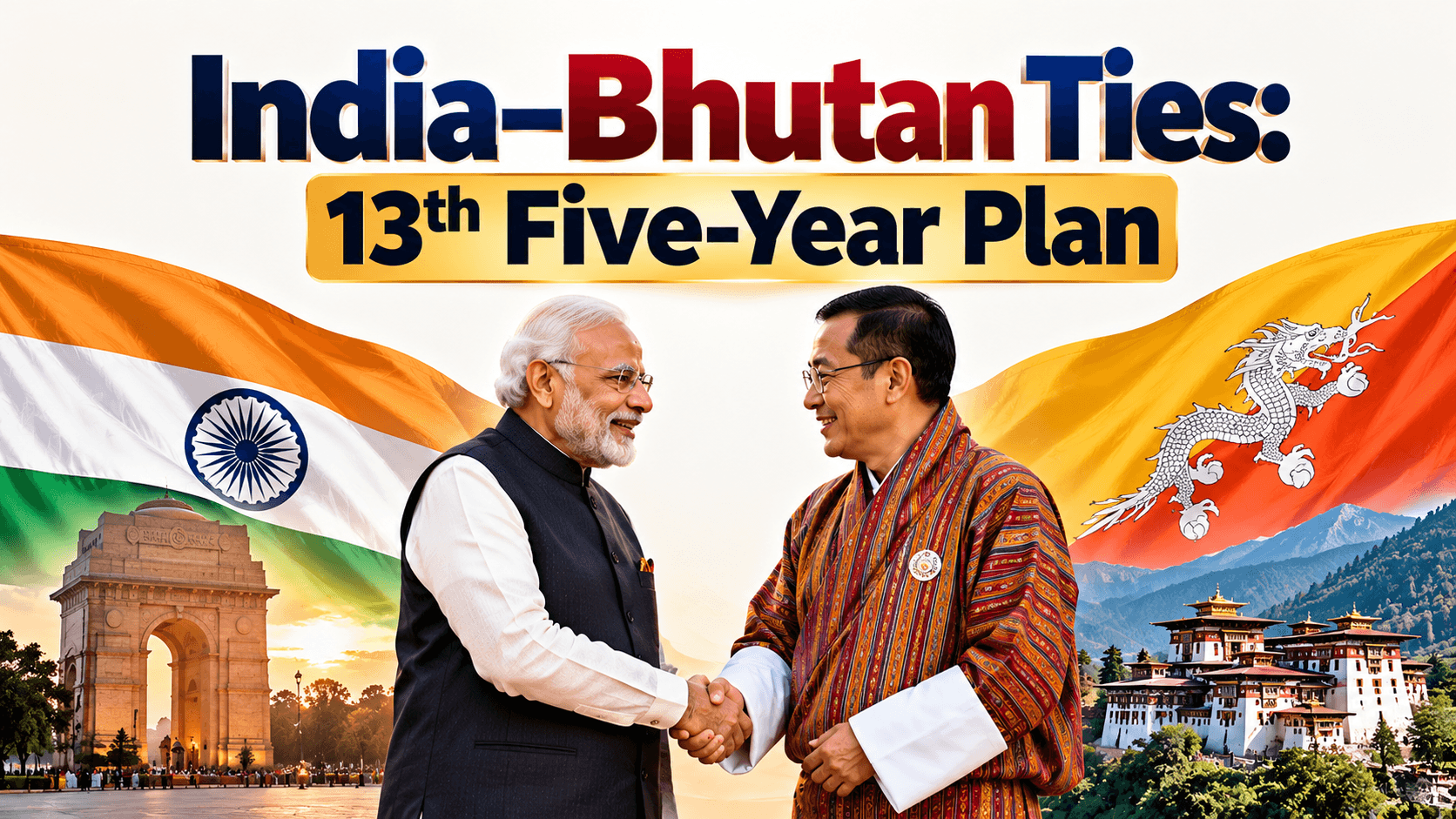
Recently, India had handed over ₹290 crore (Nu 2.90 billion) to Bhutan to support development projects under the Himalayan nation’s 13th Five-Year Plan. The assistance aims to strengthen key sectors such as education, healthcare, infrastructure, agriculture, and digital connectivity.
India’s support for Bhutan’s development started in 1961, when India funded Bhutan’s entire First Five-Year Plan (1961-66) and Second Five-Year Plan (1967-72). India remains Bhutan’s largest development partner, and Bhutan is the largest recipient of India’s foreign aid. Between 2000 and 2017, Bhutan received $4.7 billion in grants from India.
The funding was announced during the 19th Monthly Coordination Meeting in Thimphu, where Indian and Bhutanese officials reviewed ongoing projects and discussed the future.
India-Bhutan relations
India-Bhutan ties date back to 747 AD, when monk Padmasambhava spread Buddhism in Bhutan. During British rule, Bhutan came under British influence under the Treaty of Punakha (1910), where Bhutan was guided by Britain in external affairs.
In 1947, Bhutan chose to remain independent. After China took over Tibet in 1949, Bhutan grew closer to India due to security concerns.
This led to the Treaty of Peace and Friendship (1949) in Darjeeling, the bedrock of relations. India recognized Bhutan's sovereignty and assured non-interference and supported its UN entry. The treaty was revised in 2007 to reaffirm Bhutan as a fully independent and sovereign nation.
India-Bhutan Treaty
Treaty of Sinchula (1865): This was the earlier working agreement between Bhutan and British India after the Anglo-Bhutan War (1864-65). Bhutan ceded some territories and in return received an annual subsidy.
Treaty of Punakha (1910): Signed on 8th January 1910 at Punakha Dzong between British India and Bhutan.
Under this treaty, Britain guaranteed non-interference in Bhutan's internal affairs, and Bhutan agreed to be guided by Britain in its external relations. The annual subsidy to Bhutan was also doubled. It affirmed Bhutan's independence and helped maintain its status as one of the few Asian kingdoms never directly conquered by a colonial power.
Key Provisions of the Indo-Bhutan Treaty (1949 & 2007 Revision)
Sovereignty: India recognizes the sovereignty, independence, and territorial integrity of Bhutan.
Wide-ranging Cooperation: The Treaty covers cultural cooperation, sports development, cooperation in science & technology, and healthcare.
National Treatment: Both countries have agreed to extend national treatment to each other. Indian citizens have the same right to employment in Bhutan as Bhutanese nationals have in India.
Open Border: India and Bhutan have an open border system. Citizens of both countries can move into each other's territory without a visa.
Extradition Clause: The treaty has a special provision for extradition of offenders.
External Affairs Clause (1949): Originally, Bhutan had to seek India's advice in matters related to external affairs.
2007 Revision: Bhutan raised the issue of the external affairs clause in 2007 and sought its modification. India immediately agreed to revise the treaty. This instilled confidence in Bhutan that India is a true partner in Bhutan's progress and respects its full sovereignty.
India-Bhutan special relations
| Security: | Neither government will allow its territory to be used for activities harmful to the other’s national security. |
| Equal Justice: | Both ensure equal justice for each other's citizens. |
| Trade: | Free trade and commerce between India and Bhutan. |
| Defense Imports: | Bhutan can freely import arms and warlike material from or through India. |
| Hydropower: | India funds hydropower projects and buys the power, the main economic pillar. |
| Strategic Support: | India provides budgetary support for development and stands with Bhutan against Chinese expansionism. |
Key features of India-Bhutan cooperation under the treaty framework:
Security Commitment: Neither country will allow its territory to be used for activities harmful to the national security and interest of the other.
Equal Justice: Both countries ensure equal justice for each other's citizens in their respective territories.
Free Trade and Commerce: There is free trade and commerce between India and Bhutan.
Defense Imports: Bhutan is free to import arms, ammunition, machinery, and warlike material from or through India as per its requirements.
Hydropower Cooperation: India gives loans for hydroelectric projects in Bhutan and purchases power from Bhutan—this is the backbone of economic ties.
Development and Strategic Support: India provides budgetary support for Bhutan's development and backs Bhutan against Chinese expansionism.
Recent Strains and Challenges in India-Bhutan Ties
Hydropower Issues: Ties strained over India's sudden change in power purchasing policy, rigid tariffs, and refusal to allow Bhutan to join the national power grid and trade with third countries like Bangladesh. A clause requiring the exporting power company to be majority Indian-owned created friction, though now being addressed.
Environmental Concerns: Bhutan has concerns about environmental risks due to increased trade, transport, and tourism.
Connectivity Hurdle: India's plan for a Motor Vehicle Agreement under the BBIN (Bangladesh-Bhutan-India-Nepal) grouping is held up, with Bhutan having concerns.
Tourism Issue: Bhutan's proposal to levy entry charges / a sustainable development fee on Indian tourists could cause differences.
Shifting Educational Preference: Earlier, Bhutanese students preferred India, but now youth prefer Australia, Singapore, Thailand, etc.
Growing External Engagement: Increasing high-level visits to Bhutan from China and the USA shows Bhutan's growing strategic outreach.
China Factor in Bhutan
China shares a 470 km border with Bhutan but has no official diplomatic relations, and border disputes persist with Beijing stepping up pressure to settle them quickly by reviving an old land swap deal that would require Thimphu to cede territory, which is strategically concerning for India.
Conclusion
Despite occasional frictions over hydropower tariffs, connectivity and tourism issues, and growing Chinese pressure, India-Bhutan ties remain uniquely close and built on mutual trust, respect for sovereignty, open borders, and deep economic and strategic cooperation. The timely revision of the treaty in 2007 and continued development support show India as a reliable partner in Bhutan's progress, while Bhutan remains a crucial ally for India's security in the Himalayas.
Reference: