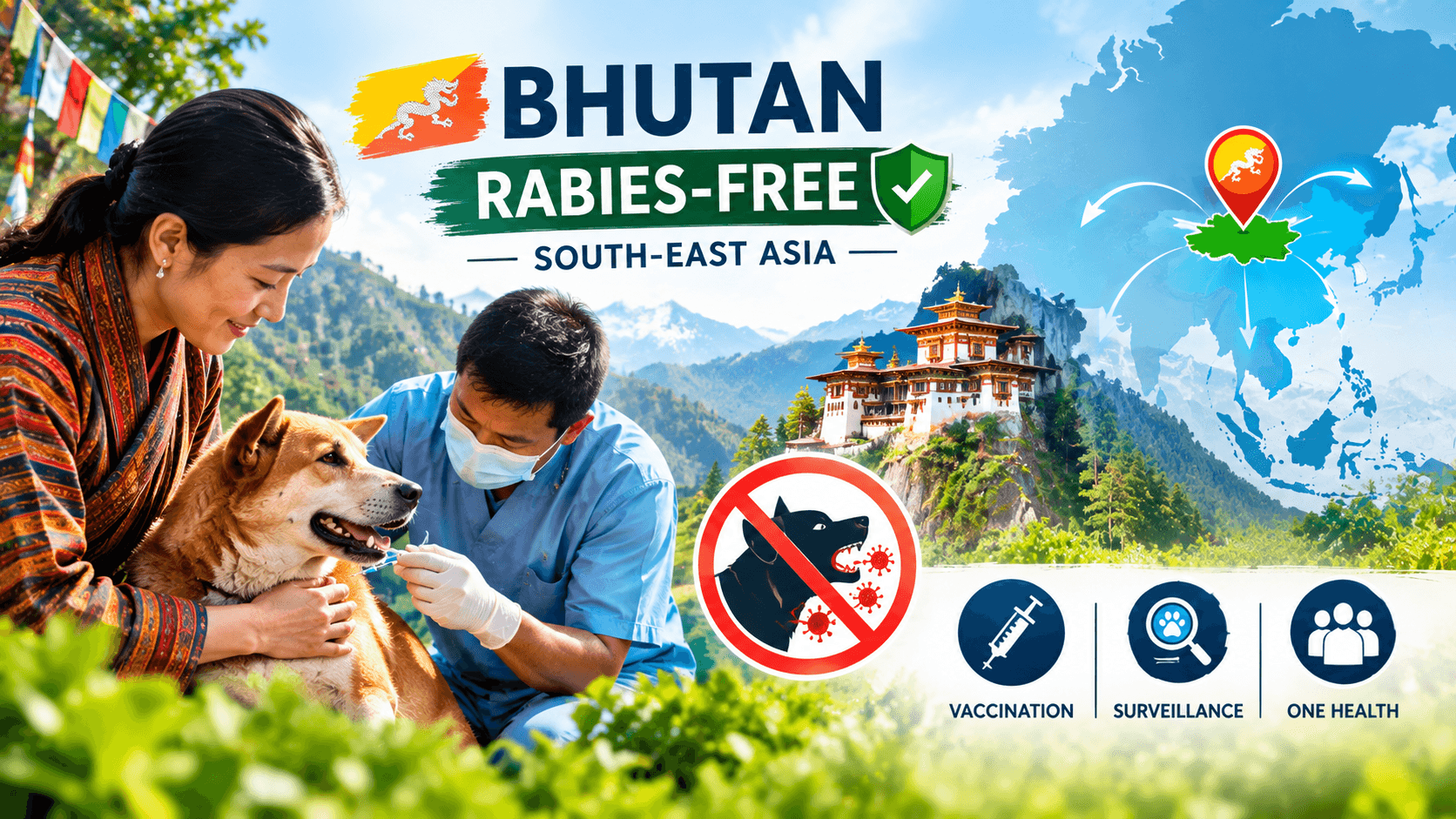
Bhutan: A Rabies-Free South-East Asia
Why in News?
Recently, Bhutan has become the 1st country in the WHO South-East Asia Region to eliminate dog-mediated rabies as a public health problem, reporting zero human deaths since June 2023 through sustained surveillance, vaccination, and the One Health approach.
The validation was done as per WHO Expert Consultation on Rabies (2018) criteria, assessed by experts from WHO and the World Organisation for Animal Health (WOAH), covering surveillance systems, labs, records, and field implementation.
Elimination requires no human deaths from dog-transmitted rabies for at least two years, along with effective surveillance, vaccination, and control mechanisms to prevent re-emergence.
About Rabies
It is caused by the rabies virus, a neurotropic virus of the Lyssavirus genus, which affects the central nervous system and leads to fatal encephalitis if untreated after symptom onset. Nature: Viral, zoonotic disease and a Neglected Tropical Disease (NTD). Once clinical symptoms appear, it is almost invariably fatal. Transmission: Spreads through saliva of infected animals, mainly via bites and scratches, or contact with broken skin or mucous membranes. Human-to-human transmission is extremely rare, reported mainly through organ transplantation. Prevention & Treatment: Deaths are completely preventable with timely Post-Exposure Prophylaxis (PEP):
1. Immediate wound washing with soap and water for 15 minutes
2. Full course of rabies vaccine
3. Rabies immunoglobulin (RIG) or monoclonal antibodies for severe exposures
Symptoms: Incubation usually takes 2-3 months and can range from one week to one year. Once symptoms appear, it is virtually 100% fatal.
Two forms:
| Furious rabies: | hydrophobia, hallucinations, hyperactivity, rapid death |
| Paralytic rabies: | gradual paralysis, often misdiagnosed |
Rabies in the context of India
India continues to face a significant rabies burden, largely linked to dog bites, while globally the disease costs an estimated US$ 8.6 billion annually, including healthcare, livelihood loss, and PEP costs.
India's Measures for Rabies Control
| National Rabies Control Programme (NRCP): | Aims to reduce rabies deaths by strengthening surveillance, prevention, and management of animal bite cases nationwide. |
| National Health Mission (NHM): | Provides financial and operational support to states for vaccines, training, IEC activities, and anti-rabies infrastructure. Ensures free availability of Anti-Rabies Vaccine (ARV) and Rabies Immunoglobulin (RIG) at public health facilities. |
| NCDC Rabies Activities: | Supports awareness generation, lab strengthening, and development of guidelines and training material. |
| National One Health Programme for Prevention and Control of Zoonosis: | Integrates human and veterinary health systems to improve animal rabies diagnosis and coordinated control. |
| Integrated Health Information Platform (IHIP): | Digital platform for real-time reporting and monitoring of animal bites and rabies deaths across states and UTs. |
Conclusion
Bhutan's validation as the first in WHO South-East Asia to eliminate dog-mediated rabies as a public health problem shows that zero human deaths is achievable with sustained One Health action, strong surveillance, and mass dog vaccination. For India, which still bears a high rabies burden, scaling up NRCP, ensuring free ARV/RIG, IHIP-based reporting, and One Health coordination is key to replicating this success and moving towards the Zero by 30 goal.