11th Ayurveda Day: Ayurveda Meets Modern Healthcare
Why in News?
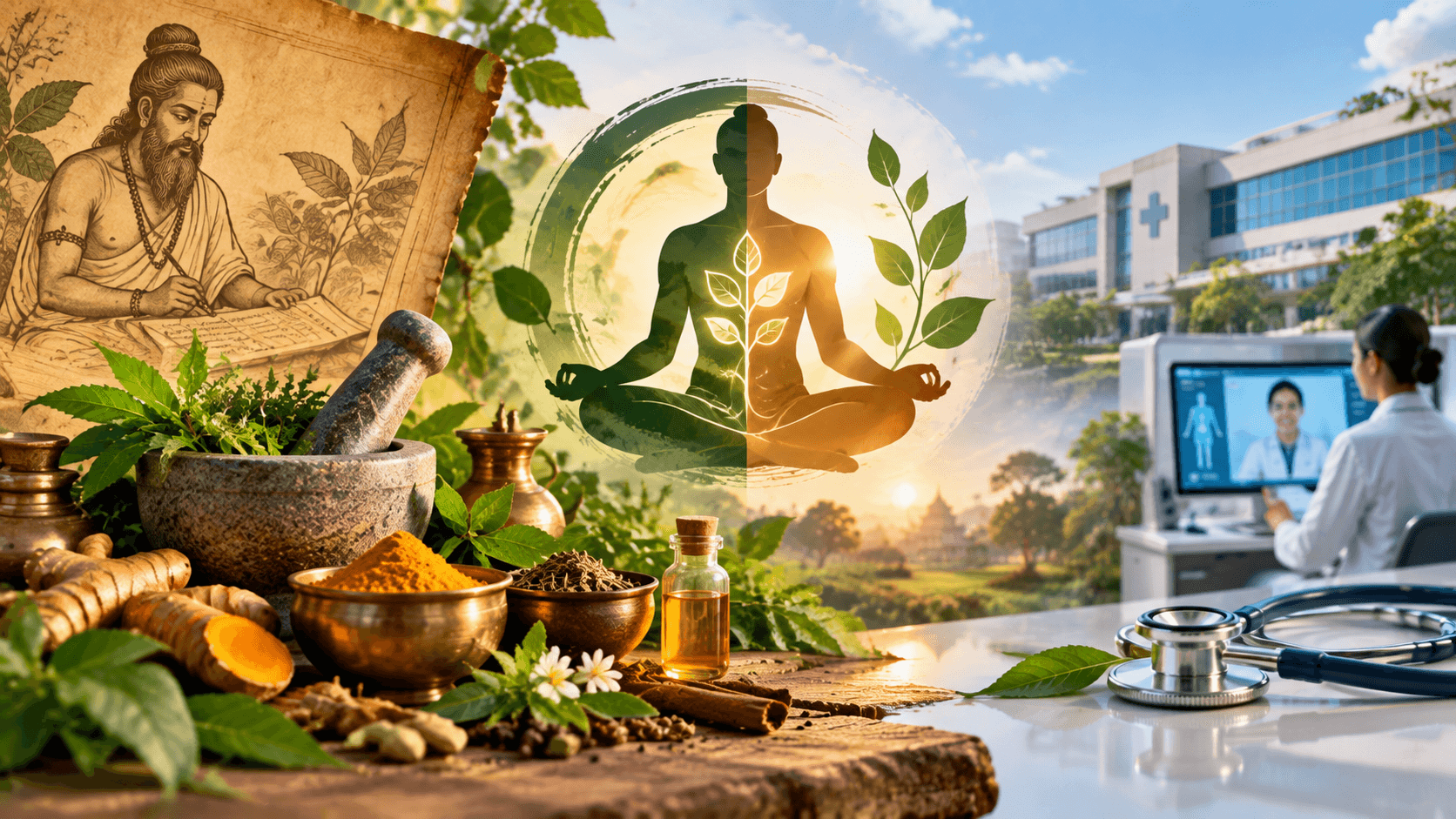
India observed the 11th Ayurveda Day on September 23, 2026, with the theme “Ayurveda for a Healthier Tomorrow.” The focus is on integrating Ayurveda with modern healthcare through scientific research, better infrastructure, quality regulation, and global cooperation.
What is Ayurveda?
Ayurveda is a more than 5,000-year-old traditional system of Indian medicine. The word comes from “Ayu” (life) and “Veda” (knowledge/science).
Its core objective is to maintain the health of healthy people and treat illness in the sick. Ayurveda emphasizes balance among the body, mind, and overall well-being.
Expanding Ayurveda Healthcare Infrastructure
The National Ayush Mission (NAM) and National Health Mission (NHM) are expanding Ayush services across India.
Between 2014-15 and 2025-26, more than ₹6,406.99 crore was released under NAM to strengthen Ayush healthcare.
As of September 19, 2026:
- 12,260 Ayushman Arogya Mandirs were functional.
- Ayush services were available in 13,249 public health facilities.
- The government supported 25,322 Ayush doctors and 5,666 paramedics.
Ayurveda Goes Digital
The government’s eSanjeevani telemedicine platform has served more than 50 crore patients.
It also provides Ayush OPD services, enabling people to consult Ayurveda practitioners online.
Ayurveda and Health Insurance
In 2024, IRDAI directed insurers to offer products or add-ons covering different systems of medicine, including Ayurveda.
In February 2026, the All India Institute of Ayurveda (AIIA) was empanelled with 32 general insurance companies, supporting cashless Ayush treatment.
WHO Recognition of Ayurveda
Ayurveda, Siddha, and Unani (ASU) diagnoses have been included in the WHO ICD-11 Module.
This provides standardized codes for recording traditional medicine diagnoses and can support research, health policy, and insurance processing.
Growth of Ayurveda Education
As of March 13, 2026, India had:
- 593 Ayurveda colleges
- 45,245 undergraduate seats
- 5,673 postgraduate seats
The expansion aims to create a larger pool of trained Ayurveda professionals.
Focus on Evidence-Based Research
The government is increasingly emphasizing scientific research and validation of Ayurveda.
The AYURGYAN Scheme, launched in 2021-22, supports research and development in Ayush.
The Central Council for Research in Ayurvedic Sciences (CCRAS) is the major research body working on Ayurvedic studies.
Regulation and Quality Control
Ayurvedic medicines are regulated under the Drugs and Cosmetics Act, 1940, and Drugs Rules, 1945.
Manufacturers must follow quality standards, including Good Manufacturing Practices (GMP) and pharmacopoeial standards.
The government has also introduced the e-Aushadhi portal for online processing and tracking of drug manufacturing licenses.
India’s Global Ayurveda Outreach
India is expanding international cooperation in traditional medicine through:
- 27 country-to-country MoUs
- 16 Ayush Academic Chair MoUs
- 57 institute-to-institute MoUs
- 46 Ayush Information Cells in 43 countries
India also hosted the Second WHO Global Summit on Traditional Medicine in New Delhi in December 2025, where the Delhi Declaration encouraged scientifically supported integration of traditional medicine into healthcare.
Union Budget 2026-27
The Ministry of Ayush received ₹4,408 crore in the Union Budget 2026-27.
Key initiatives include:
- Establishment of three new All India Institutes of Ayurveda
- Upgradation of Ayush pharmacies and drug-testing laboratories
- Upgradation of the WHO Global Traditional Medicine Centre, Jamnagar
Conclusion
Ayurveda is gradually moving from a traditional practice towards a more institutionalized and research-oriented healthcare system. The current approach focuses on combining traditional knowledge with scientific research, quality regulation, digital access, and modern healthcare infrastructure.