EDU TERIA Logo
CartSign InSign UpEnroll Now
Back Modern Indian History
BPSC Mains GS-1 Masterclass · Modern Indian History

Socio-Economic Changes in Colonial BiharSchools, Presses, Zamindars and Lost Trade

After Plassey and Buxar, British rule reshaped Bihar. Society changed slowly, through English schools, newspapers and reform laws. The economy changed fast: wealth drained away, Patna lost its trade, zamindars and indigo came to dominate the countryside, and Bihar's crafts declined. This page sets out both.

Education1835First western school

in Patna; Purnea the same year.

College1863Patna College

established 9 January.

Land1793Permanent Settlement

zamindars became owners.

Trade300+ yearsPatna's trade

a hub until the railways.

Mines2.2 → 22.6 mtCoal output

between 1890 and 1920.

Sugar25%India's sugar

from Bihar in the mid-fifties.

Part 1 · Changes in the social scenario: education

From Pathshalas to Patna College

Traditional schooling gave way to English education after 1835, but only a few schools reached Bihar and mass education was neglected.

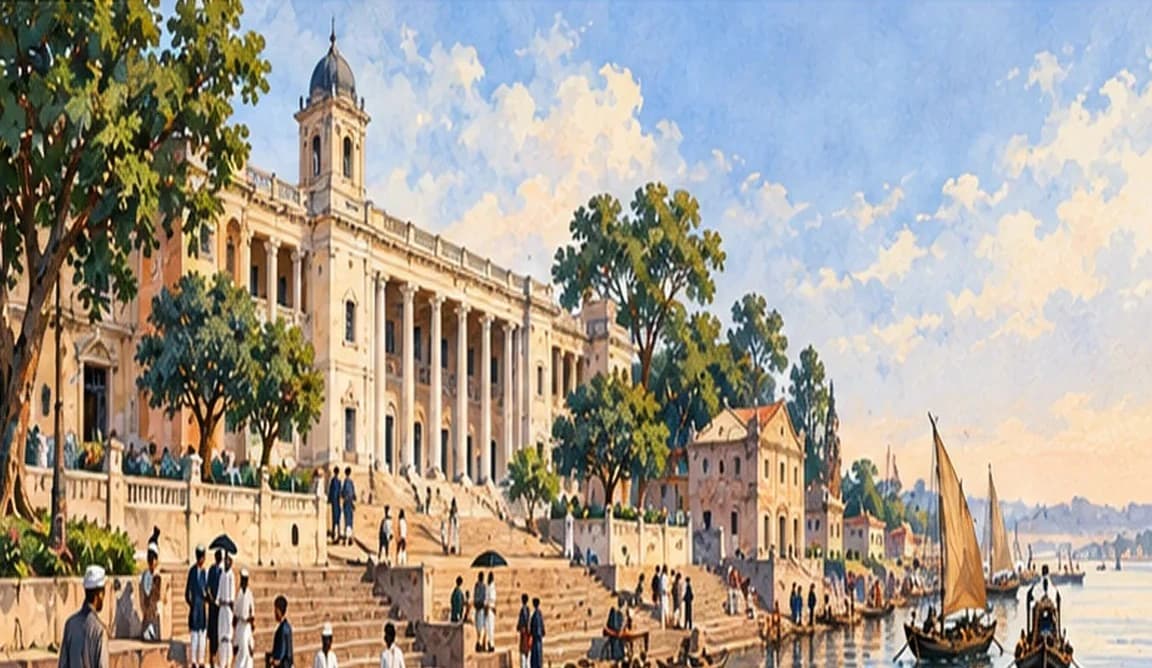
Illustration of a 19th-century colonial college building on the bank of the Ganga at Patna, students in period dress on the steps

Sudden economic, gradual social change

The establishment of British rule in Bihar after the battle of Buxar and battle of Plassey brought in the changes in all the dimensions of life.

While the changes in the economic scenario were sudden, the changes in the social scenario were comparatively gradual because of the policy of non-intervention followed till 1813.

Education

  • Earlier, traditional education was provided in mainly Sanskrit and Persian languages in 4 types of educational institutes: Pathsalas and Maktabs for elementary education and Chatuspadi and Madrasas for higher education. According to survey of Adam in 1837-38, there were about 1 lakh primary schools in about 15 lakh villages in Bihar and Bengal.
  • During British rule, Western education in English medium was introduced in Bihar from 1820s-30s.
  • The Charter act of 1813 directed the British government to spend 1 lakh rupees for education. But it was followed by the controversy regarding how this amount is to be spent.
  • Following the orientalist-anglicist controversy, a radical change was introduced in 1835 with introduction of Macaulay's minutes on education. It favored English education and directly impacted content, methodology and medium of Indian education system.
  • The government soon made English as the medium of instruction in its schools and colleges and opened a few English schools and colleges instead of a large number of elementary schools, thus neglecting mass education.
    • Though very few English schools and colleges were set up in Bihar, e.g. district school in Purnea, Ara, Chhapra and Biharsharif.
    • The first modern-western educational school was established in 1835 in Patna. In the same year, another Western school was opened in Purnea. And in the next year a number of District Schools were started in Biharsharif, Bhagalpur, Ara, Chhapra etc.
  • Later after Wood's dispatch (1854) on educational system, the government assumed wider responsibility for the spread of education.
  • Patna college was established on 9 January, 1863 which became Patna university in 1917.
Mass education neglected

The education policies continued to evolve during the colonial rule. But, overall the mass education was neglected leading to widespread illiteracy (1911—84 per cent and in 1921—92 per cent) which created a wide linguistic and cultural gulf between the educated few and the masses. There was also almost total neglect of women's education.

“While motivation behind almost all the policies was to serve the colonial interest, the positive outcomes were mostly unintended by-products of these policies.”
— BPSC Mains answer · Colonial Bihar

Curated for BPSC, UPSC & State PCS Civil Services Aspirants | Modern Indian History Master Module