EDU TERIA Logo
CartSign InSign UpEnroll Now
Back Science & Technology
BPSC Mains GS-2 Masterclass · Science & Technology

Genetic Engineering & CloningGenes, Clones, DNA Profiles & Blood Groups

Scientists can now cut, copy and move genes between species. This page explains genetic engineering and how far it can cure inherited disease, what cloning is and why it divides opinion, how a DNA fingerprint identifies a person, and how blood groups decide who can give blood to whom.

MethodrDNARecombinant DNA

genes from many sources joined.

CRISPR2018Gene-edited babies

made with CRISPR in China.

Cloning1996Dolly the sheep

the cloned sheep.

IndiaCDFDHyderabad

India's DNA fingerprinting centre.

Blood36 / 346Blood group systems / antigens

recognised by ISBT.

TransfusionO & ABDonor and recipient

universal donor and receiver.

Part 1 · What is genetic engineering?

Genetic Engineering: Rewriting an Organism's Genes

The direct manipulation of genes, moving them within and across species with recombinant DNA, to make improved or novel organisms.

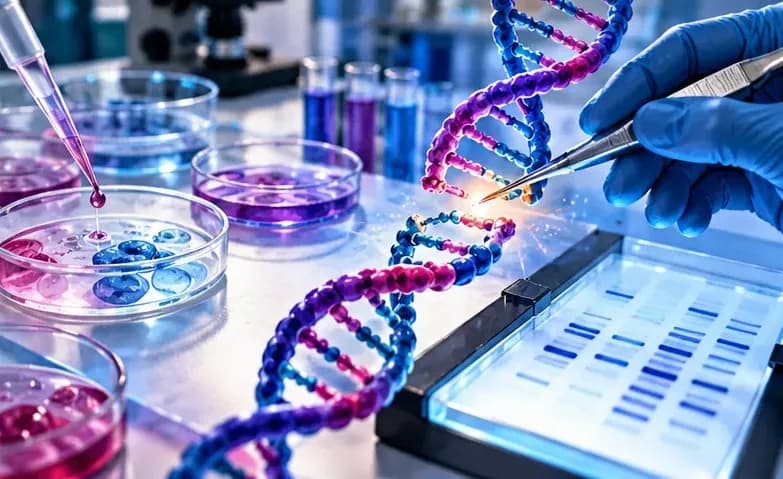
Illustration of a DNA double helix being cut and joined by molecular scissors, with a lab bench, petri dishes and a pipette

Genetic engineering

Genetic engineering, also called genetic modification or genetic manipulation, is the direct manipulation of an organism's genes using biotechnology. It is a set of technologies used to change the genetic makeup of cells, including the transfer of genes within and across species boundaries to produce improved or novel organisms.

New DNA is obtained by either isolating and copying the genetic material of interest using recombinant DNA methods or by artificially synthesising the DNA.

GMOs

An organism that is generated through genetic engineering is considered to be genetically modified (GM) and the resulting entity is a genetically modified organism (GMO). GM crops are modified to increase resistance to insects and herbicides.

Genetic engineering has been applied in numerous fields including research, medicine, industrial biotechnology and agriculture.

Recombinant DNA

Recombinant DNA (rDNA) molecules are DNA molecules formed by laboratory methods of genetic recombination to bring together genetic material from multiple sources, creating sequences that would not otherwise be found in the genome.

Example: Think of DNA as a recipe book. Recombinant DNA is like cutting a recipe out of one book and pasting it into another: the human insulin 'recipe' pasted into a bacterium's book makes the bacterium cook insulin.

“Positive use of genetic engineering techniques can change the fate of mankind.”
— BPSC Mains answer · Genetic engineering

Curated for BPSC, UPSC & State PCS Civil Services Aspirants | Science & Technology Master Module