Sea-Level Rise: UN Declaration
Why in News?
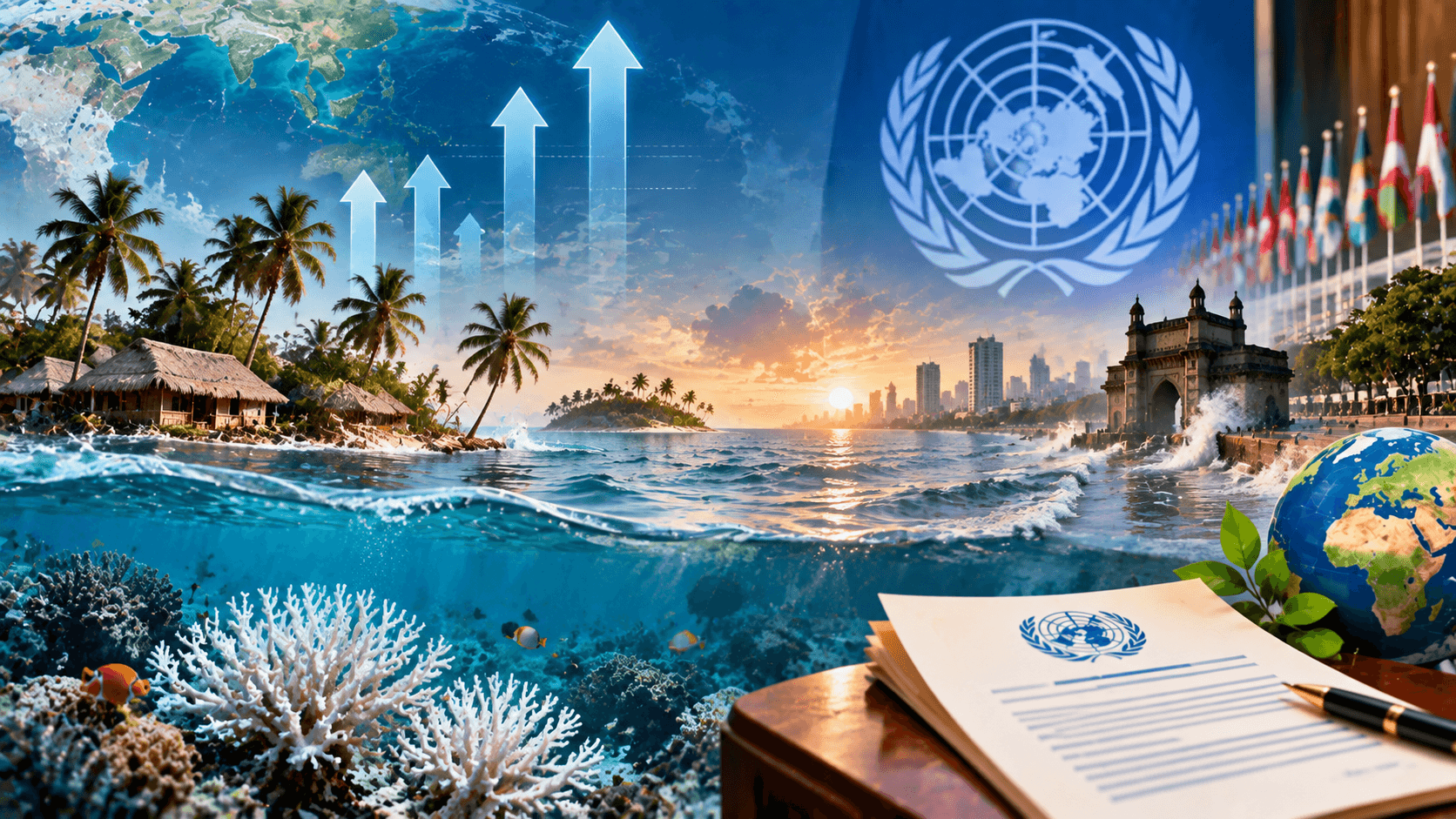
At the 81st UNGA session, India welcomed the new UN Declaration on Sea-Level Rise. The Declaration tackles the accelerating climate crisis; sea levels rose by 5.9 mm in 2024 alone due to greenhouse gas emissions, melting ice, and warming oceans.
India said it supports the Declaration, stressing climate equity, maritime stability, and help for the most vulnerable nations facing rising seas.
The declaration makes some important commitments:
1. Protects statehood even if land is lost: It says that Small Island Developing States (SIDS) will continue to retain their sovereignty, statehood, UN membership, and rights even if they lose their physical territory to rising seas.
2. Protects maritime rights: It safeguards their maritime zones under UNCLOS, meaning their territorial waters and Exclusive Economic Zones (EEZs) will remain intact.
3. Sees sea-level rise as a human rights crisis: It highlights how rising seas threaten housing, drinking water, food security, culture, and identity and cause displacement. To deal with this, it calls for stronger climate adaptation, resilient infrastructure, early-warning systems, and more adaptation finance for developing countries.
India's stand:
1. Climate Justice: India stressed that climate action must be based on equity and the principle of Common but Differentiated Responsibilities (CBDR-RC), meaning developed countries that have emitted more historically should take greater responsibility for adaptation.
2. India's own vulnerability: India has a long coastline and over 350 million people depend on coastal areas and the marine economy. So, rising seas are not just a distant issue for islands, it is a direct threat to India's own coastal communities, fisheries, and ecosystems. According to INCOIS, sea level along India's coast could rise by 0.5 to 1 meter by 2100. This will make storm surges, high tides and coastal flooding much more frequent and intense. Low-lying areas like Mumbai, Chennai, Kolkata, Sundarbans, Lakshadweep and Andaman & Nicobar Islands are most at risk, facing permanent submergence, coastal erosion and saltwater entering farmland and drinking water sources.
What is sea-level rise, and why is it a threat to islands?
It is the long-term rise in ocean levels. Globally, seas are rising at about 3.2 mm per year, but the Indian Ocean is rising even faster at 3.3 mm per year. This is causing coral bleaching in sensitive regions like the Maldives, Lakshadweep, and Chagos.
What causes it?
1. Melting glaciers and ice sheets: Melting ice adds freshwater to oceans. Between 2005 and 2013, glaciers contributed almost double the rise compared to thermal expansion. Greenland's ice loss increased 7 times and Antarctica's nearly 4 times between 1992 and 2016.
2. Thermal expansion: As oceans absorb heat, water expands and occupies more volume.
3. Groundwater depletion: Water pumped from aquifers, rivers, and lakes eventually ends up in the sea, adding to the rise. Overall, since 1880, sea levels have risen by 21-24 cm, with 2023 recording the highest ever, 101.4 mm above 1993 levels. New Finding: Coral Microatolls as Proof of Early Sea-Level Rise A study in the Maldives shows that sea-level rise in the central Indian Ocean started earlier and faster than we thought. Earlier it was believed that the significant rise began only in the 1990s.
Conclusion:
The UN Declaration on Sea-Level Rise is a landmark step; it not only recognizes rising seas as a climate, human rights, and displacement crisis but also assures that island nations will not lose their statehood, UN membership, and maritime rights even if their land disappears.
For India, it is both a diplomatic commitment to climate justice and a matter of national interest. With 350 million people dependent on coasts and a projected 0.5-1 meter rise by 2100 threatening cities like Mumbai, Chennai, and Kolkata, India needs early action, resilient coasts, early-warning systems, and more adaptation finance. Ultimately, protecting islands and coasts is about protecting people, livelihoods, and cultural identity from an irreversible crisis.